
Side Hustle Taxes: How Much to Set Aside and How to Avoid a Surprise Bill in 2026
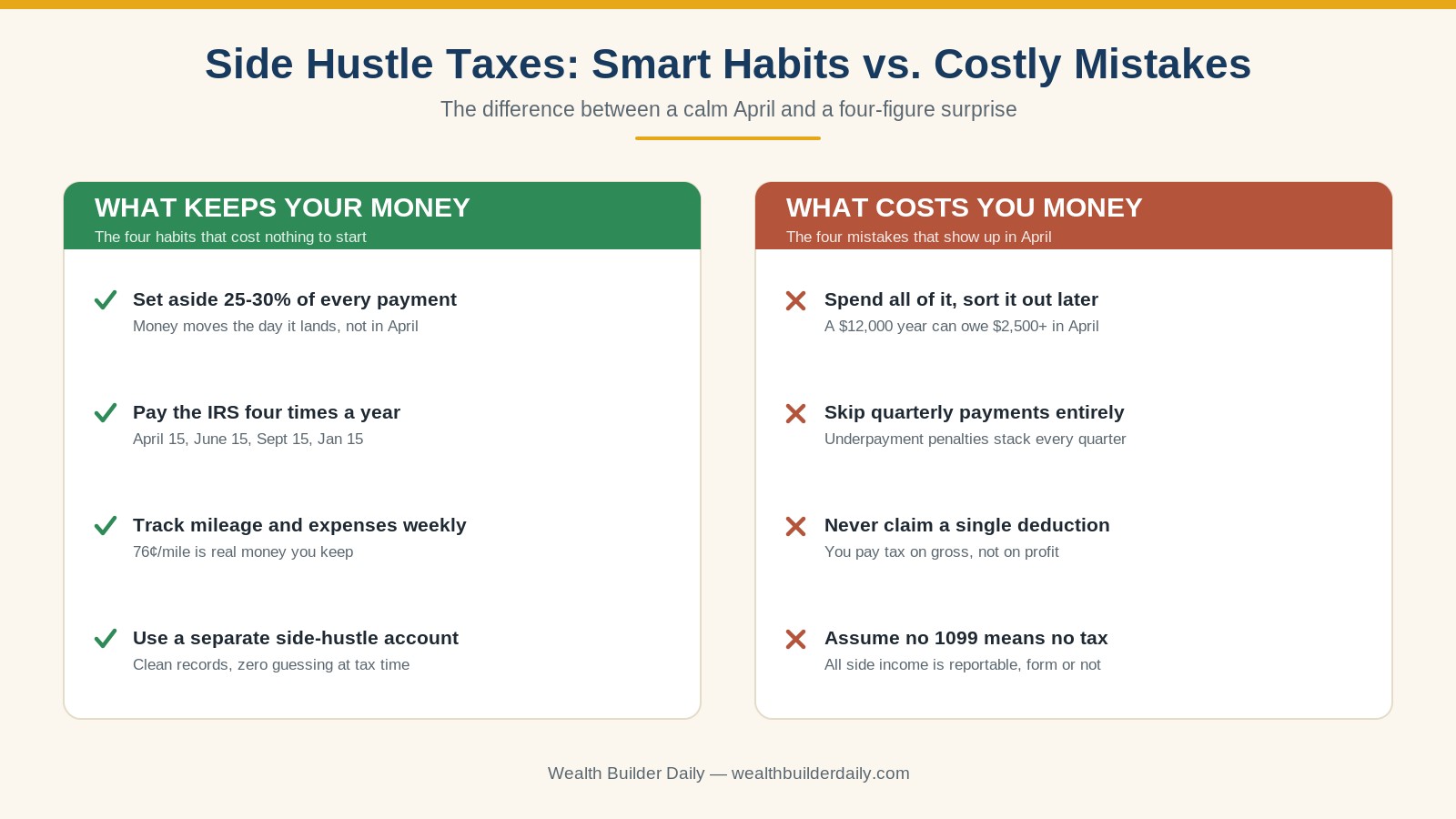
Side hustle taxes are simpler than they sound: set aside 25% to 30% of your side hustle profit the day you get paid, send the IRS a payment four times a year, and you will never face an April surprise again. That one habit is the entire difference between a side hustle that builds wealth and one that quietly borrows from your future self.
This guide is for anyone earning money outside a W-2 job — driving, freelancing, detailing cars, selling online, tutoring, consulting on the side. You will learn what you actually owe, how to calculate your set-aside number in about five minutes, which deductions legitimately lower the bill, and exactly when the 2026 payment deadlines land.
Side Hustle Taxes at a Glance
If you earn $400 or more in net self-employment income, you owe self-employment tax on it — regardless of whether anyone sent you a tax form. On top of that, the profit gets added to your regular income and taxed at your normal bracket. That stacking is why side hustle income feels taxed harder than a paycheck: your employer used to pay half your Social Security and Medicare. Now you pay both halves.
| Question | Short Answer | | --- | --- | | How much should I set aside? | 25–30% of profit; 30–35% if you're in a higher bracket or a high-tax state | | What's the self-employment tax rate? | 15.3% (12.4% Social Security + 2.9% Medicare) on 92.35% of net profit | | When do I owe it? | Four times a year: April 15, June 15, Sept 15, and Jan 15 of the next year | | At what income does it start? | $400 in net self-employment earnings — no form required | | What forms do I file? | Schedule C (profit), Schedule SE (self-employment tax), with your Form 1040 | | Do I need an LLC? | No. Sole proprietors report side income on Schedule C with no entity at all |
Quick facts worth knowing before you go further:
- The Social Security portion of self-employment tax applies only up to $184,500 of earnings in 2026. The 2.9% Medicare portion applies to every dollar with no cap.
- You can deduct half of your self-employment tax on your return, which softens the real cost meaningfully.
- No 1099 does not mean no tax. Cash, Venmo, Zelle, and app payouts are all reportable income.
- If your side income is uneven month to month, the same set-aside percentage still works — you just move a different dollar amount each time. Our guide to budgeting on an irregular income pairs well with this one.
Why You Can Trust This Guide
At Wealth Builder Daily, we've spent years helping everyday earners turn side income into real, keepable money — and the single most common thing we see undo a good hustle is an unplanned tax bill in April. In this guide, we'll walk you through the exact percentage to hold back, the 2026 deadlines, the deductions most side hustlers leave on the table, and the small system that makes all of it automatic. Every figure below reflects the rules as they stand for the 2026 tax year.
How Side Hustle Taxes Work
Your side hustle is taxed on profit, not on what lands in your account. That distinction is worth real money. If you earned $18,000 driving and spent $4,500 on gas, maintenance, and mileage, you are taxed on $13,500 — not $18,000.
From there, that profit gets hit twice:
- Self-employment tax (15.3%) covers Social Security and Medicare. It's calculated on 92.35% of your net profit, so $13,500 in profit produces roughly $12,467 of taxable base and about $1,907 in self-employment tax.
- Federal income tax adds your profit to your other income and taxes it at your marginal bracket — 12%, 22%, or higher depending on your household.
- State income tax, if your state has one, stacks on top. Nine states don't, which is why the right set-aside percentage varies by where you live.
- Two offsets work in your favor. You deduct half of your self-employment tax, and the Qualified Business Income deduction — made permanent for 2026 — lets most side hustlers deduct up to 20% of their business profit before income tax is applied.
That last one matters more than most people realize. New for 2026, if you have at least $1,000 of qualified business income from an active business, you're entitled to a minimum deduction of $400. The full 20% applies if your taxable income is at or below $201,750 single or $403,500 married filing jointly — which covers nearly every side hustler.
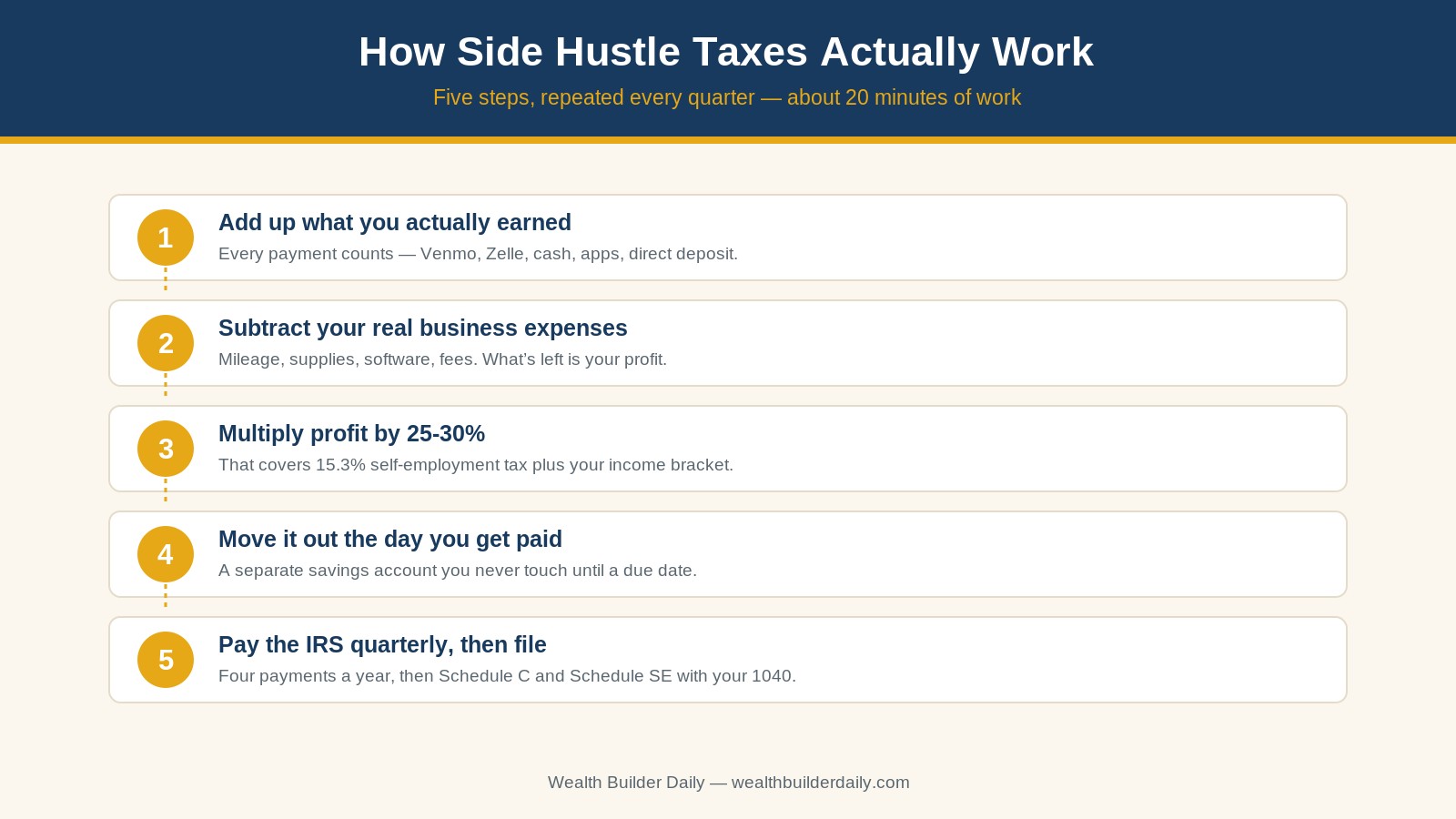
Here's the sequence, start to finish:
How to Choose the Right Set-Aside Percentage
"Save 30%" is decent advice, but the right number for you depends on a few things. Work through these five:
-
Your marginal tax bracket. If your day job already puts household income in the 22% bracket, every dollar of side profit is taxed at 22% plus 15.3% self-employment tax. Lean toward 30–33%. If you're in the 12% bracket, 25% is usually plenty.
-
Your state. No state income tax means you can sit at the low end of the range. A state charging 5–9% means adding that much on top of your federal set-aside.
-
Whether your W-2 withholding has slack. If you normally get a refund of $1,500 or more, that cushion absorbs part of your side hustle tax automatically. You can either set aside slightly less or — cleaner — bump your W-2 withholding on Form W-4 and skip quarterly payments entirely.
-
How expense-heavy your hustle is. A delivery driver or detailer with real mileage and supplies has a much lower profit margin than a consultant with a laptop. Set aside on profit, not revenue, or you'll badly over-save.
-
How predictable your income is. Steady monthly retainer work lets you set a fixed number. Lumpy project income is safer at a flat percentage of each deposit as it arrives.
A real number to anchor on: a side hustler in the 22% bracket with $15,000 of profit and no state income tax owes roughly $2,120 in self-employment tax and roughly $2,640 in federal income tax before the QBI deduction — about $4,300 total, or 29% of profit. If she'd been moving 30% into a separate savings account all year, she'd have $4,500 waiting and zero stress. If she hadn't, that's a bill arriving the same month as everything else. This is exactly the kind of obligation a sinking fund is built for.
Quarterly Payments vs. Extra W-2 Withholding
If you have a regular job alongside your hustle, you have a choice most people don't know about. Instead of sending the IRS four separate payments, you can increase the withholding from your paycheck to cover your side hustle tax. Withholding is treated as paid evenly across the year, so it can wipe out underpayment penalties even if you adjust it late in the year — something quarterly payments can't do retroactively. If your side income is modest and your day job is steady, this is often the simpler path. If you're self-employed full time or your side income is large, quarterly payments are the way.
Side Hustle Taxes for Every Situation

The right approach depends on how much you're earning and how established the hustle is:
- You made under $2,000 this year. Set aside 25% and file a Schedule C at tax time. You likely don't need quarterly payments — the amount is small enough that your W-2 withholding or a single April payment covers it. Just don't skip reporting it. If you're still building toward a consistent number, our guide to earning your first $1,000 a month on the side is the place to start.
- You're earning $500 to $2,000 a month consistently. This is where quarterly payments become worth doing. Open a dedicated savings account, move your percentage on every payment day, and pay the IRS four times a year. The three-account system makes this nearly automatic.
- The hustle is becoming a business. Once profit clears roughly $40,000, it's worth a conversation with a CPA about an S-corp election, a solo 401(k), or a SEP-IRA — each of which can cut your tax bill by more than the cost of the advice.
Beginner, Intermediate, and Advanced Setups
Beginner: One dedicated savings account. Move 30% of every payment the day it arrives. A single note in your phone tracking income and expenses. That's it — this alone solves the problem for most people.
Intermediate: A separate business checking account so income and expenses never mix with personal spending. A free mileage-tracking app running in the background. Quarterly payments scheduled through IRS Direct Pay with calendar reminders a week ahead of each deadline.
Advanced: Bookkeeping software categorizing transactions automatically, a retirement account absorbing pre-tax profit, and a CPA reviewing your entity structure once a year. At this stage, the tax planning itself becomes a meaningful part of your return.
What Changed for 2026
Two reporting thresholds moved, and both work in your favor administratively — though neither changes what you owe. The Form 1099-NEC threshold rose from $600 to $2,000 for payments made in 2026, and the 1099-K threshold for payment apps and marketplaces returned to $20,000 and 200 transactions. Practically, that means you will receive fewer tax forms than you used to, which makes it easier to accidentally under-report. Your own records are now the reliable source of truth, not the forms in your mailbox. The mileage deduction also went up mid-year: 72.5 cents per mile through June 30, 2026, and 76 cents from July 1 onward. Track those two periods separately.
Frequently Asked Questions
What happens if I skip quarterly estimated tax payments?
You'll owe an underpayment penalty, calculated as interest on what you should have paid each quarter. You avoid it entirely through safe harbor: pay at least 90% of this year's tax, or 100% of last year's total tax (110% if your prior-year adjusted gross income exceeded $150,000). The prior-year rule is easiest because it requires no forecasting.
Do I owe taxes on side income if I never received a 1099?
Yes. Income is taxable based on what you earned, not on which forms were issued. Cash payments, Venmo transfers, and app payouts all count. With 2026 reporting thresholds higher than before, fewer forms will arrive — so keeping your own income log is now the most important record you have.
Can I deduct my home office if I only hustle part-time?
Yes, if you use a defined space regularly and exclusively for the business. The simplified method is $5 per square foot up to 300 square feet, for a maximum deduction of $1,500. A spare bedroom corner used only for your work qualifies; the kitchen table where your family eats does not.
Final Thoughts
Side hustle taxes only feel brutal when they arrive all at once. Move 25% to 30% of every payment into a separate account on the day it lands, pay the IRS four times a year, and track your expenses well enough to be taxed on profit instead of revenue — and the whole thing becomes a 20-minute chore each quarter instead of a springtime crisis. The money you set aside was never really yours to spend, so the earlier you separate it, the more accurate your sense of what your hustle actually earns.
- Plain-language guidance. No jargon, no assumed accounting background — just what to do and when to do it.
- Real numbers and real examples. Actual 2026 rates, thresholds, and worked calculations you can apply to your own income tonight.
- Proven, time-tested methods. Set-aside percentages and safe harbor rules that have protected self-employed people for decades.
- Free, practical tools and guides. Every strategy here works with a free savings account and an app you already have.
Pick one thing from this guide and do it this week — open the separate savings account, or move 30% of your most recent payment. Then keep building: browse more strategies at wealthbuilderdaily.com/blog, and confirm current rates and deadlines directly at Investor.gov and the IRS self-employed tax center. The version of you filing next April will be glad you started in 2026 instead of waiting.
The Newsletter
Get the Free Budget Tracker
Join our weekly newsletter. Practical money guides, no fluff. Unsubscribe anytime.