
Three-Account System: How to Make Budgeting Automatic in 2026
The three-account system is a simple banking setup where your bills, your spending money, and your savings each live in a separate account, so you always know exactly what you can spend without doing math. It is not a new app, a spreadsheet, or a stricter budget. It is a plumbing change you make once, and then your money sorts itself every time you get paid.
This guide is for anyone who has tried budgeting apps, envelopes, or spreadsheets and quietly given up because keeping track of it all took more energy than it was worth. You will learn exactly which accounts to open, how much to route to each one, how to set the transfers, and how to adjust the system if your income is irregular.
The Three-Account System at a Glance
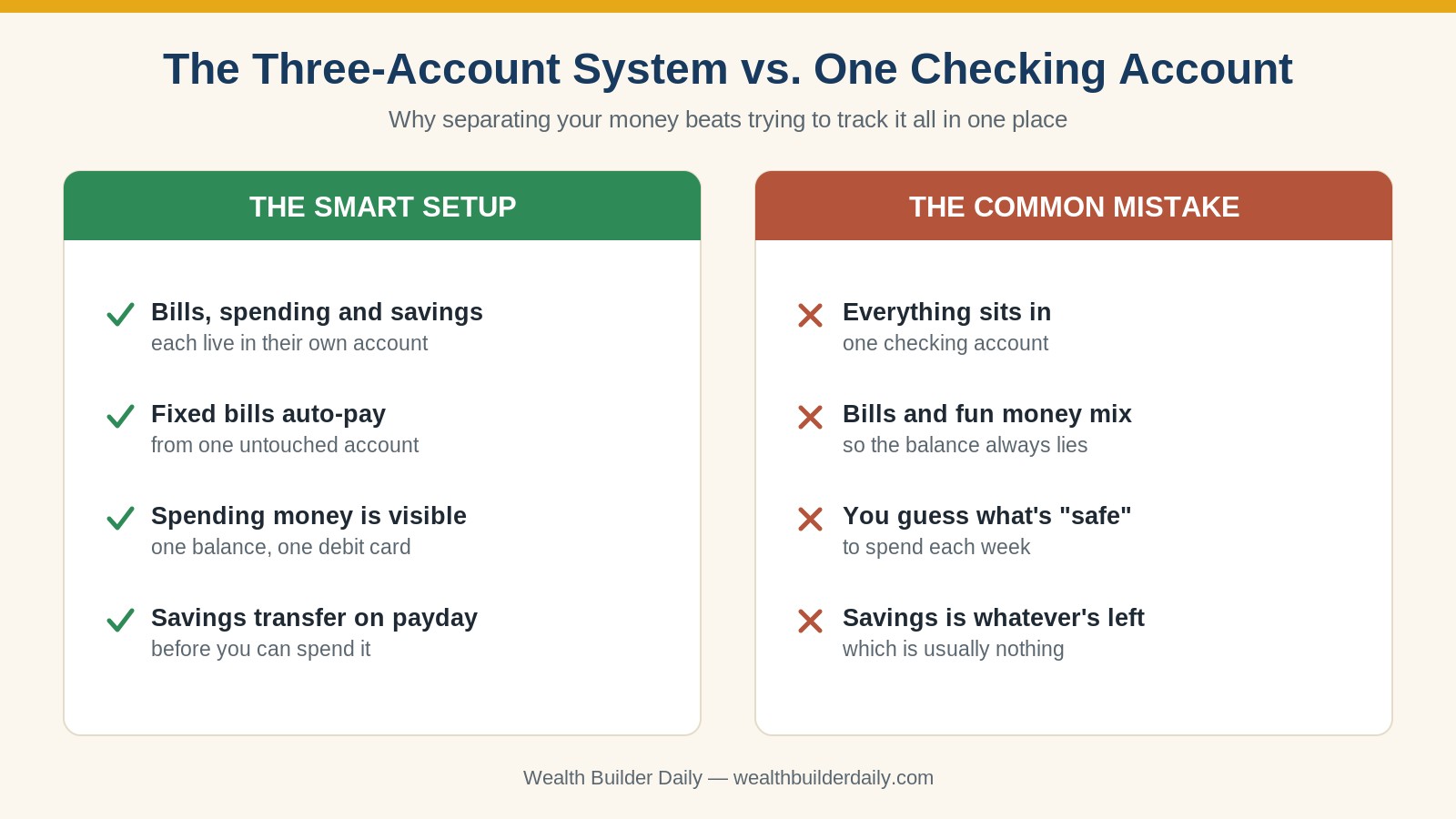
If you keep every dollar in one checking account, your balance is a lie. It looks like $2,400, but $1,900 of that is rent and insurance that hasn't cleared yet. The three-account system fixes that by giving each job its own container, so the number you see is the number you can actually spend.
| Account | What It Holds | Where Money Goes | Debit Card? | |---|---|---|---| | Bills checking | Rent, insurance, utilities, loans, subscriptions | Paycheck lands here first | No card, no app | | Spending checking | Groceries, gas, dining, everyday life | Weekly or biweekly auto-transfer | Yes — this is your only card | | High-yield savings | Emergency fund, sinking funds, goals | Auto-transfer on payday | No card |
Quick facts before you start:
- You need three accounts, not five. More accounts means more logins and more forgotten balances.
- Two of them can be at the same bank; the savings account should ideally be somewhere else so it's slightly harder to raid. See our guide to high-yield savings accounts for where to park it.
- Total setup time is about 60 to 90 minutes, most of it spent updating auto-pay details.
- You are not budgeting less — you are budgeting once, in advance, instead of 40 times a month.
At Wealth Builder Daily, we've spent years helping everyday people replace willpower-based budgeting with systems that hold up on a bad week. The three-account system is the setup we recommend first, because it is the only budgeting change that keeps working when you're tired, busy, or distracted. In this guide, we'll walk you through the exact account structure, the transfer schedule, and the numbers to use so your budget runs without you.
How the Three-Account System Works
The core idea is separation. Most budgeting failures aren't discipline failures — they're visibility failures. When rent money and taco money sit in the same balance, your brain treats the whole number as available. Separating the two removes the guesswork entirely, because the spending account balance is, by design, only spendable money.
Here's what each piece does:
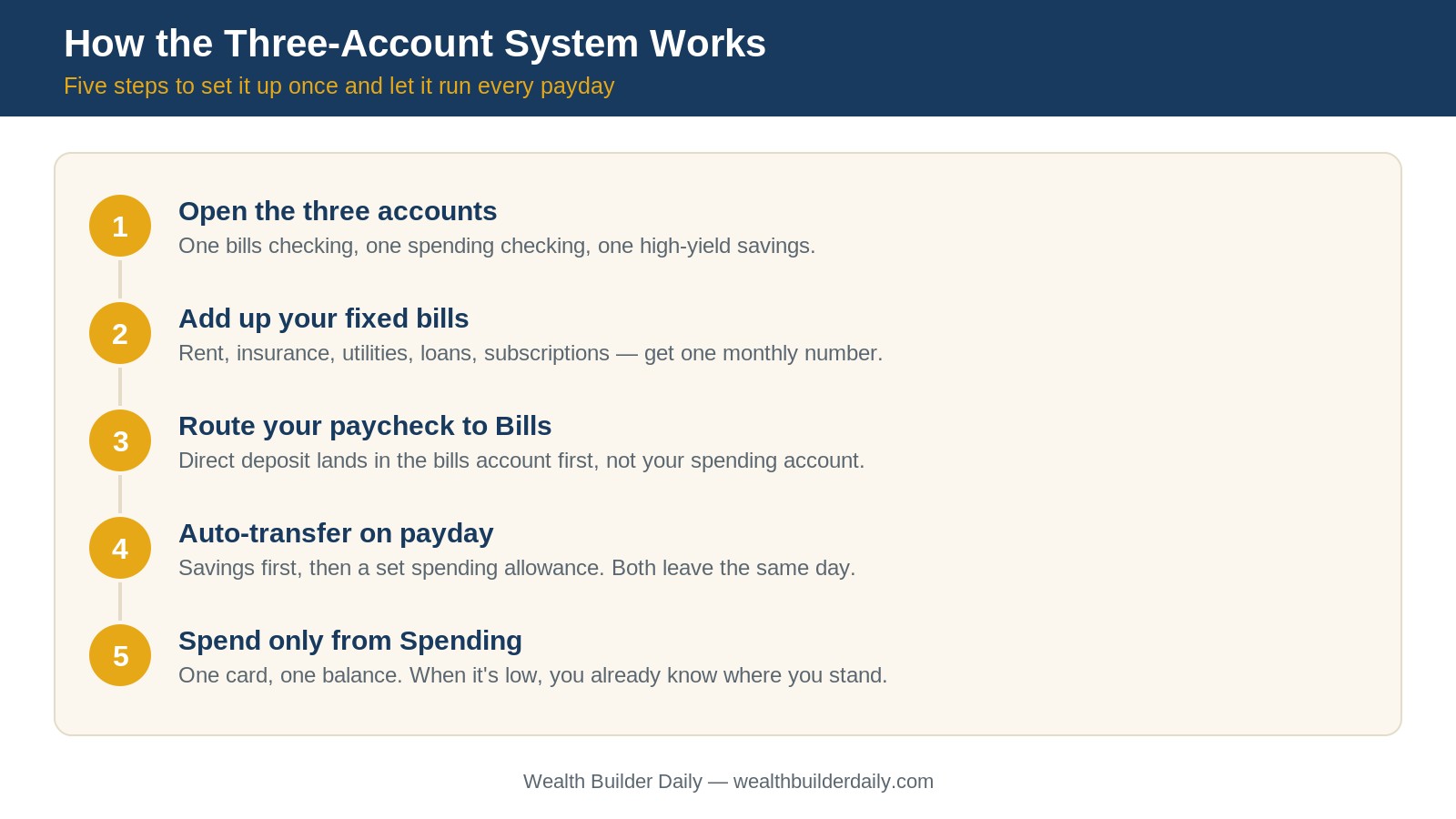
- The bills account is the hub. Your direct deposit lands here. Every fixed, recurring, non-negotiable charge auto-pays from this account. You never carry a card for it and rarely log in.
- The spending account is the buffer. A fixed amount transfers in each payday. That amount is your real, honest allowance for groceries, gas, restaurants, and everything else that varies.
- The savings account is the exit. Money leaves for savings the same day you get paid, before you've had a chance to think about it. This is the pay yourself first principle, wired directly into your bank.
- Two automatic transfers do all the work. One to savings, one to spending. Both scheduled for payday. That's the entire ongoing maintenance.
The reason this works better than a budgeting app is that an app tells you what you did after you did it. The three-account system decides before you spend. By the time the money hits your spending card, every other obligation has already been handled.
How to Choose the Right Account Setup
Not every version of this system fits every household. Use these six criteria to build yours.
-
Pick banks with no minimum balance or monthly fee. You're going to hold small balances in the bills account between paydays. A $12 monthly maintenance fee is $144 a year for the privilege of being organized. Free checking is standard in 2026 — don't settle for less.
-
Put savings at a different institution. Keeping your emergency fund at the same bank as your debit card makes a transfer take four seconds. Putting it at a separate online bank makes it take one to two business days. That friction is a feature, not a bug.
-
Get the interest rate right on savings only. The bills and spending accounts hold small balances and their rate barely matters. Your savings account should be earning a competitive yield — the difference between 0.01% and 4% on a $10,000 emergency fund is about $400 a year in free money.
-
Confirm the bills account supports scheduled outgoing transfers. Some smaller institutions limit automatic transfers to accounts they hold. Test one transfer before you move your direct deposit over.
-
Decide on one card, not three. Carry only the spending account's debit card. Leaving the bills card at home — or never ordering one — eliminates the single most common failure mode, which is tapping the wrong card at checkout.
-
Match the transfer frequency to your paycheck. Paid biweekly? Transfer biweekly. Paid monthly? Consider transferring your spending allowance weekly so you don't front-load the month.
Expert tip: Add a 10% cushion to your bills account. If your fixed costs total $2,150 a month, route $2,365. That extra $215 absorbs the annual insurance increase, the utility spike in August, and the subscription that quietly went from $9.99 to $14.99. Without a cushion, one surprise charge triggers an overdraft and the whole system loses your trust in month two.
Three Accounts vs. Two Accounts
A two-account version — bills and everything else — is simpler and works fine if you already save consistently without thinking about it. Choose three accounts if your savings rate is inconsistent, if you have specific goals you're funding, or if you've ever raided your savings for something that wasn't an emergency. The third account exists to create distance between you and your savings, and most people need that distance more than they need the simplicity.
The Three-Account System for Every Situation
The structure stays the same; the numbers and the timing change based on how you earn.

- Steady salary, paid biweekly. The easiest case. Split your monthly fixed costs in half and route that amount from each paycheck to bills, transfer your savings amount on the same day, and send the remainder to spending. Two of your 26 paychecks each year are "extra" — send those entirely to savings.
- Irregular or commission income. Route 100% of every deposit to the bills account and pay yourself a fixed salary out of it. When a big month lands, the surplus stays in bills as a buffer for the slow month coming. Our guide to budgeting on an irregular income walks through how to size that salary.
- Two incomes, shared expenses. Make the bills account joint and fund it proportionally to income. Keep separate spending accounts. This is the setup that ends most money arguments, because nobody has to justify a personal purchase from a shared pool.
Beginner, Intermediate, and Advanced Setups
Beginner: Two checking accounts plus one savings account. One transfer to savings, one to spending, both on payday. Nothing else.
Intermediate: Add named sinking funds inside your savings account — car repairs, holidays, annual premiums — each with its own monthly transfer amount. Most online banks let you create sub-accounts or "buckets" at no cost.
Advanced: Add a fourth account for taxes if you're self-employed, and automate the overflow: once your emergency fund hits its target, redirect that same transfer amount to a brokerage account so your savings rate never drops.
Personalizing the System in 2026
Start with one month of honest numbers before you set the transfer amounts. Pull three months of statements, total your genuinely fixed costs, and use the highest month — not the average — as your bills number. Then set your savings transfer at an amount that feels slightly uncomfortable but not impossible, and let whatever remains be your spending allowance. If spending runs out five days early in month one, that's information, not failure. Adjust once, then leave it alone for 90 days.
Frequently Asked Questions
Will opening three bank accounts hurt my credit score?
No. Checking and savings accounts are deposit accounts, not credit accounts, so opening them does not create a hard inquiry or appear on your credit report. Some banks run a ChexSystems check, which reviews banking history rather than credit. Your score is unaffected either way, so you can open all three in the same week without concern.
What if I overspend the money in my spending account?
That's the system doing its job. When the spending balance hits zero, you've hit your limit, and your bills and savings are still fully funded. Avoid transferring more in mid-cycle — instead, note how much short you ran and adjust next month's transfer amount. Two or three cycles is usually enough to find the right number.
Do I still need a budgeting app with this system?
Not necessarily. The three-account system replaces most of what a budgeting app does by handling allocation at the bank level instead of the tracking level. An app is still useful if you want category-level detail on your variable spending, but many people find that once the accounts are separated, checking one balance is all the tracking they need.
Final Thoughts
You don't need more discipline to budget well in 2026 — you need a setup where the easy thing and the right thing are the same thing. The three-account system gets you there by making your spending balance tell the truth, funding your savings before you can touch it, and reducing your monthly money management to glancing at one number.
- Plain-language guidance. No jargon, no lectures — just the exact steps, in the order you'd actually do them.
- Real numbers and examples. Concrete dollar figures and buffer amounts you can plug into your own accounts today.
- Proven, time-tested methods. Separating money by purpose is one of the oldest ideas in personal finance, updated for modern online banking.
- Free, practical tools and guides. Every strategy we publish is free, actionable, and written for people building wealth from an ordinary income.
Open one account this week. Move your direct deposit next payday. Ninety days from now, budgeting will be something your bank does instead of something you do. Browse more free guides at Wealth Builder Daily, and if you want to compare account features and fee disclosures before you open anything, the Consumer Financial Protection Bureau publishes plain-English explanations of what banks are required to tell you.
The Newsletter
Get the Free Budget Tracker
Join our weekly newsletter. Practical money guides, no fluff. Unsubscribe anytime.