

Variable Earner's Guide to Budgeting on Irregular Income: How to Manage Money When Every Paycheck Is Different (2026)
What Every Variable Earner Needs to Know About Irregular Income Budgeting
If your paychecks bounce between $1,800 and $7,400 depending on the month, standard budgeting advice is going to fail you. Most personal finance content assumes you know exactly what hits your account on the 1st and the 15th. You do not. And that mismatch is why so many freelancers, gig workers, commission salespeople, and small business owners feel like they are "bad with money" when really they are just trying to run a fixed-expense life on a variable-income engine.
The good news in 2026 is that irregular income budgeting is a solved problem. It just looks different from a traditional W-2 budget. Once you set up the right structure, the swings actually become an advantage instead of a stressor.
Here are the income types this guide covers:
- Freelancers and contractors paid per project
- Gig workers driving, delivering, or doing tasks on platforms
- Commission-only or commission-heavy salespeople
- Small business owners and Etsy/Shopify sellers
- Seasonal workers and creators with launch-based revenue
Here are the core problems variable earners face that this system fixes:
- Big months feel like a windfall, lean months feel like an emergency
- Quarterly taxes get forgotten until they hurt
- Saving and investing get skipped because "next month will be better"
- No clear definition of what is "enough" income
- Lifestyle inflation eats every good month
Once you separate income from spending and let a buffer do the heavy lifting, the whole thing gets calm. This guide walks you through the exact variable paycheck system, the percentage splits, the tax setup, and the buffer math you need to make 2026 the year your irregular income finally feels predictable.

The Core Building Blocks of an Irregular Income Budget
The variable income landscape in 2026 is bigger than most people realize. According to recent labor data, roughly 36% of working Americans now earn at least some of their income outside of a traditional W-2 paycheck. That is over 60 million people running their financial life on income that moves. And yet the budgeting tools most of them use still assume a single, steady deposit.
The fix is to build your budget around four separate accounts and a defined baseline. You stop thinking in "monthly income" and start thinking in "monthly draw." Anything you earn above your draw goes into the buffer. Anything you earn below it comes out of the buffer. Your spending stays flat while your income wiggles.
The Baseline Number
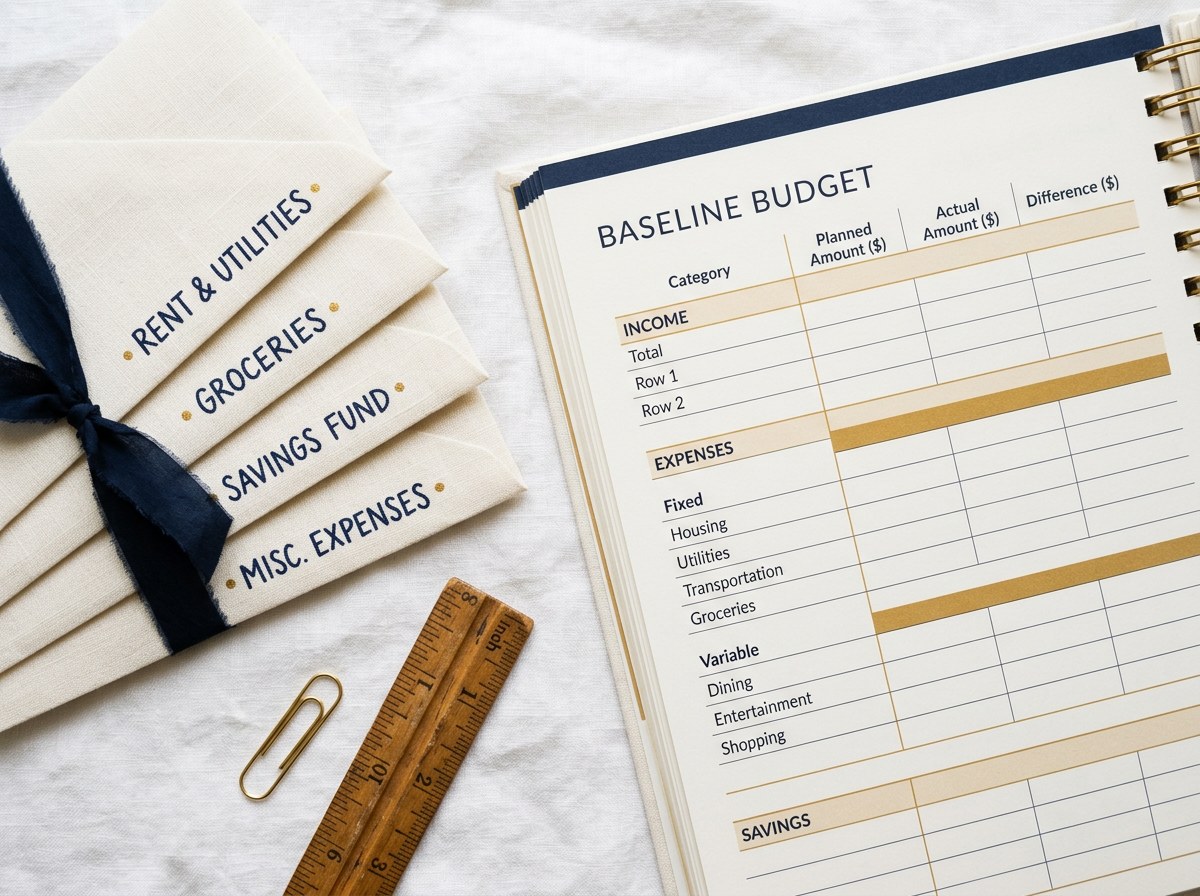
Your baseline is the monthly amount you commit to paying yourself. It is the engine of the entire system. To find yours, pull the last 12 months of income, throw out the highest month and the lowest month, then take 70% of the average of what is left. That becomes your monthly draw.
- It is conservative on purpose
- It survives a soft month without panic
- It leaves room to fund taxes, savings, and the buffer
- It can be raised on purpose once your buffer is full
The Four-Account Setup
Most variable earners try to run their finances out of one checking account. That is the trap. Splitting your money across four accounts removes 80% of the mental friction.
- Income account: every dollar earned lands here first, untouched
- Operating account: receives the fixed monthly baseline draw
- Tax account: receives a fixed percentage of every deposit, immediately
- Buffer account: catches everything above the draw and tax allocation
How to Choose the Right Buffer Size for Your Income Pattern
Your buffer is the savings cushion that smooths out the swings. The right size depends on how volatile your income is and how seasonal your work is. A monthly retainer freelancer needs less buffer than a commission rep with a Q4-heavy book.
| Income Pattern | Volatility | Buffer Target | Best For | |---|---|---|---| | Stable retainers + small projects | Low | 1 month of baseline | Established freelancers, agency contractors | | Mixed projects, no seasonality | Medium | 2 months of baseline | Designers, consultants, developers | | Commission-driven with cycles | High | 3 months of baseline | Sales reps, real estate, recruiting | | Seasonal or launch-based | Very High | 4-6 months of baseline | Creators, course sellers, holiday businesses |
The buffer is not your emergency fund. Keep those separate. The emergency fund is for car repairs and medical bills. The buffer is for the regular, expected variability of running a non-W-2 income. If you mash them together, you will raid the emergency fund during a normal slow month and feel like you are failing. You are not. The system is just missing a layer.
A practical example: if your baseline draw is $4,500/month and you have medium volatility, you want a buffer of around $9,000 sitting in a separate high-yield savings account earning around 4.2% in 2026. That cushion lets you pay yourself $4,500 every month for two months even if you earned $0. It is the difference between irregular income feeling like a rollercoaster and feeling like a steady job that occasionally pays a bonus.
Practical Tips for Filling the Buffer Quickly
- Direct deposit 100% of any month where you earn above 150% of your baseline straight into the buffer
- Send every tax refund into the buffer until it is full, not into spending
- Treat the first 90 days of the system as "buffer-building mode" with no lifestyle upgrades
- When you take on a new big project, route 50% of the first payment to the buffer before anything else
If you have not yet built a real emergency fund alongside this, start there first. Our step-by-step plan to build a $10,000 emergency fund in 2026 is the right next read.
Retainer-Driven Income vs. Project-Driven Income
If most of your money comes from monthly retainers, your variability is mostly downside risk from clients churning. Build a smaller buffer but keep your client pipeline list updated weekly and aim to have at least one prospect at the proposal stage at all times. The buffer protects you from a single client leaving; the pipeline protects you from your buffer ever needing to do its job.
If most of your money comes from one-off projects or launches, your variability is timing-based. You may earn a year of income in three quarters and almost nothing in the other one. Build a bigger buffer and let it carry you through the quiet months on purpose. You are not having a bad month. You are following the pattern of your business.
Irregular Income Budgeting for Every Stage of Your Career

Where you are in your earning journey changes which part of the system you focus on first.
- Just starting out (under $40k/year of variable income): Focus only on the four-account setup and the tax account. Skip the formal buffer until your numbers stabilize.
- Stabilized (between $40k and $100k): The baseline draw and the buffer become the core of your work. This is where most variable earners feel the system click.
- Established (over $100k): Layer in retirement savings through a SEP IRA or Solo 401(k), and start treating yourself like a business that pays a salary and bonuses.
Beginner, Intermediate, and Advanced Tiers
At the beginner tier, your only job is consistency. Open the four accounts, route every dollar earned into the income account, and pull a small, conservative baseline draw each month. You will feel poor. That is the trade-off for building the foundation.
At the intermediate tier, you start raising your baseline draw deliberately. Every six months, recalculate using your trailing 12-month average. If your buffer is full, you can safely raise the draw by 80% of the new number. Lifestyle expansion is allowed, but only on schedule.
At the advanced tier, you add deliberate income smoothing through quarterly bonuses to yourself. When the buffer is overfull, sweep the excess into investments, debt payoff, or a planned distribution. You stop drifting and start running your finances like a CFO.
Customizing the System to Your Reality
The 70%-of-trimmed-average baseline is a starting point, not a law. Variable earners in 2026 are running this system in three common ways depending on their cash flow:
- Conservative: 60% of trimmed average - used by people with very lumpy income or high anxiety about money
- Standard: 70% of trimmed average - the default for most freelancers
- Aggressive: 80% of trimmed average - used by people with strong client pipelines and 3+ months of buffer already in place
Pick the version that lets you sleep at night. You can always tighten or loosen later.
Why the Variable Paycheck System Makes a Difference
For most variable earners, the problem is not the income. The income is fine. The problem is that the income arrives in chaos and they are trying to live a structured life on top of it. The variable paycheck system fixes the structure layer so the chaos no longer reaches your spending.
- It separates earning from spending, which kills lifestyle creep on big months
- It pre-pays the tax bill, which removes the worst surprise self-employed people face
- It creates a visible, growing buffer that doubles as confidence
- It makes every month feel the same, even when the deposits do not
Getting the Most Out of the System
- Set your tax account to receive 28% of every deposit automatically - for most variable earners, this covers federal, state, and self-employment tax with room to spare
- Pay yourself on the 1st and the 15th, every month, exactly the same amount - your future self thrives on predictability
- Review your trailing 12-month income on the first of every quarter and recalibrate the baseline if needed
- Once your buffer hits target, automatically sweep anything above it into a Roth IRA or taxable brokerage - never let extra cash idle in a buffer account beyond what you need
Once your tax account and buffer are funded and your draw is steady, the next layer is putting your business income to work for you. Our guide on how to build $1 million tax-free with a Roth IRA in 2026 walks through exactly how variable earners can use SEP IRA and Roth IRA contributions to convert irregular income into long-term wealth.
Frequently Asked Questions About Irregular Income Budgeting
How do I budget if my income changes every month and I have no savings yet?
Start with the baseline draw and the tax account only. Pull the lowest realistic monthly income you have had in the last six months and use 90% of that as your starting baseline. Send 25% of every deposit to a separate tax account immediately. Do not try to build the buffer until you have lived on the baseline draw for at least 60 days. The order matters: get spending stable first, then build the buffer behind it.
What happens if I have a great month and a terrible month back to back?
This is exactly what the system is designed for. On the great month, every dollar above your baseline draw and tax allocation goes into the buffer. On the terrible month, you still pay yourself the same baseline draw, drawn partially from new income and partially from the buffer. The steps look like this:
- Great month deposit → tax account fills, baseline draw goes out, the rest goes to buffer
- Terrible month deposit → tax account fills (smaller amount), baseline draw still goes out (buffer covers the gap)
- End of the two-month cycle → your spending was identical, your buffer absorbed the swing
- Net result → your lifestyle stayed flat and you avoided the panic that usually follows a lean month
Can I use this system if I also have a part-time W-2 job?
Yes, and it actually makes the system easier. Treat your W-2 paycheck as the floor of your baseline draw and run the variable income through the four-account setup on top of it. Many variable earners in 2026 are running hybrid setups like this on purpose - a small W-2 job covers part of fixed expenses and provides health insurance, while the variable income builds wealth on top. Just be careful not to count on a part-time W-2 to subsidize an oversized lifestyle if the variable income could vanish.
Conclusion
Irregular income is not the problem. Running a fixed-expense life on a single chaotic checking account is the problem. Once you separate earning from spending, build a real buffer, and pre-pay your taxes, the swings stop feeling like emergencies and start feeling like the normal rhythm of how you make money.
In 2026, more people than ever are earning outside the traditional W-2 system, and the ones who feel calm about it are not the ones with the highest incomes. They are the ones who set up the structure. Pick your four accounts this week, run the math on your trailing 12-month income, and start the buffer with whatever you can.
If you want the next step, start with our Financial Order of Operations roadmap - it lays out exactly which dollars to deploy first once your variable paycheck system is up and running.
The Newsletter
Get the Free Budget Tracker
Join our weekly newsletter. Practical money guides, no fluff. Unsubscribe anytime.