
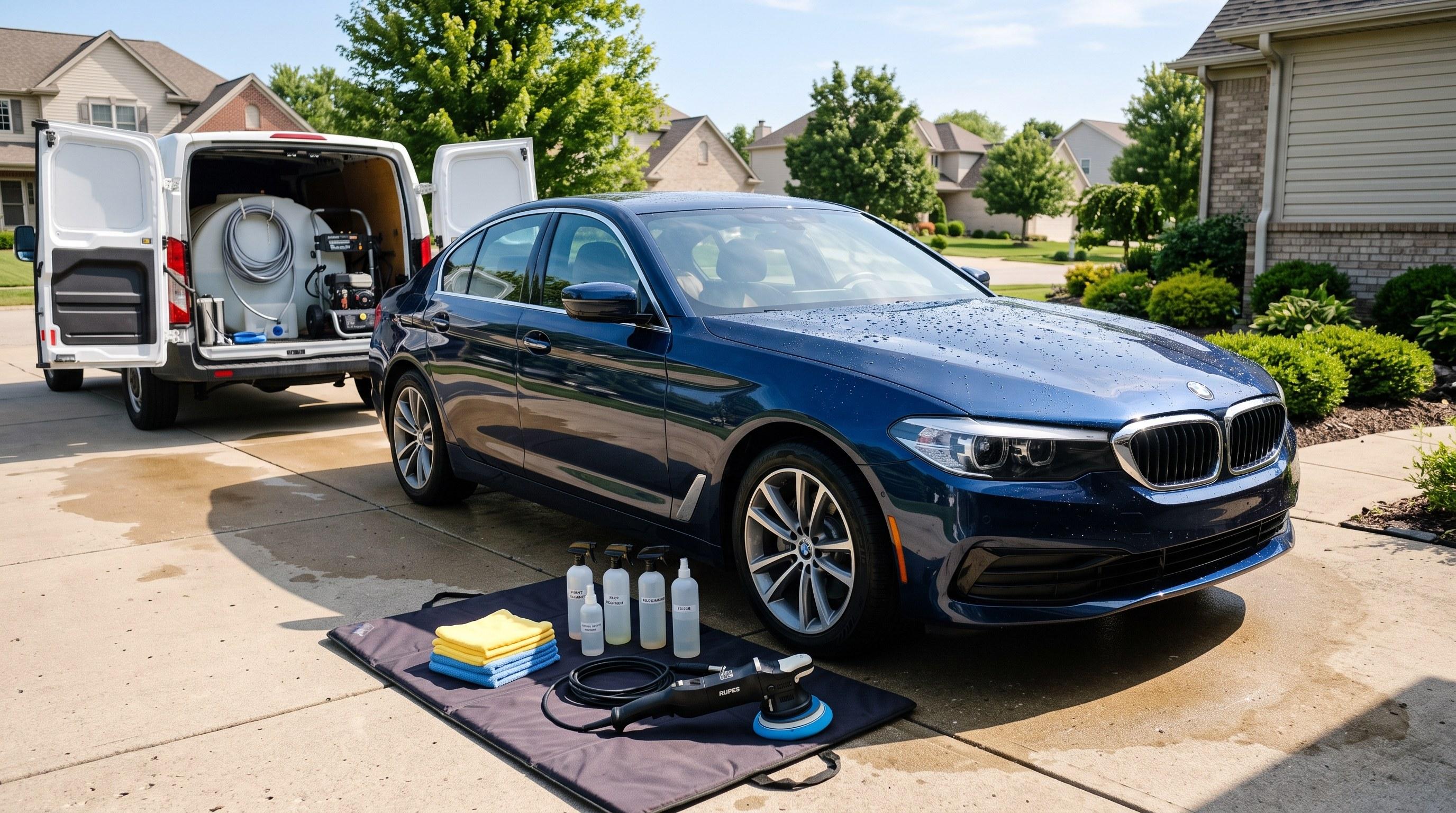
Mobile Car Detailing Side Hustle: How to Earn $2,000-$3,000 a Month on Weekends in 2026
A mobile car detailing side hustle can realistically earn you $2,000 to $3,000 a month working weekends in 2026, because you drive to the customer's driveway, charge by the package instead of the hour, and keep nearly every dollar you collect after supplies. There's no storefront to rent, no franchise fee, and no waiting on a platform to approve you — the equipment fits in a trunk and the first paying job can happen the same week you start.
This guide is for anyone who wants side income that doesn't require staring at a laptop after already staring at one all day. We'll cover what mobile detailing actually pays after supplies and drive time, exactly what gear you need to start, how to price packages so you're not competing with $25 drive-through washes, and how to turn one-time jobs into recurring monthly clients.
Mobile Car Detailing Side Hustle at a Glance
If you're wondering whether detailing is worth your weekends in 2026, here's the direct answer: yes, if you build it around packages and repeat customers. A detailer doing four jobs each Saturday and Sunday at an average ticket of $140 clears roughly $2,240 a month before supplies — and supplies typically run 8-12% of revenue.
| Service Package | Typical Price | Time Required | Best For | |---|---|---|---| | Express exterior wash & wax | $75-$100 | 60-75 minutes | Volume days and repeat clients | | Full interior detail | $130-$175 | 2-3 hours | Families, pet owners, rideshare drivers | | Full detail (inside + out) | $200-$275 | 3-4 hours | Pre-sale prep and first-time customers | | Monthly maintenance plan | $60-$90 per visit | 45-60 minutes | Predictable recurring income |
A few quick facts worth knowing before you buy a single towel:
- Startup costs run $600 to $1,200 for a usable kit — far below the $5,000+ most people assume a detailing business requires.
- Your biggest hidden expense isn't chemicals, it's drive time; detailers who stay inside two or three ZIP codes fit one extra job into every weekend day.
- Recurring maintenance clients are what smooth out the income, the same way a pay-yourself-first savings system smooths out saving.
- Most customers pay on the spot by card app or transfer, so there's no 30-day invoice chase like other freelance work.
Built on Real Experience
At Wealth Builder Daily, we've spent years helping everyday people find side income that fits a real schedule instead of a fantasy one. We look at side hustles the way we look at budgets: honest numbers, honest timelines, and no pretending that a business is passive when it isn't. In this guide, we'll walk you through what a mobile car detailing side hustle actually pays after supplies and fuel, the equipment that earns back its cost fastest, the pricing structure that keeps you out of a race to the bottom, and how to build a client list that books itself month after month.
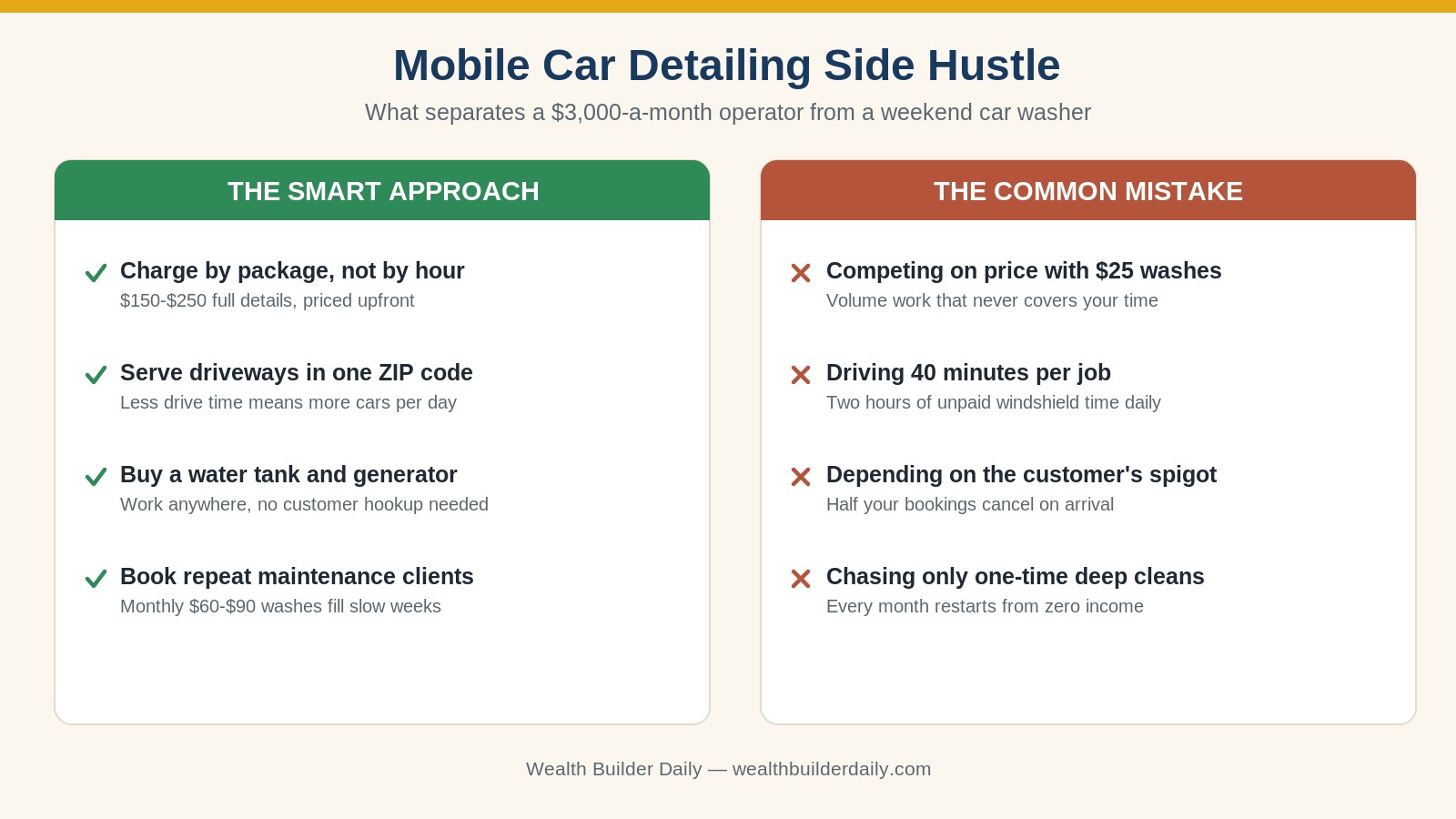
How a Mobile Car Detailing Side Hustle Works
A mobile car detailing side hustle works by bringing the wash bay to the customer: you arrive at a driveway or office parking lot with water, power, and chemicals already loaded, complete a defined service package on-site, collect payment, and drive to the next booking. The customer pays a premium — usually 30-50% more than a fixed-location shop — because they never have to leave home or lose an hour in a waiting room. That convenience premium is the whole business model, and it's why a detailer working alone out of a sedan can out-earn an employee at a commercial car wash.
The mechanics are simple, but a few components separate a profitable weekend from an exhausting one:
- Water independence — a 35-65 gallon tank and a 12V pump mean you can service apartment complexes and office lots where no spigot exists, which roughly doubles your addressable customers.
- Power independence — a small inverter generator runs your vacuum, extractor, and polisher anywhere, so you're never negotiating for an outlet.
- A dual-action polisher — this is the single tool that upgrades you from "car wash" to "detailer" and justifies a $200+ ticket, because paint correction is the visible result customers brag about.
- A hot-water extractor — pulls stains out of upholstery and carpet, which is the highest-margin service you can offer and the one families and pet owners will pay most for.
- Defined packages — three fixed offerings with fixed prices remove the guesswork from quoting and stop you from underbidding your own labor.
Once you've completed a handful of full details, the work becomes predictable — you'll know precisely how long each package takes on each vehicle size, and that's the point where you can safely stack four jobs into a single day.
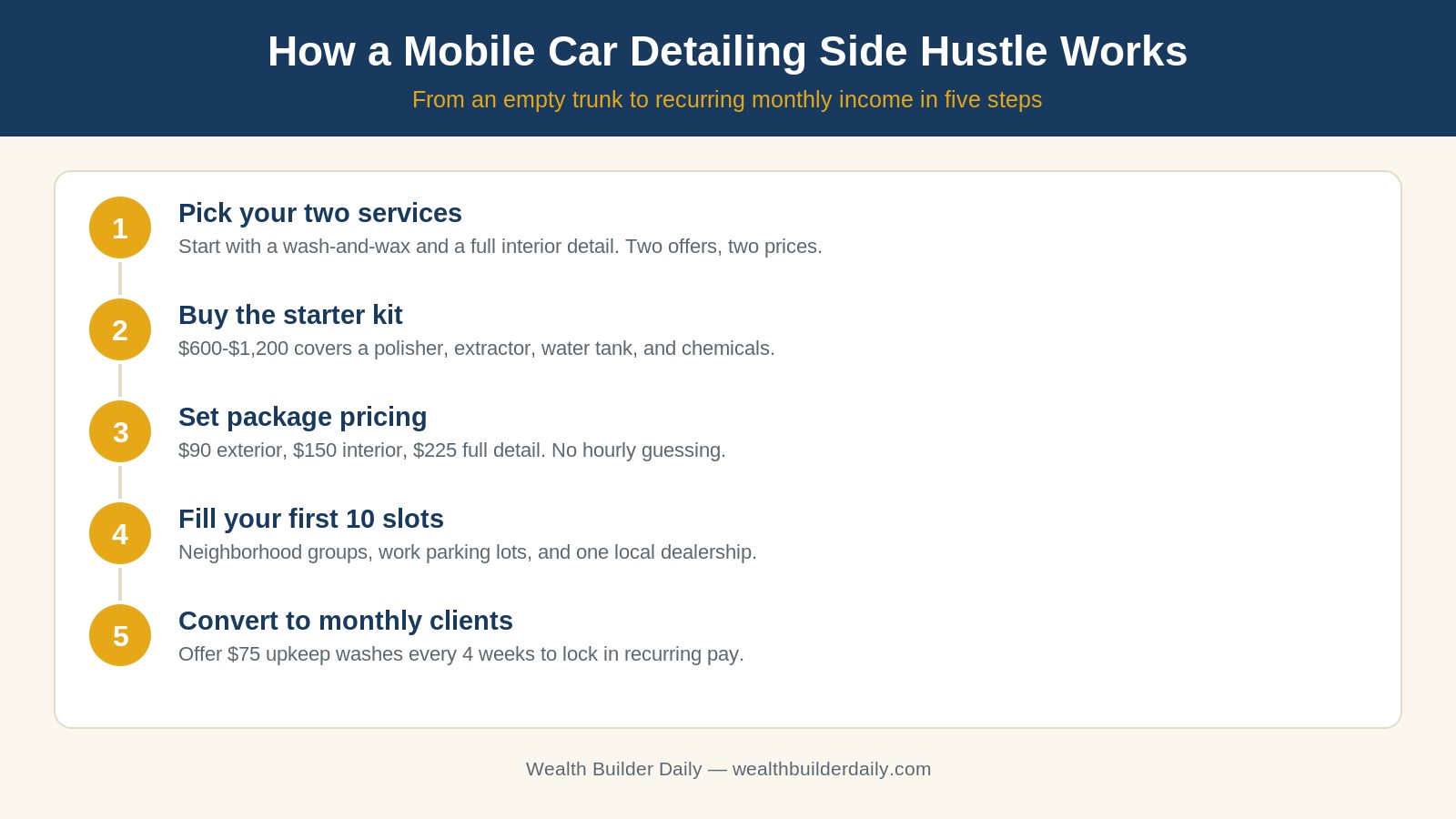
How to Choose the Right Detailing Setup
The wrong first purchase can eat your entire startup budget and leave you unable to take the jobs that actually pay. Work through these criteria before you spend a dollar:
-
Buy for your highest-value service first. If interior details are your best margin, the extractor comes before the fancy polisher. Buy the tool that unlocks the ticket you plan to charge most often, not the one that looks best in photos.
-
Choose water capacity based on your market. Suburban driveways with outdoor spigots need only a 20-gallon buffer tank. Apartment complexes and office lots need 50+ gallons and a pump — and those customers are usually less price-sensitive.
-
Decide between rinseless and traditional washing. A rinseless wash uses two gallons instead of forty, works in parking garages, and eliminates runoff complaints. Traditional pressure washing is faster on heavily soiled trucks. Most detailers eventually carry both.
-
Match your vehicle to your service radius. A sedan with a folding tank works fine for a 10-mile radius. If you're covering 25+ miles, the fuel and loading time will quietly erase your margin unless you're running a van or truck bed.
-
Get liability insurance before your first paid job. A commercial general liability policy runs $400-$700 a year for a solo detailer. One scratched clear coat costs more than a decade of premiums.
-
Verify local water-runoff rules. Many municipalities restrict soapy runoff into storm drains. A water reclamation mat runs $150-$400 and keeps you compliant in the neighborhoods most worth serving.
Here's a number worth planning around: at an average ticket of $140 and eight jobs per weekend, you're generating $4,480 a month in gross revenue. Subtract roughly $450 in chemicals, $220 in fuel, $58 in insurance, and you're keeping about $3,750 — but only if you're booked solid. Most detailers realistically fill five to six slots a weekend in their first six months, which lands squarely in that $2,000-$3,000 range. If you're deciding whether to reinvest that income or pay down balances first, our guide on paying off debt versus investing walks through the math.
Mobile Detailing vs. Renting a Shop Bay
New detailers often ask whether they should skip the mobile stage and rent a bay. For a side hustle, mobile wins on nearly every axis: no lease, no fixed monthly overhead, and you can quit any month without penalty. A shop bay makes sense only once you're consistently turning away work and doing paint correction or ceramic coatings that require controlled lighting and temperature. Start mobile, prove the demand, and let the customers tell you when a bay is worth the risk.
Mobile Car Detailing for Every Situation
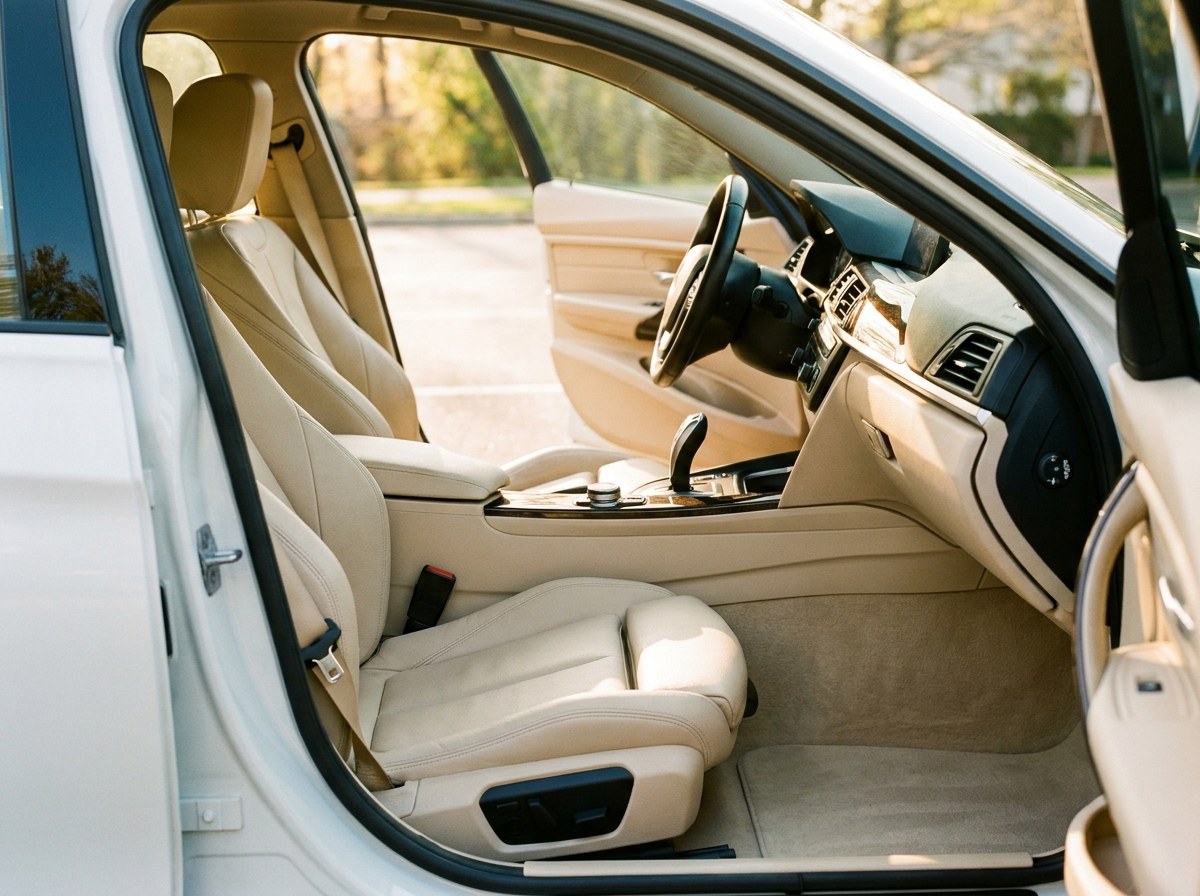
Not everyone comes to detailing from the same starting point, and the smartest approach depends on your schedule and what you already own:
- The weekend-only earner with a full-time job. Block Saturday and Sunday, offer only two packages, and serve a single ZIP code. Six jobs a weekend at $140 average is roughly $3,360 a month gross — without touching a weekday.
- The parent with unpredictable hours. Focus on monthly maintenance plans instead of big details. A 45-minute upkeep wash at $75 can be squeezed into a school pickup window, and 20 monthly clients equals $1,500 that arrives on a schedule you control. Pairing that with irregular income budgeting keeps the variable months from stinging.
- The rideshare or delivery driver already on the road. You're passing dozens of parking lots daily. Offer express exterior washes to fleet vehicles and small business lots during your existing routes — the drive time is already sunk.
Beginner, Intermediate, and Advanced Setups
Beginner ($600-$800): Two buckets with grit guards, a rinseless wash solution, a cordless vacuum, a dozen quality microfiber towels, an all-purpose cleaner, tire dressing, and a spray wax. This kit handles express washes and light interiors — enough to earn your first $1,000 and fund the next tier.
Intermediate ($1,500-$2,500): Add a dual-action polisher with a pad set, a hot-water carpet extractor, a 35-gallon water tank with a 12V pump, and an inverter generator. This is the configuration that unlocks $200+ full-detail tickets and makes you independent of the customer's utilities.
Advanced ($4,000+): Add a steamer, a ceramic coating certification, professional-grade lighting for paint correction, and a dedicated cargo van build-out. At this level you're charging $600-$1,200 for coating jobs and the side hustle has quietly become a business.
Personalizing Your Approach in 2026
The detailing market in 2026 rewards specialization more than it rewards being cheap. Electric vehicles are now a large enough share of driveways that "EV-safe interior detailing" is a legitimate niche, since EV interiors use more synthetic and vegan leather that reacts badly to standard conditioners. Pet-owner packages, rideshare-driver turnaround specials, and pre-sale prep for private car sellers are all narrow enough that you stop competing on price and start being the obvious call. Pick one niche, name it explicitly in every listing, and let the general-purpose detailers fight over the discount shoppers.
Frequently Asked Questions
How much does it cost to start a mobile car detailing side hustle?
A functional starter kit costs $600 to $1,200, covering a cordless vacuum, microfiber towels, chemicals, buckets, and a basic polisher. Adding water and power independence — a tank, pump, and inverter generator — pushes the total to roughly $2,000. Most detailers recover that investment within eight to twelve completed jobs.
Do I need a license or insurance to detail cars?
Requirements vary by city and state, but most areas require a basic business license, and many municipalities regulate soapy water runoff into storm drains. General liability insurance isn't always legally required, though it's strongly recommended at $400 to $700 annually, since a single paint or upholstery claim can exceed years of premiums.
How do I find my first detailing customers?
Start with your immediate network and neighborhood social groups, then approach small business parking lots, apartment complex managers, and used car dealers who need reconditioning. Offering the first five jobs at a modest discount in exchange for photos and reviews builds the proof you need to charge full package rates by week three.
Final Thoughts
A mobile car detailing side hustle earns $2,000 to $3,000 a month on weekends because it solves a real problem for people who value their Saturday more than their money — and it does it with equipment that fits in a trunk and a startup cost most people can cover in a single paycheck. Price by the package, stay inside a tight service radius, and convert one-time jobs into monthly clients, and the income stops being a scramble and starts being a schedule.
- Plain-language guidance — no industry jargon or business-school theory, just what actually happens when you show up at a driveway with a bucket and a plan.
- Real numbers and examples — actual package prices, startup costs, insurance figures, and honest monthly totals based on the slots you can realistically fill.
- Proven, time-tested methods — package pricing, tight service radiuses, and recurring maintenance plans are the same fundamentals profitable detailers have used for decades.
- Free, practical tools and guides — every strategy on this site is free to read and built to be used this weekend, not someday.
The best time to start is the weekend you decide to. Pick two packages, buy the beginner kit, and book three neighbors before you buy anything else — momentum funds the rest. For more step-by-step money guides built for real schedules, browse the full library at Wealth Builder Daily, and check the U.S. Small Business Administration for licensing and registration requirements specific to your state.
The Newsletter
Get the Free Budget Tracker
Join our weekly newsletter. Practical money guides, no fluff. Unsubscribe anytime.