

Bare-Bones Budget: How to Find Your True Minimum Monthly Number in 2026
A bare-bones budget is the smallest dollar amount you need every month to keep a roof over your head, food on the table, the lights on, your car running, your insurance active, and your debts out of default — and nothing else. Most people have never calculated it, which means that when income drops, they are doing panic math at the worst possible moment.
This guide is for anyone whose income could change: freelancers between contracts, anyone in an industry with layoffs, couples planning for one partner to stay home, and people eyeing a career switch that pays less at first. You will learn exactly which expenses count, how to price each one honestly, how to test the number before you need it, and how the figure you end up with quietly improves every other money decision you make.
Bare-Bones Budget at a Glance
Your bare-bones number is not your current spending minus a little discipline. It is a different calculation entirely: you start from zero and add back only what you cannot function without. For most households the answer lands somewhere between 50% and 70% of normal monthly spending, and seeing that gap written down is the whole point.
| Category | What Stays In | What Gets Cut | Typical Share of Total | |---|---|---|---| | Housing | Rent or mortgage, property tax, HOA | Upgrades, storage units, extra parking | 30–40% | | Food | Groceries at a realistic floor | Restaurants, delivery, coffee out | 12–18% | | Utilities | Power, water, basic internet, phone | Premium tiers, streaming bundles | 8–12% | | Transportation | Gas, insurance, basic maintenance | Second car, rideshare, upgrades | 10–15% | | Insurance & Health | Health, auto, renters, prescriptions | Elective care, gym memberships | 10–15% | | Debt Minimums | Minimum payment on every account | Extra principal payments | 5–20% |
A few things worth knowing before you start:
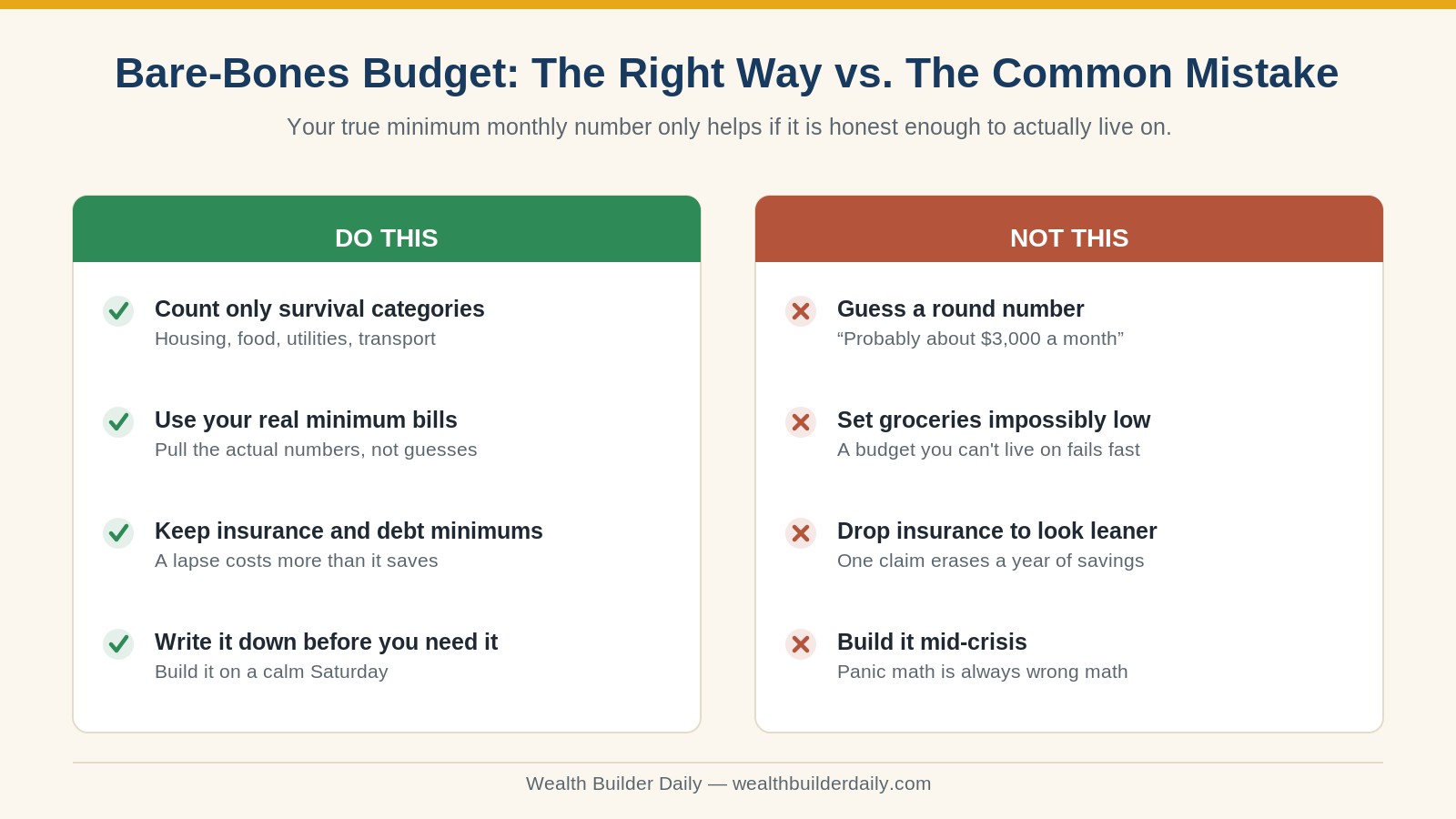
- Minimum debt payments stay. Paying extra is optional; paying the minimum is not. A default does lasting damage that no amount of temporary savings offsets.
- Insurance stays. Dropping coverage to shrink the number is the single most expensive mistake people make in this exercise.
- The number is a floor, not a plan. You are not moving in permanently — you are measuring how low you could go for three to six months if you had to.
- It directly sizes your emergency fund. Three to six months of this number is far more achievable than three to six months of your normal spending. Our emergency fund guide walks through how many months you actually need.
Why This Number Matters More Than Your Regular Budget
At Wealth Builder Daily, we have spent years helping everyday people turn vague money anxiety into specific, workable numbers. The pattern we see again and again is this: people build detailed monthly budgets but have no idea what their floor is, so every income disruption feels like a free fall. In this guide, we will walk you through building a bare-bones budget you can trust — one that holds up when you actually need it, not one that looks good on a spreadsheet in a calm month.
How a Bare-Bones Budget Works
A regular budget answers "where should my money go this month." A bare-bones budget answers a narrower and more useful question: "what is the absolute minimum that has to go out, no matter what." Because the second question has a fixed answer, you can calculate it once and reuse it for years with only small adjustments.
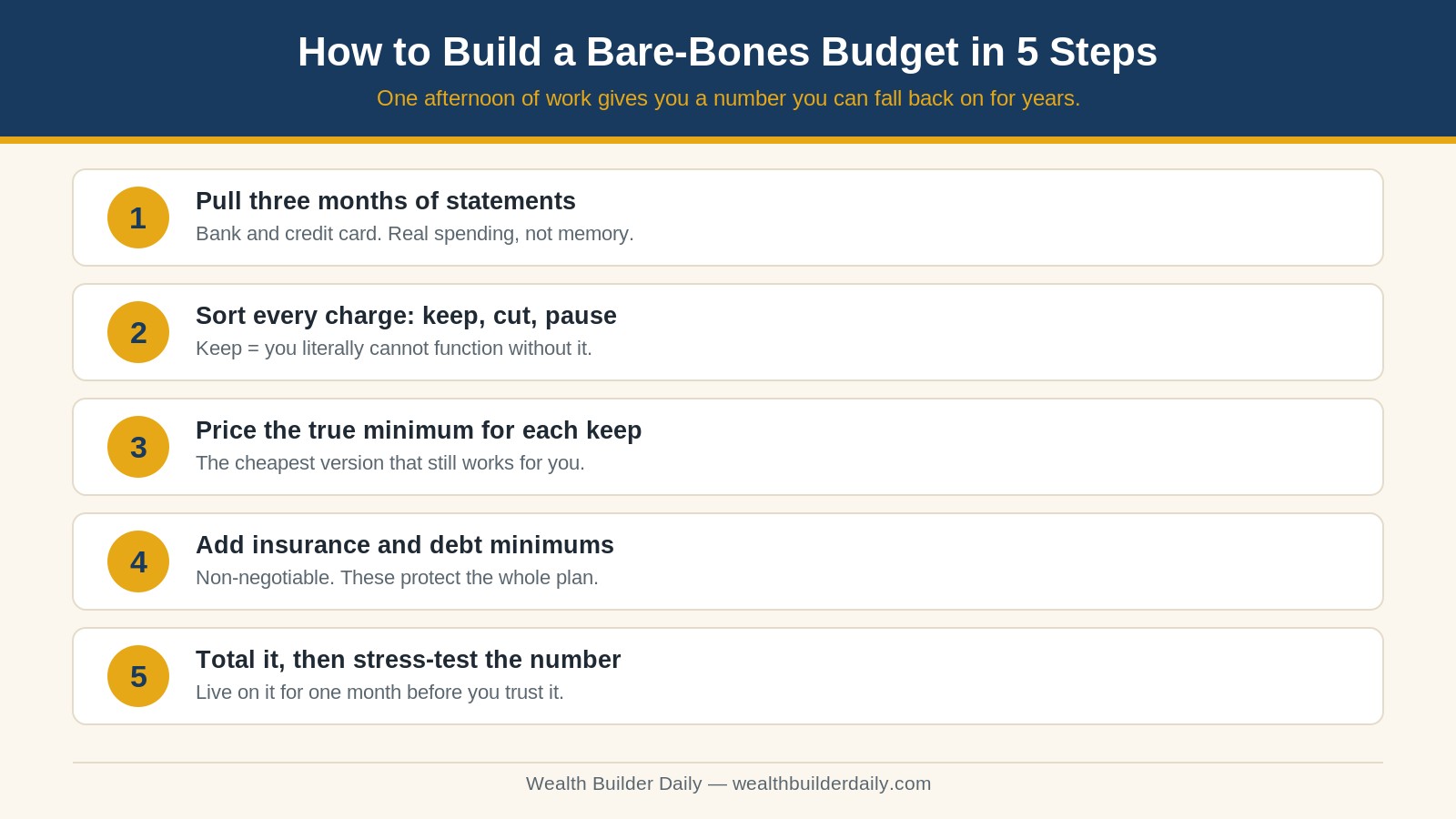
The mechanism is simple. You audit real spending, sort every line into one of three buckets, price the survivors at their cheapest workable level, and total the result. What makes it powerful is not the math — it is the honesty. The number only helps if you could genuinely live on it.
Key components of the calculation:
- The keep bucket — expenses that, if unpaid, create a cascading problem: eviction, repossession, a lapsed policy, a defaulted loan, an empty refrigerator.
- The cut bucket — everything you would drop instantly if income stopped. Subscriptions, dining out, travel, hobbies, upgrades.
- The pause bucket — expenses that are genuinely valuable but can be temporarily suspended: retirement contributions above the employer match, extra debt payments, sinking fund deposits.
- The floor price — for each keep item, the cheapest version that still works. Not the aspirational version, and not a fantasy version you would abandon in week two.
- The stress test — one real month spent living at the number, to prove it is survivable rather than theoretical.
How to Choose What Stays and What Goes
The sorting step is where most people get stuck, because almost every expense feels necessary in the moment. These criteria cut through that.
-
Does skipping it create a legal or contractual problem? Rent, mortgage, auto loans, insurance premiums, and minimum credit payments all carry consequences beyond inconvenience. These are automatic keeps, no debate.
-
Does skipping it threaten your ability to earn? Your phone, basic internet, reliable transportation to work, and the childcare that makes work possible are all income infrastructure. Cutting them to save $200 while losing $3,000 of earning capacity is a bad trade.
-
Does skipping it threaten your health? Prescriptions, ongoing treatment, and health coverage stay. So does a real grocery budget. Undereating to hit a number is not discipline — it is a plan that fails in week three.
-
Is there a cheaper version of the same function? Many keeps do not have to be cut, just downgraded. A $95 phone plan becomes a $30 one. A $120 internet tier becomes the $50 tier. The function survives; the price does not.
-
Would you restore it the moment income returned? If yes, it belongs in cut or pause, not keep. This question is remarkably good at exposing habits dressed up as necessities.
-
Is it seasonal or annual rather than monthly? Car registration, annual insurance premiums, and tax bills still have to be paid. Divide them by twelve and include them, or you will be short in the month they land.
Expert tip: run the downgrade pass before you run the cut pass. In a typical household, switching a phone plan, dropping to a lower internet tier, shopping auto insurance, and canceling forgotten subscriptions frees $180 to $250 a month without changing how you live at all. That is often 8% to 10% of the bare-bones total found in a single afternoon. Our guide to lowering your monthly bills covers the specific calls and scripts that work.
Bare-Bones Budget vs. Zero-Based Budget
These get confused constantly, and they do different jobs. A zero-based budget assigns every dollar of your actual income a job each month — it is an operating system for normal life, and it includes fun, savings, and goals. A bare-bones budget ignores your income entirely and measures a floor. You run a zero-based budget every month. You calculate a bare-bones budget once, review it annually, and keep it in a drawer. The zero-based budget tells you how to live well on what you earn; the bare-bones budget tells you how little you could earn and still be fine.
Bare-Bones Budgeting for Every Situation

The number means something different depending on where you are standing:
- Variable or commission income. Your bare-bones number becomes your monthly target. Anything you earn above it in a strong month is surplus that funds the weak months. This turns income volatility from a source of stress into a mechanical system — pair it with a three-account setup so the surplus never sits in checking where it gets spent.
- Stable salary, uncertain industry. Your number tells you exactly how many months of runway your savings represent. Most people discover they have more runway than they feared, because they were measuring against normal spending instead of their floor.
- Planning a deliberate income drop. Starting a business, switching careers, or moving to one income all become concrete decisions once you know the floor. The question stops being "can we afford this" and becomes "can we cover the gap between the floor and the new income for eighteen months."
Beginner, Intermediate, and Advanced Setups
Beginner: one sheet of paper, six categories, one total. Do not build a spreadsheet — build a number. Ninety percent of the value is in simply knowing it.
Intermediate: add the annual expenses divided by twelve, separate a "true floor" from a "comfortable floor" about 15% higher, and calculate how many months your current savings cover at each level.
Advanced: maintain three tiers — floor, comfortable, and normal — with pre-written trigger points for when you shift between them. Assign each tier a specific action list so the decision is already made before the stressful month arrives. Pair the floor with clearly defined sinking funds so irregular costs never force you below it.
Personalizing the Number in 2026
Two forces make recalculating worthwhile this year. First, housing and insurance costs have moved unevenly by region, so a number you calculated two or three years ago may understate your floor by a meaningful margin — insurance in particular has repriced sharply in several states. Second, more households now carry income that varies month to month, whether from contract work, a side business, or variable hours, and a floor is far more useful than an average when income moves. Recalculate every January, and again any time your housing cost, insurance premium, or household size changes.
Frequently Asked Questions
How is a bare-bones budget different from an emergency fund?
They work together but measure different things. Your bare-bones budget is a monthly expense figure — what must go out each month. Your emergency fund is a savings balance. You multiply the first by three to six to size the second. Calculating the bare-bones number first is what makes the emergency fund target realistic instead of intimidating.
Should I include retirement contributions in a bare-bones budget?
Generally no, with one exception: contribute enough to capture a full employer match, since that is an immediate guaranteed return you cannot buy back later. Everything above the match belongs in the pause bucket. If income actually stops, pausing contributions is the right call — but resume them the moment it recovers.
How long should I actually live on my bare-bones budget?
As a test, one month is enough to prove the number works and expose anything you underpriced. As a response to real income loss, live on it until stable income returns plus one additional month. It is designed as a temporary floor, not a permanent lifestyle — extended time at the floor tends to produce rebound spending.
Final Thoughts
Knowing your bare-bones number does not require you to live on it. It just removes the worst part of a financial setback, which is not the money — it is the uncertainty. When you already know that your floor is $3,240 and your savings cover five months at that level, a layoff becomes a problem with a timeline instead of a crisis with no bottom. That is a calculation worth one afternoon of your time, and it will keep paying you back for years.
- Plain-language guidance. No jargon, no assumed background. Every term gets explained the first time we use it.
- Real numbers and real examples. Specific dollar figures and ranges you can check against your own accounts, not vague percentages.
- Proven, time-tested methods. We publish approaches that have worked for ordinary households across good markets and bad ones, not whatever is trending this quarter.
- Free, practical tools and guides. Every framework we cover comes with the steps to actually implement it, at no cost.
Run the five steps this weekend, write the number somewhere you will find it again, and then get back to your regular budget knowing exactly where your floor sits. For more step-by-step guides on building a budget that holds up under pressure, browse the full library at Wealth Builder Daily. For official consumer guidance on budgeting and managing financial hardship, the Consumer Financial Protection Bureau publishes free tools and worksheets worth bookmarking.
The Newsletter
Get the Free Budget Tracker
Join our weekly newsletter. Practical money guides, no fluff. Unsubscribe anytime.