
Grocery Budget: How to Cut Your Food Spending by $200 a Month in 2026
A grocery budget is a weekly dollar cap you set for food before you shop — and for most households, tightening it is the fastest way to free up $150 to $250 a month without giving up meals you actually like. No coupon binders, no extreme couponing apps, no eating rice for thirty days.
This guide is for anyone who looks at their bank statement and thinks, "I did not spend that much on food." If groceries are your second- or third-largest expense after rent and your car, you're in the right place. We'll cover how to find your real number, how to set a cap you'll actually hit, and where the money quietly disappears.
Grocery Budget at a Glance
The short answer: pick a weekly dollar cap, plan five dinners around what you already own, write one list, and shop once. That combination alone cuts most food bills by 20% to 30% in the first month, because it removes the three habits that inflate a cart — extra trips, unplanned buying, and food you throw away.
| Question | Short Answer | |---|---| | How much should I spend on groceries? | Aim for 10%–12% of take-home pay. For $4,500/month take-home, that's roughly $450–$540. | | Weekly or monthly budget? | Weekly. You can course-correct in days instead of finding out on the 28th. | | Biggest single leak? | Extra store trips. Each one adds an average $15–$25 in unplanned items. | | How much food gets wasted? | Roughly 30% of what a typical household buys never gets eaten. | | How long until I see savings? | Most people see a measurable drop in the first full week. |
Quick facts worth knowing before you set your number:
- Grocery prices rose faster than general inflation for most of the last several years, so a budget you set in 2022 is almost certainly too low for 2026.
- Store-brand equivalents run 20% to 35% cheaper than name brands on identical products — same factory, different label, in many categories.
- Buying five dinners instead of seven leaves room for leftovers and one flexible night, which is why five-day plans survive real life and seven-day plans don't.
- If you're also trying to trim fixed costs, pair this with our guide on how to lower your monthly bills — food and bills together are where most of the slack lives.
Where This Advice Comes From
At Wealth Builder Daily, we've spent years helping everyday people find room in a budget that already feels stretched. Food is where we see the biggest gap between what people think they spend and what they actually spend — often $200 or more a month. In this guide, we'll walk you through the exact sequence: measure your true baseline, set a weekly cap, build a five-dinner plan from what's already in your kitchen, and check in once a week. It takes about 30 minutes a week once it's running.
How a Grocery Budget Works
A grocery budget isn't a restriction — it's a decision made in advance. When you decide on Sunday what you're eating and what you're spending, you stop making thirty small decisions in the store aisle where the packaging, the smells, and your hunger are all working against you.
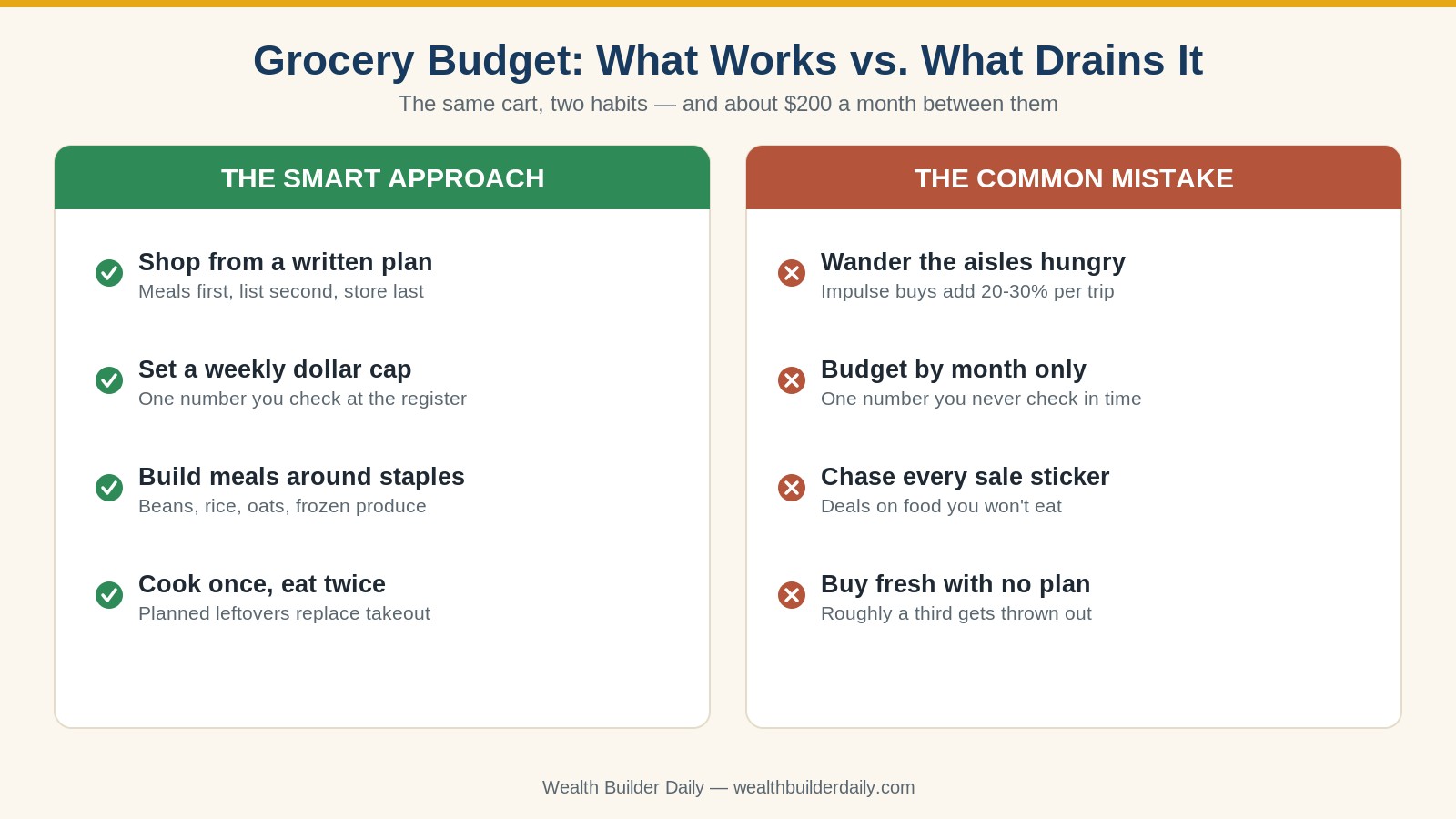
The mechanism is simple. Every dollar of grocery overspending traces back to one of four sources, and a weekly plan closes all four at once:
- Unplanned trips. You run in for milk and leave with $28 of groceries. Two extra trips a week is roughly $150 a month.
- Buying without a plan. You buy ingredients, not meals. Then Thursday arrives, nothing goes together, and you order takeout on top of the groceries you already bought.
- Spoilage. Fresh produce bought optimistically with no assigned meal turns into a science experiment in the crisper drawer.
- Brand default. Reaching for the name brand out of habit on staples where the store version is identical.
The weekly cap is what makes the system self-correcting. A monthly number is too abstract — you don't know you blew it until it's gone. A weekly number gives you four chances a month to notice and adjust, and that feedback loop is the whole engine. It's the same logic behind the zero-based budget, applied to the one category most people never assign a real limit to.
How to Choose the Right Grocery Budget Number
Picking a number that's too aggressive is the most common reason people quit in week two. Here's how to land on one you'll actually hold.
-
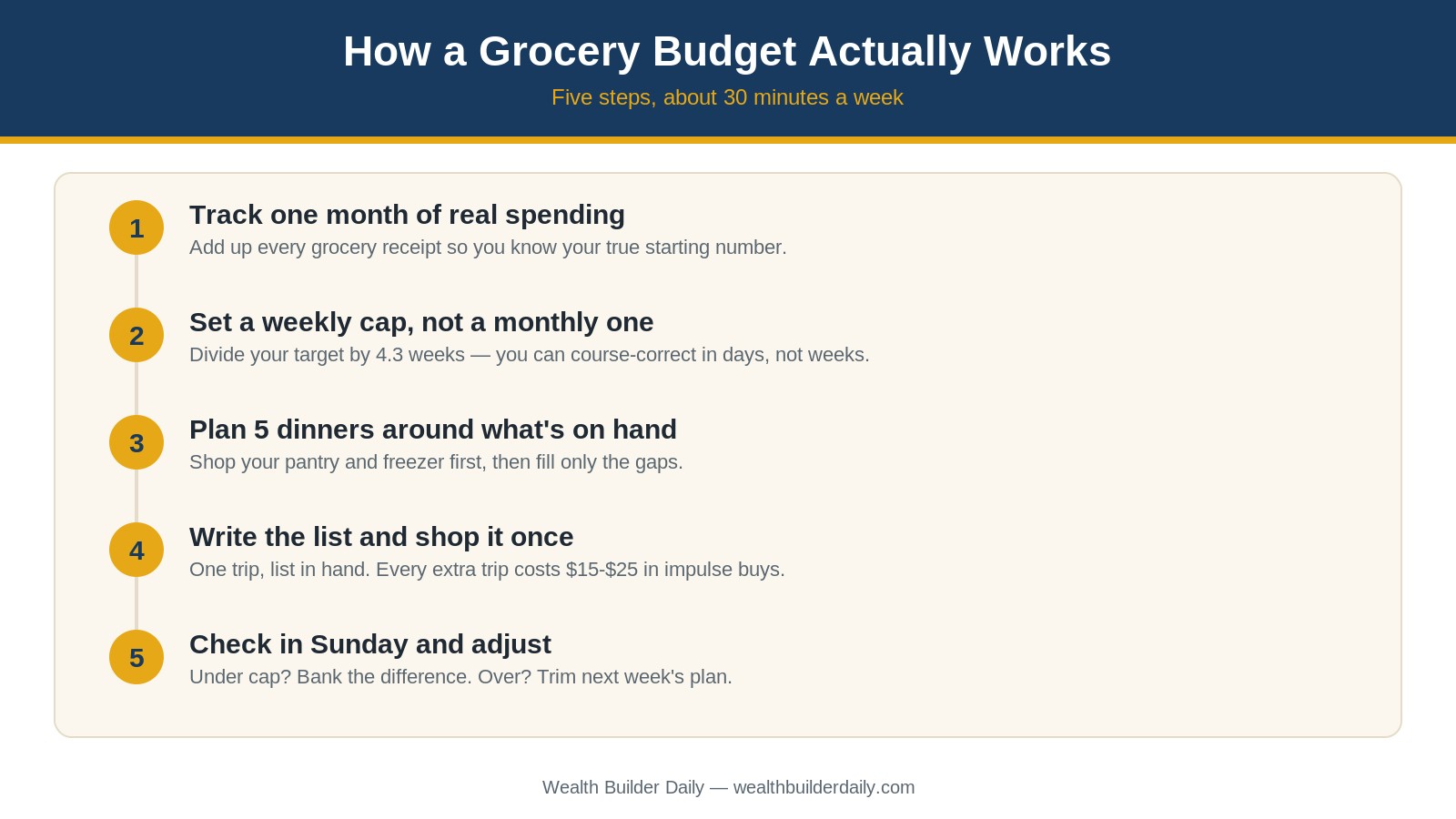
Start from your real baseline, not a target. Pull one full month of grocery transactions from your bank or card statement. Add them all — including the gas station snack run and the $12 "quick stop." That total is your honest starting point. Most people are 15% to 25% above what they'd have guessed.
-
Cut 15% for month one, not 40%. If your baseline is $700, set $595, not $420. A cut you can hit builds the habit; a cut you miss convinces you the whole thing doesn't work. You can tighten again in month two once the system is running.
-
Divide by 4.3, not 4. There are about 4.3 weeks in a month. A $600 monthly target is a $140 weekly cap, not $150 — that small difference is why so many budgets quietly run over by the end of the year.
-
Decide what counts. Groceries only, or does household stuff — paper towels, soap, dog food — come out of the same cap? Either works. Just be consistent, because the number is meaningless if the definition shifts week to week.
-
Adjust for your actual household. Teenagers, dietary restrictions, and a food desert with one expensive store all legitimately raise the floor. Budget for the life you have, not the one on a spreadsheet.
-
Build in a small buffer. Give yourself $20 a week of slack for the birthday cake, the unexpected guest, the sale on something you genuinely use. Budgets with zero flex snap.
Expert tip: Track the delta, not just the total. If your baseline was $700 and you land at $520, that's $180 a month — $2,160 a year. Move that exact amount into savings by automatic transfer the day after your weekly check-in, or it evaporates into other spending. Parking it in a high-yield account earning 4% turns $2,160 a year into roughly $11,700 over five years. That's the difference between cutting costs and actually building something.
Weekly Cap vs. Monthly Envelope
A monthly envelope is easier to set up; a weekly cap is far easier to hold. If you're already running a cash envelope system, split the grocery envelope into four weekly stacks rather than one monthly pile. Same total money, radically different behavior — with one pile, week one eats week four's dinner. With four stacks, the constraint is visible every time you shop.
Grocery Budgeting for Every Situation
There's no universal number, because a single person in a small apartment and a family of five have almost nothing in common at the checkout. Match the approach to your situation:
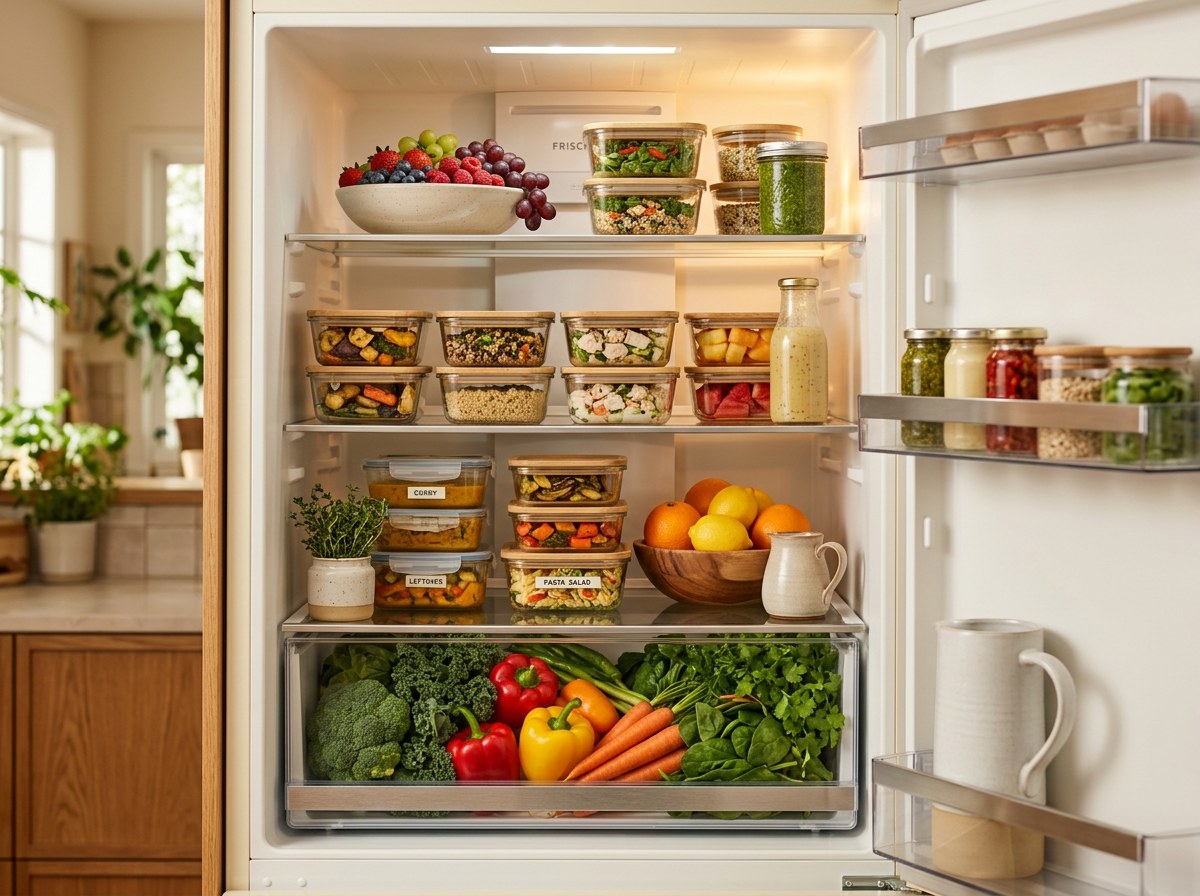
- Single or a couple. Your enemy is waste and convenience spending. Buy smaller quantities of fresh items, lean on the freezer for proteins, and cook double batches deliberately so tomorrow's lunch is already handled. A realistic target for one person in 2026 is $70–$95 a week; for a couple, $120–$160.
- Family with kids. Volume is your lever. Bulk staples — rice, oats, dried beans, frozen vegetables, chicken thighs — carry most of the meals, with fresh produce filling in around them. Get the kids to pick one dinner each week; participation cuts the "I don't want that" tax dramatically. Expect $180–$280 a week for a family of four depending on ages.
- Irregular or variable income. Set your cap off your lowest recent month, not your average. In a strong month, the surplus goes to your emergency fund rather than into a bigger cart, so a slow month doesn't force a painful reset.
Beginner, Intermediate, and Advanced Setups
Beginner: One weekly cap and a written list. That's it. Don't add anything else until you've hit your number three weeks in a row.
Intermediate: Add a five-dinner meal plan built from a pantry inventory, plus a standing "shop what we have first" rule before any list gets written. Track your weekly totals in a note on your phone.
Advanced: Layer in unit-price comparison on your ten highest-volume items, a rotating two-week meal template so planning takes five minutes, and a monthly bulk run for shelf-stable staples. At this level, most households run 30% to 40% under their original baseline.
Personalizing Your Approach in 2026
Prices, apps, and store loyalty programs keep shifting, so build the system around your habits rather than a rigid rule. If you shop online for pickup, that alone kills most impulse spending — the cart total is visible the entire time and you never walk past an endcap. If you cook rarely, spend your effort on a shorter, cheaper repeatable rotation instead of an ambitious plan you'll abandon. And if a no-spend challenge is more your speed, run one on food for a single week to see how much your pantry can actually carry. Most people are startled.
Frequently Asked Questions
What is a reasonable grocery budget for one person?
For one person in 2026, $70 to $95 a week — roughly $300 to $410 a month — is realistic in most parts of the country. Higher-cost metros push toward the upper end or past it. The right number is 10% to 12% of your take-home pay; if food is eating more than 15%, that's where your first cuts should land.
Does meal planning actually save money?
Yes, and the savings come from an unexpected place. Meal planning saves money less by finding cheaper ingredients and more by eliminating the takeout you order when nothing in the fridge goes together. Households that plan five dinners typically cut both grocery spending and restaurant spending, which is why the total drop often exceeds what the grocery line alone would suggest.
Should I buy in bulk to save on groceries?
Bulk works for shelf-stable staples you already use consistently — rice, dried beans, oats, pasta, frozen vegetables, paper goods. It backfires on perishables and on anything you're trying for the first time. Check the unit price rather than the sticker price, because warehouse-club sizes are not automatically cheaper per ounce than a store-brand box.
Final Thoughts
Cutting your grocery budget by $200 a month isn't about deprivation — it's about deciding in advance instead of deciding in the aisle. Set the weekly cap, plan five dinners from what's already in your kitchen, shop once, and check in on Sunday. The first month is the hardest; by month three it's just how you shop.
- Plain-language guidance. No jargon, no complicated systems — just the steps in the order you should do them.
- Real numbers and examples. Actual dollar targets by household size, so you're not guessing what "reasonable" means.
- Proven, time-tested methods. Weekly caps and meal planning have worked for decades because they change behavior, not just spreadsheets.
- Free practical tools and guides. Everything on Wealth Builder Daily stays free, because building wealth shouldn't have a paywall.
Start with one week. Pull your last month of grocery spending tonight, set a cap that's 15% lower, and write five dinners down before you shop next. Then take whatever you save and put it somewhere it can grow — that's how a smaller grocery bill quietly becomes real money. For more step-by-step guides on budgeting, saving, and investing, browse the full library at wealthbuilderdaily.com/blog, and for unbiased consumer money resources, the Consumer Financial Protection Bureau publishes free budgeting worksheets worth bookmarking.
The Newsletter
Get the Free Budget Tracker
Join our weekly newsletter. Practical money guides, no fluff. Unsubscribe anytime.