

Lifestyle Creep: How to Keep Your Next Raise Instead of Spending It in 2026
Lifestyle creep is what happens when your spending rises to match every pay increase, so a bigger paycheck never turns into more money in the bank. It is the single most common reason people who earn far more at 40 than they did at 30 still feel like they are living paycheck to paycheck.
This guide is for anyone who has gotten a raise, a bonus, a promotion, or a new client in the last year or two and cannot point to where the extra money went. We will walk through how lifestyle creep actually works, the five-step system that stops it in the week the money arrives, how much of a raise you should realistically keep, and how to handle it whether you are earning $45,000 or $250,000.
Lifestyle Creep at a Glance
The short answer: lifestyle creep is not caused by big splurges. It is caused by small permanent increases in your fixed monthly costs — a nicer apartment, a bigger car payment, four new subscriptions — that each feel affordable on their own and collectively eat the entire raise. The fix is to decide where the money goes before it hits your account.
| Where the Raise Goes | What It Feels Like | Effect on Wealth | | --- | --- | --- | | New fixed monthly bill (rent, car, gym) | Permanent upgrade, hard to reverse | Cancels the raise forever | | More casual spending (takeout, shopping) | Barely noticeable day to day | Cancels most of the raise | | One-time purchase, paid cash | A real, felt reward | Costs you one month, not every month | | Automatic transfer to savings or investing | Nothing changes day to day | Raise compounds for decades |
A few quick facts worth knowing before you go further:
- Fixed costs are the danger zone. A $400 jump in rent costs you $4,800 a year, every year, until you move.
- The window is short. Most lifestyle creep is locked in within 60 days of a raise landing.
- Take-home is smaller than you think. A $10,000 raise usually lands as roughly $600–$650 a month after taxes, not $833.
- Savings rate is the scoreboard. If your income rose 12% and your savings rate did not move, the raise did nothing for you. Our guide to pay yourself first covers how to automate that number.
Why We Trust This Approach
At Wealth Builder Daily, we've spent years helping everyday people turn rising incomes into rising net worth instead of rising bills. The pattern is remarkably consistent: the people who build wealth are rarely the highest earners in the room — they are the ones whose fixed costs stayed flat while their income climbed. In this guide, we'll walk you through the exact five-step process to run the week a raise arrives, with real dollar figures at every income level, so you keep the majority of every increase you earn from here on.
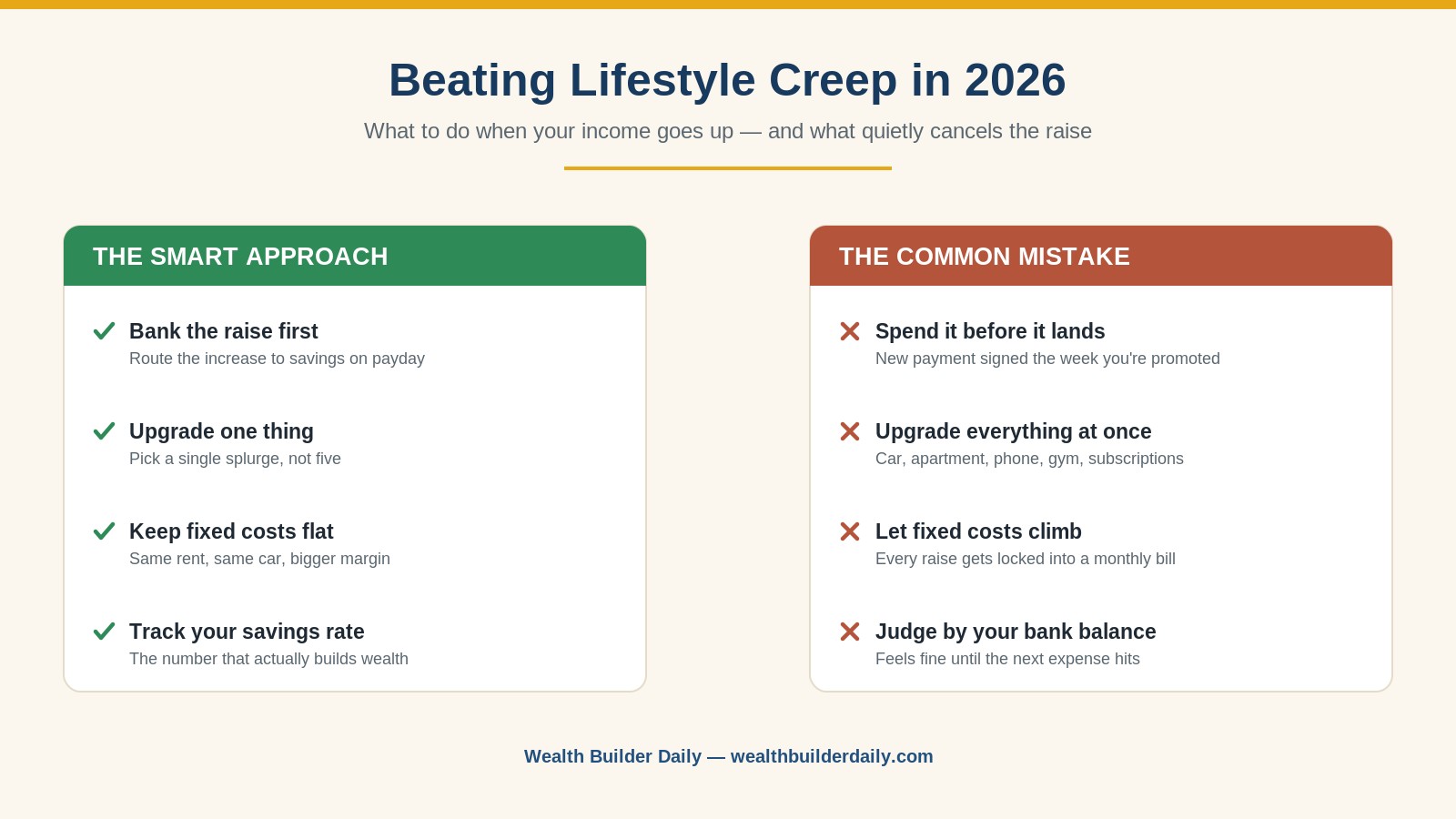
How Lifestyle Creep Works
Lifestyle creep works because it never asks for a decision. Nobody sits down and chooses to spend an entire raise. Instead, a series of individually reasonable choices stack on top of each other, and each one quietly becomes permanent.
Here is the typical sequence. You get a $9,000 raise, which lands as about $550 a month after taxes. Your lease is up, so you take the apartment with the second bathroom for $250 more. Your car has 140,000 miles on it, so you finance a newer one and your payment goes from $180 to $390. You start ordering lunch twice a week instead of once. Eleven months later your income is $9,000 higher and your savings are exactly where they were.
The mechanics that make this so hard to see:
- Anchoring to your new income. Within about two months, the higher number feels normal and the old budget feels like deprivation rather than the baseline it actually is.
- Fixed costs compound against you. Variable spending fluctuates and self-corrects. A monthly payment does not — it renews itself automatically until you actively cancel it.
- Upgrades rarely reverse. Moving to a nicer place is easy; moving back is not. Each upgrade resets the floor of what feels acceptable.
- Percentages hide the damage. "It's only 4% more rent" sounds trivial. Over ten years at that pace, housing eats a third of every raise you will ever get.
- No feedback loop. Nothing in your bank app tells you your savings rate flatlined. Without tracking, the problem is invisible until you check your net worth years later.
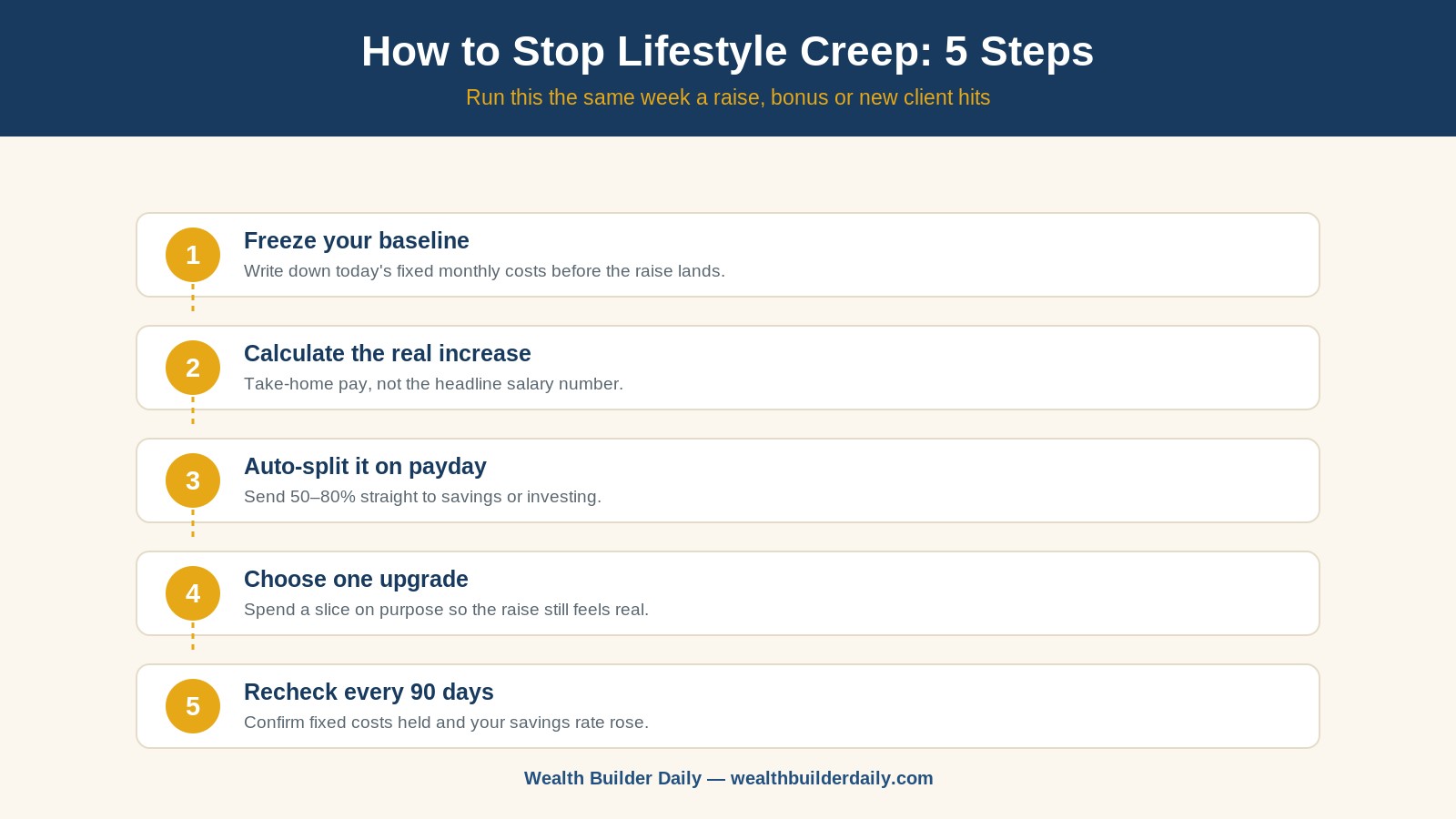
How to Choose the Right Split for Your Raise
There is no universal percentage, but there is a right answer for your situation. Work through these criteria in order.
-
Check your emergency fund first. If you have less than three months of expenses set aside, the entire raise goes there until you do. Nothing else you could do with the money produces a better return than not having to use a credit card when the transmission goes. Our emergency fund guide walks through the target math.
-
Clear high-interest debt next. Any balance above roughly 8% interest beats almost any investment on a guaranteed basis. A raise directed at a 24% credit card is a guaranteed 24% return, which no market will promise you.
-
Look at your current savings rate. If you are saving under 10% of gross income, aim to keep 80% of the raise. If you are already above 20%, keeping 50% is reasonable and you have genuinely earned the flexibility.
-
Separate fixed from variable upgrades. A one-time $1,500 trip costs you $1,500. A $200 monthly car payment upgrade costs you $2,400 a year and $24,000 over a decade. Prefer one-time purchases over recurring ones whenever you want to enjoy the money.
-
Decide before the money arrives. Set the automatic transfer the same week you get the offer letter, not after the first higher paycheck clears. Money you never see in checking is money you never adjust to.
-
Pick exactly one lifestyle upgrade. This is not optional — it is what makes the system survivable. Choose the single thing that improves your life most and fund it deliberately.
The expert tip that matters most: run the ten-year number before you sign anything recurring. A $300-a-month apartment upgrade is $36,000 over ten years. Invested at a 7% average annual return instead, that same $300 a month becomes roughly $51,800. That is the real price tag on the second bathroom, and seeing it written down changes the decision more than any amount of willpower. If you want to check where you actually stand today, start with your net worth calculation.
Raise vs. Bonus: Why the Difference Matters
Yes, and the difference matters more than most people realize. A bonus is a one-time amount, so spending it creates a one-time cost — it is the safer money to enjoy. A raise is recurring, which means any recurring expense you attach to it locks in permanently. The practical rule: treat bonuses as your fun money and raises as your wealth-building money. If you want to upgrade your car or apartment, fund the down payment or moving costs from a bonus and keep the monthly payment flat.
Lifestyle Creep for Every Situation

The right response depends heavily on where you are starting from.
-
You're early career and underpaid. Some lifestyle creep is legitimate here. If your first raise lets you stop splitting a two-bedroom three ways or fix the car that keeps breaking down, that is not creep — that is your baseline finally reaching adequate. Keep 40–50% of the increase and spend the rest on genuine quality-of-life gaps.
-
You're mid-career and comfortable. This is where creep does the most damage, because everything is already fine and every upgrade is purely optional. Target keeping 70–80% of any raise. Use a zero-based budget to make sure the extra money has an assigned job before the month starts.
-
You're self-employed or your income varies. Your risk is different: a great quarter feels like a raise but is not one. Set your budget on your lowest three-month average, and treat everything above it as bonus money — savings first, upgrades never. Our guide to budgeting on an irregular income covers the mechanics.
Beginner, Intermediate, and Advanced Setups
Beginner: One automatic transfer on payday for 50% of the raise into a high-yield savings account. That is the entire system. Do not add complexity you will abandon in March.
Intermediate: Split the raise three ways on payday — a percentage to retirement, a percentage to a taxable brokerage or savings goal, and a defined slice to spending. Increase your 401(k) contribution by the same percentage as the raise so the change is invisible.
Advanced: Set a hard ceiling on total fixed monthly costs as a share of take-home pay — many people use 50% — and refuse to cross it regardless of income. Every raise then flows to investing by default, and you review the ceiling once a year rather than reacting to each increase.
Personalizing This in 2026
Two things make 2026 different from a few years ago. First, prices in several everyday categories have settled but not reversed, which means part of any raise is genuinely absorbing higher costs rather than funding upgrades — subtract your actual cost increases before you calculate what is left to allocate. Second, high-yield savings accounts are still paying meaningfully more than the near-zero rates of the early 2020s, so the parked portion of your raise earns real money while you decide what to do with it. Run the numbers on your own situation rather than applying a rule of thumb from a different decade.
Frequently Asked Questions
Is all lifestyle creep bad?
No. Spending more as you earn more is the point of earning more. Lifestyle creep only becomes a problem when it is unconscious and permanent — when spending rises automatically to absorb every dollar without a decision. Deliberately choosing to spend part of a raise on something you value is healthy. Waking up a year later unable to say where it went is not.
How much of a raise should I actually keep?
A reasonable default is keeping 50% and spending 50%, but adjust based on your savings rate. If you save less than 10% of your income, keep 80% of the raise until you get there. If you already save more than 20%, keeping half is perfectly sound. The only wrong answer is having no target at all and letting the number sort itself out.
What if I've already spent my last few raises?
You have not lost anything permanently — you have just reset your baseline. Start by listing every fixed monthly cost and identifying the ones added in the last two years. Cancel or downgrade what you do not genuinely value, then commit the entire next raise to savings before it arrives. One disciplined raise can undo several careless ones.
Final Thoughts
Lifestyle creep is not a discipline problem, and it is not solved by trying harder to spend less. It is a timing problem: the money gets committed before you ever decide what it is for. Move that decision earlier — to the week the raise is announced rather than the month after it lands — and the entire dynamic reverses. Your fixed costs hold, your savings rate climbs with your income, and every future increase compounds instead of evaporating.
Here's why readers keep coming back to Wealth Builder Daily:
- Plain-language guidance. No jargon, no assumed finance background, no lectures about lattes.
- Real numbers and real examples. Every recommendation comes with the actual dollar figures so you can check the math against your own situation.
- Proven, time-tested methods. We stick to approaches that have worked across decades and market cycles, not whatever is trending this quarter.
- Free, practical tools and guides. Everything we publish is free, actionable, and written to be used the same week you read it.
The next raise you get is already spoken for — the only question is whether you decided that or your spending did. Pick your split now, set the transfer, and let the increase do what raises are supposed to do. Explore more guides on building a system that works at Wealth Builder Daily, and for unbiased background on budgeting and consumer finance, the Consumer Financial Protection Bureau is a reliable free resource.
The Newsletter
Get the Free Budget Tracker
Join our weekly newsletter. Practical money guides, no fluff. Unsubscribe anytime.