

Notary Loan Signing Agent: How to Earn $1,500 to $3,000 a Month Part-Time in 2026
A notary loan signing agent is a commissioned notary public trained to guide borrowers through a mortgage closing packet, and most part-time agents are paid $100 to $200 per appointment for roughly 90 minutes of work. It is one of the few side hustles where a single evening job pays more than most people earn in a full day of gig driving.
This guide is for anyone who wants a flexible, appointment-based income stream without inventory, without an audience, and without a four-year degree. You will see the real startup costs, the licensing timeline, what agents actually earn in 2026, and the specific mistakes that cause new agents to quit before their third month.
Notary Loan Signing Agent Income at a Glance
A notary loan signing agent gets hired by title companies, escrow offices, and third-party signing services to meet a borrower, present each document in the loan package, notarize the pages that require it, and ship the signed packet back the same day. You are not giving legal or financial advice. You are making sure the right person signs the right page, correctly, on time.
| Question | Short Answer | | --- | --- | | What does it pay? | $75 to $200 per signing; $100 to $150 is the common range in 2026 | | How long is one appointment? | 45 to 120 minutes, plus printing and drop-off time | | What does it cost to start? | $700 to $1,200 all in, including printer and insurance | | How long until I can work? | 3 to 8 weeks, depending on your state's notary processing time | | Do I need a license or degree? | A state notary commission, yes; a college degree, no | | Is it recurring or one-off? | Recurring — title companies rebook agents they trust | | Realistic part-time income | $1,200 to $3,000 a month at 3 to 6 signings a week |
Quick facts worth knowing before you commit:
- Roughly half of every loan package is signature and initial pages, which is why speed and accuracy matter more than sales skill.
- Evening and weekend appointments are the norm, which makes this unusually compatible with a full-time job.
- Income arrives in irregular bursts, so pair it with a plan like the one in our guide to budgeting on an irregular income.
- Refinance volume drives demand, so your calendar will swing with mortgage rates.
Why You Can Trust This Guide
At Wealth Builder Daily, we have spent years helping everyday people find side income that survives contact with real life — work with honest math, honest startup costs, and no course to buy. In this guide, we will walk you through exactly what a notary loan signing agent spends, earns, and does in a typical week in 2026, including the numbers most "become a signing agent" pitches leave out.
How a Notary Loan Signing Agent Works
Every mortgage that closes in the United States needs a neutral third party to witness and notarize the borrower's signatures. Lenders and title companies rarely have the staff to send someone to a borrower's kitchen table at 6 p.m., so they outsource that appointment. That outsourced role is you.
A typical job runs like this. A signing service or escrow officer texts you an offer with a date, time, ZIP code, and fee. You accept, download a 100- to 180-page packet, print two copies on legal and letter paper, drive to the borrower, walk them page by page, notarize the acknowledgments and jurats, then scan the critical pages back and drop the originals with a shipping courier.
The key components of the business:
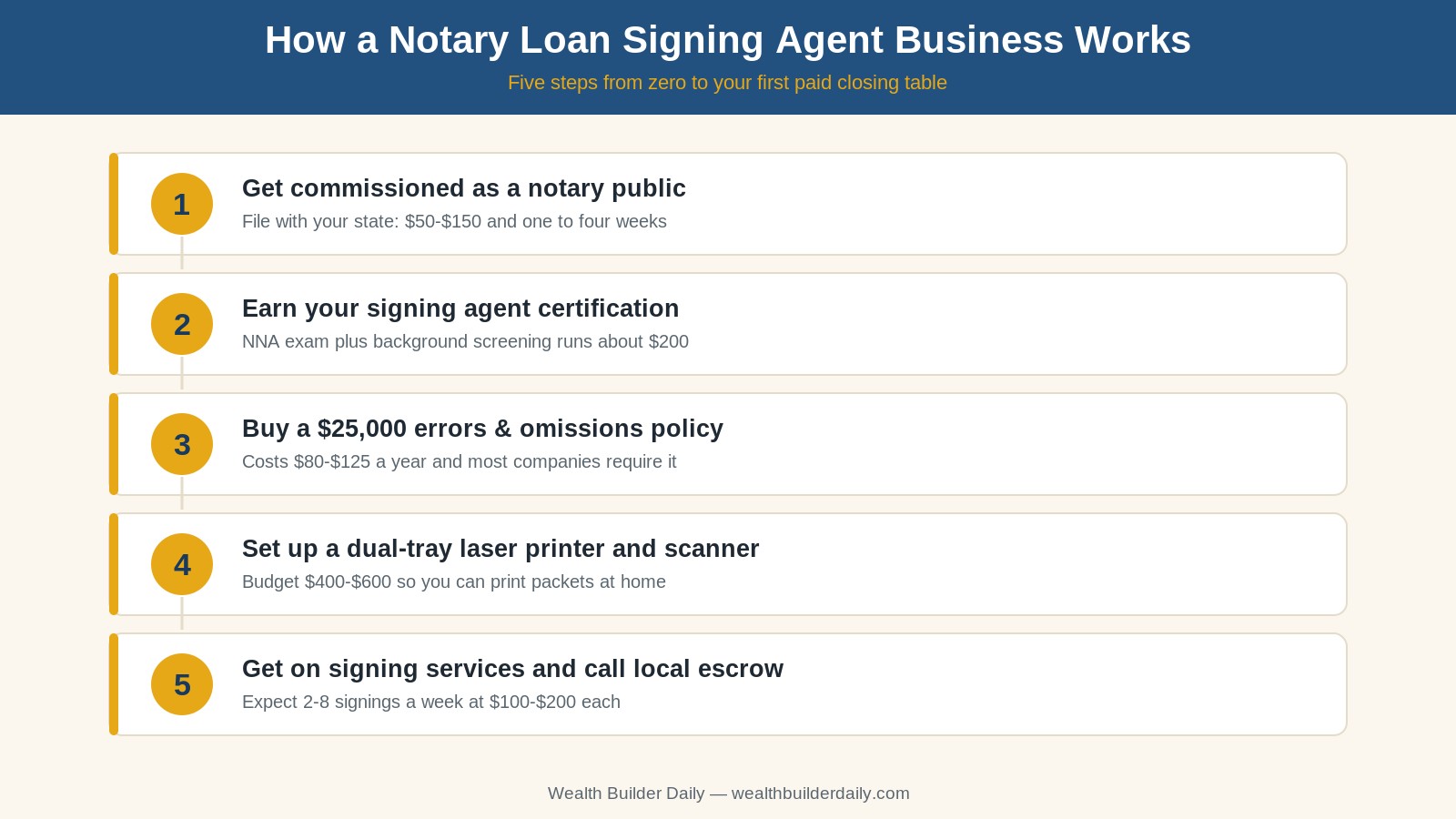
- Your notary commission. Issued by your state, usually good for four to ten years. This is the legal foundation of everything else.
- Signing agent certification. Not a government license. It is an industry credential — an exam plus an annual background screening — that title companies use to vet you.
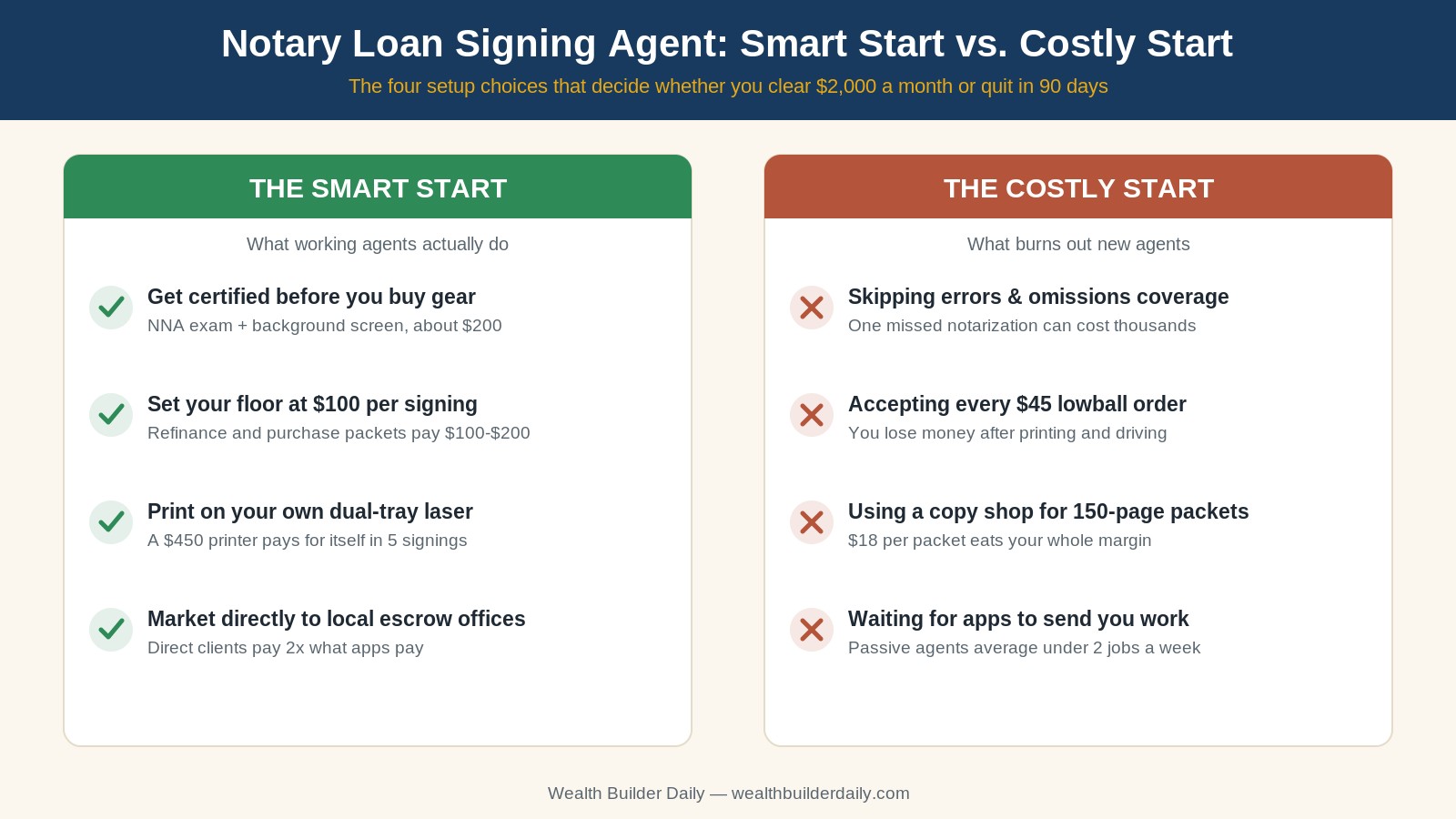
- Errors and omissions insurance. A $25,000 policy is the standard requirement and typically costs $80 to $125 a year.
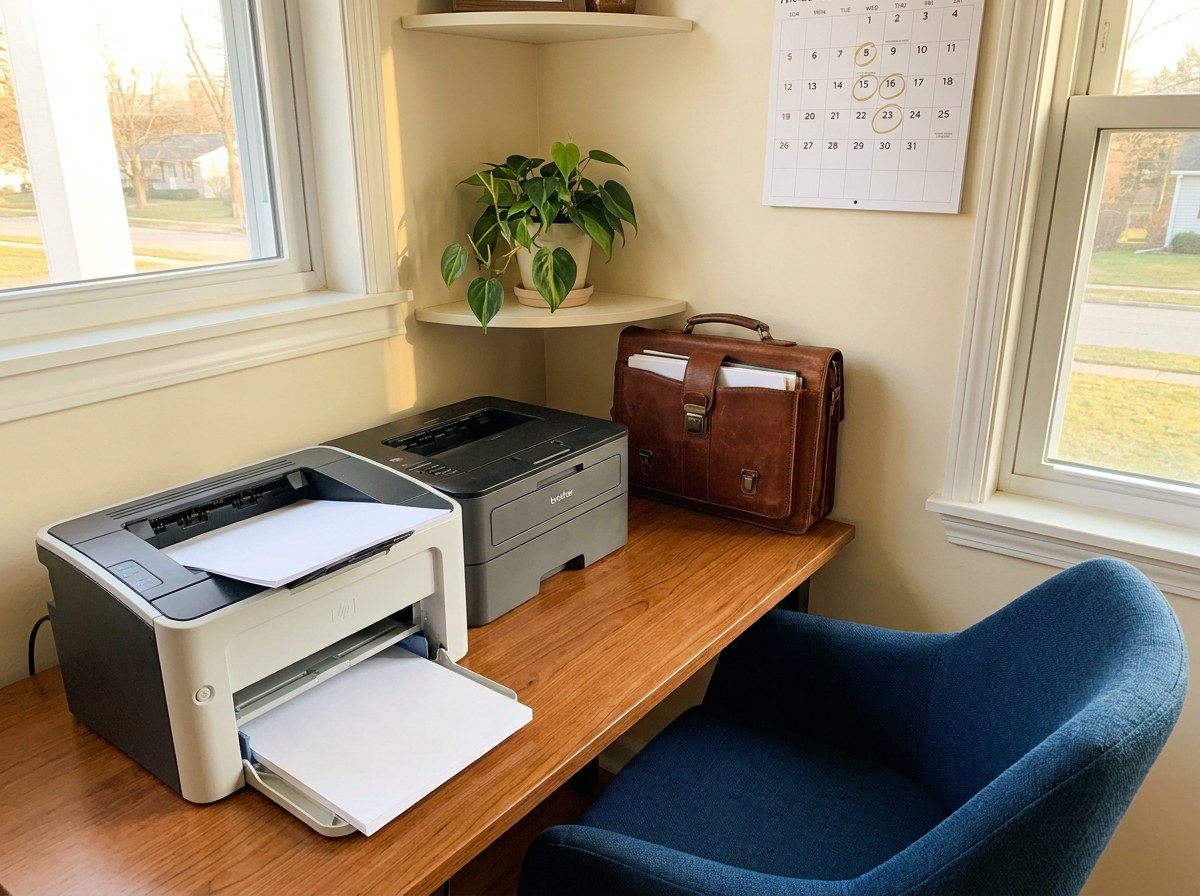
- A dual-tray laser printer. Loan packets mix letter and legal paper. Manually swapping trays for every packet is the fastest way to hate this job.
- A referral reputation. Escrow officers rebook the agent who returned a clean packet on time. That is the entire marketing strategy.
How to Choose the Right Way Into Signing Work
Not every path into this business pays the same. Use these six criteria to decide how to set yourself up before you spend a dollar.
-
Check your state's notary rules first. Commission costs range from about $50 to $150, and a handful of states cap what a notary may charge per notarial act. That cap does not limit your signing fee, but it changes how you itemize your invoice. Confirm the rules before you plan your pricing.
-
Decide between signing services and direct clients. Signing services send steady volume at lower fees, often $75 to $110. Title and escrow offices you contact directly typically pay $125 to $200 because there is no middleman. Most working agents run both: services for the base, direct clients for the margin.
-
Buy the printer before you buy a course. A dual-tray monochrome laser printer runs $400 to $600 and pays for itself in roughly five signings. A $700 certification course does not print your packets. If you have to choose one in month one, choose the printer.
-
Get certified through a recognized provider. The National Notary Association exam plus background screening runs about $200 and is the credential most title companies check for. Some signing platforms require an annual re-screen, so treat it as a recurring cost, not a one-time fee.
-
Map your realistic radius. A $125 signing 45 minutes away is a $125 signing that costs you two hours of driving. Draw a 25-minute circle around your home and treat anything outside it as premium-only work.
-
Set your floor and hold it. New agents accept $45 orders to "build a reputation." Reputation is built by clean packets, not cheap ones, and the platforms that pay $45 will keep paying $45 forever.
Here is the number that decides whether this works for you: a single signing at $125 nets roughly $95 after $12 in printing, $8 in fuel, and shipping. Do four a week and that is about $1,520 a month in take-home side income for perhaps eight hours of appointments. That is real money, and it is why we treat this as a serious complement to strategies like earning $1,000 a month freelancing.
Mobile Notary vs. Loan Signing Agent
These get used interchangeably, and the difference matters to your income. A mobile notary travels to notarize anything — a power of attorney, an affidavit, a single form — and usually collects a state-capped fee plus a travel charge, often $25 to $75 total. A loan signing agent handles the full mortgage package and charges a flat professional fee for the entire appointment, which is why the pay is two to four times higher. Nearly every loan signing agent is also a mobile notary; the reverse is not true, and the certification is the difference.
Notary Signing Work for Every Situation
The right approach depends on how much time you actually have and what you need the money to do.
- You work a rigid 9-to-5. Take evening and Saturday appointments only, and tell your signing services your availability window up front. Two evenings a week is a realistic $800 to $1,000 a month. Route that money straight into a goal, like the plan in our guide to building an emergency fund.
- You are already self-employed or work from home. You can take daytime signings, which are less competitive and often better paid, and you can accept short-notice jobs that other agents decline. This is where $2,500 to $3,000 months come from.
- You are semi-retired or between jobs. Signing work has no employer, no schedule, and no ceiling on how slow you go. Many agents in this group pair it with something like a bookkeeping side hustle so their calendar is never empty.
Beginner, Intermediate, and Advanced Setups
Beginner (about $750). State commission, NNA certification and background screen, $25,000 errors and omissions policy, a used dual-tray laser printer, a basic embosser and stamp, and a $40 document bag. Take signing-service work only. Target two jobs a week.
Intermediate (about $1,400). Add a fast sheet-fed scanner, a second toner cartridge, a simple LLC and business bank account, and a one-page capability sheet you email to local escrow officers. Target four to six jobs a week with a mix of services and direct clients.
Advanced (about $2,500). Add a backup printer, a second commission if you live near a state line, RON — remote online notarization — credentials where your state permits it, and a scheduling system so title companies can book you directly. Target eight-plus jobs a week and treat it as a business, not a side hustle.
Personalizing Your Approach in 2026
Two things have changed the shape of this work heading into 2026. First, remote online notarization is now authorized in a large majority of states, which means a growing slice of signings happen over secure video from your desk with no drive time at all — but the platform fees are lower, so the trade is convenience for margin. Second, mortgage volume remains rate-sensitive, so a smart agent in 2026 builds relationships beyond refinances: purchase closings, home equity lines, reverse mortgages, and loan modifications all need the same signature. Diversify your client list and your calendar stops swinging with the headlines.
Frequently Asked Questions
How much does a notary loan signing agent make per year?
Part-time agents doing three to six signings a week typically gross $18,000 to $36,000 a year before expenses. Full-time agents with direct title relationships commonly reach $50,000 to $75,000. Your income depends far more on how many escrow officers know your name than on how many platforms you signed up for.
Do I need a real estate or lending background to do this?
No. You are a neutral witness, not an advisor, and explaining loan terms is explicitly outside your role. What you need is precision, punctuality, and comfort telling a borrower to call their loan officer with questions. The certification exam covers everything about the documents you actually need to know.
How quickly can I start earning after I apply?
Most people are taking paid signings within four to eight weeks. State commission processing is the long pole, typically one to four weeks, followed by certification and background screening in about a week and insurance in a day. Ordering your printer while you wait removes the last delay.
Final Thoughts
A notary loan signing agent business is one of the cleanest side-income setups available in 2026: a defined credential, a startup cost under $1,200, a per-job fee that respects your time, and clients who rebook you instead of making you start over every month. It will not make you rich in ninety days, but four appointments a week is a meaningful, durable raise — and it compounds when you reinvest it instead of spending it.
- Plain-language guidance. We explain the licensing, the paperwork, and the money without jargon or an upsell.
- Real numbers and real examples. Every figure here is a working range, not a best-case screenshot from a course sales page.
- Proven, time-tested methods. Notarization is a centuries-old function that every mortgage in the country still requires.
- Free, practical tools and guides. Our entire library is free, with no course to buy and no email wall.
Pick your start date, check your state's notary requirements this week, and let your first signing fee cover your certification. When you are ready for the next step, browse the rest of our free guides at Wealth Builder Daily, and review the mortgage-closing consumer protections published by the Consumer Financial Protection Bureau so you understand the process you are being paid to steward.
The Newsletter
Get the Free Budget Tracker
Join our weekly newsletter. Practical money guides, no fluff. Unsubscribe anytime.