

Bookkeeping Side Hustle: How to Make $2,000/Month Doing the Books in 2026
A bookkeeping side hustle is one of the most reliable ways to earn $1,500 to $2,000 a month from home in 2026, even if you've never balanced a business's books before. Small business owners are busy, they dread paperwork, and they will happily pay someone organized and dependable to keep their finances in order.
This guide is for anyone who likes numbers, order, and steady income — parents, career-changers, students, and full-time workers who want extra money on their own schedule. You'll learn which services to offer, what to charge, how to land your first clients, and how to grow a few one-time gigs into recurring monthly retainers that pay you the same money month after month.
Bookkeeping Side Hustle at a Glance
Bookkeeping pays well because it's a recurring need, not a one-time favor. Every business with income and expenses has to track them, and most owners would rather hand that off than do it themselves. Here's what the main services involve, what they pay in 2026, and who each one fits.
| Service | What It Involves | Typical Rate (2026) | Best For | | --- | --- | --- | --- | | Monthly bookkeeping | Categorize transactions, reconcile accounts, send reports | $300–$600 per client/month | Steady recurring income | | Catch-up cleanup | Fix months of messy or neglected books | $40–$75 per hour | Fast one-time cash | | Software setup | Set up QuickBooks or Xero from scratch | $300–$1,500 per project | Higher one-time fees | | Payroll add-on | Run payroll and handle basic filings | $75–$200 per month | Upselling existing clients |
A few things to know before you start:
- Recurring revenue is the goal. Just four monthly clients at $500 each is $2,000 a month — predictable income that shows up whether or not you chase new work that week.
- Startup cost is low. A laptop, reliable internet, and one software subscription are enough to begin; manage the uneven early income with our guide to budgeting on irregular income.
- You don't need to be an accountant. Bookkeeping records and organizes transactions; it isn't tax filing or CPA-level work. A short course is enough to start.
- Demand is steady year-round. Unlike seasonal gigs, businesses need their books kept every single month, which makes income easier to predict.
Why You Can Trust This Guide
At Wealth Builder Daily, we've spent years helping everyday people turn practical, in-demand skills into income that actually adds up. We've watched readers go from zero bookkeeping experience to a full roster of monthly clients by doing the unglamorous things well: getting certified, niching down, pricing with confidence, and delivering clean books on time. In this guide, we'll walk you through the exact steps, the real numbers, and the beginner mistakes that quietly cap your income — so you can build a bookkeeping side hustle that grows instead of stalling.
How a Bookkeeping Side Hustle Works
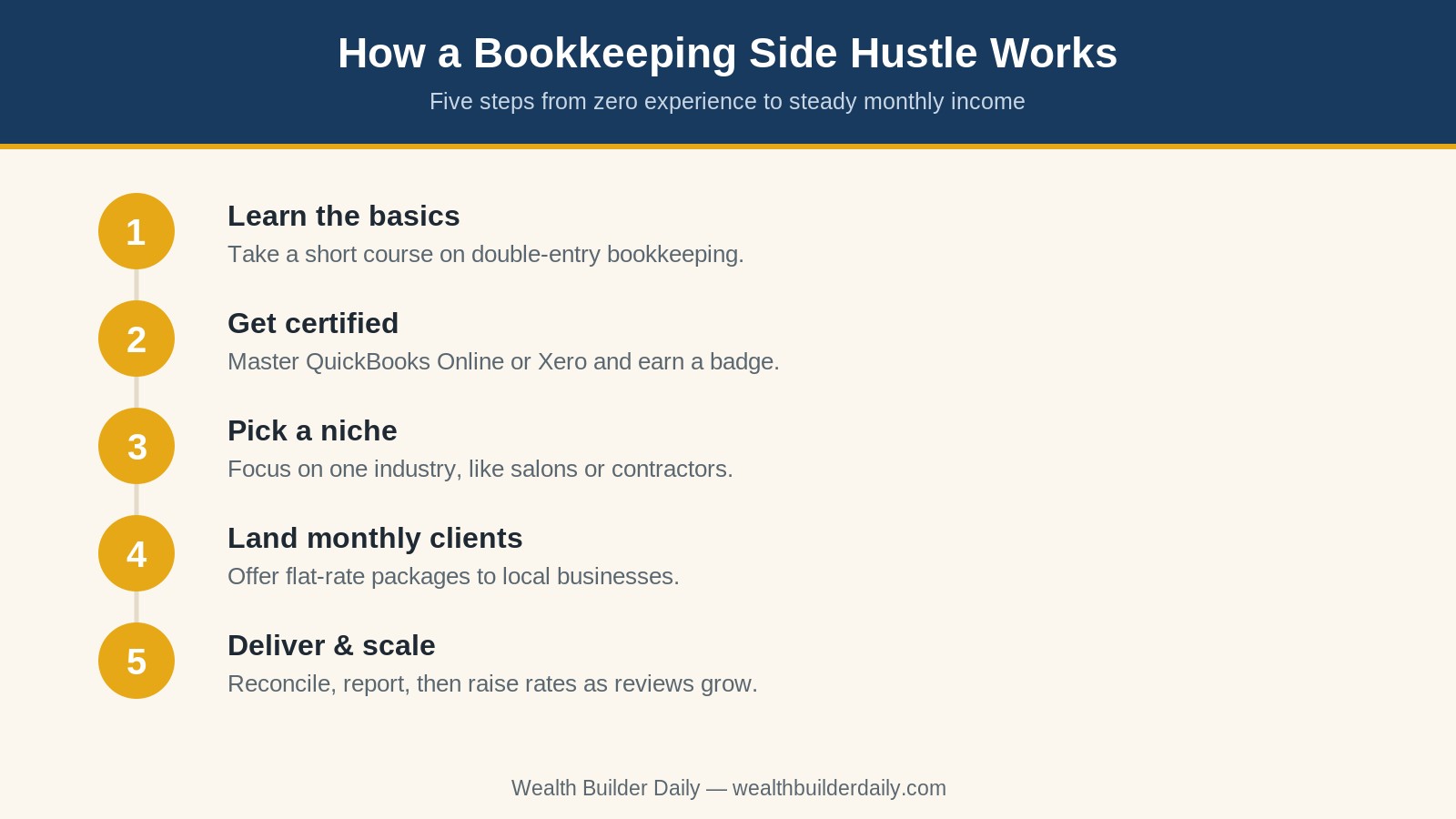
A bookkeeping side hustle works because it solves a problem owners can't ignore: their money has to be tracked, categorized, and reconciled, or their taxes and decisions fall apart. You take that weight off their plate. Each month you make sure every dollar in and out is recorded correctly, the bank statements match the books, and the owner gets a clean report they can actually understand.
Here's what the engine looks like under the hood:
- The software — a cloud tool like QuickBooks Online or Xero where the books live and update in real time.
- Bank feeds — automatic connections that pull in transactions so you're not typing everything by hand.
- Categorization — sorting each transaction into the right account, like rent, supplies, payroll, or income.
- Reconciliation — matching the books to the bank statement so nothing is missing or double-counted.
- Monthly reports — the profit-and-loss and balance sheet you deliver so the owner always knows where they stand.
The real money lives in the recurring nature of the work. A one-time cleanup might pay you $600, but that same client kept on a monthly retainer can pay you $500 every month for years — and they tend to refer their business friends. Modern software does the heavy lifting now: bank feeds import transactions automatically, and rules can categorize the repetitive ones for you. Your job is accuracy, consistency, and clear communication. Before your first client, get fluent in one software platform, build a simple folder system for documents, and create a monthly checklist so every client gets the same dependable service.
How to Choose the Right Bookkeeping Niche
You don't have to serve everyone. The bookkeepers who earn the most pick a focus and become known for it. A niche makes your marketing sharper, your work faster, and your rates higher. Use these criteria to decide where to aim.
- Pick an industry you already understand. Salons, contractors, restaurants, e-commerce sellers, and real estate agents all need books kept. If you've worked in or around one of these, you already know its language and quirks — and that head start wins trust.
- Match the work to your schedule. Monthly bookkeeping spreads evenly across the month, while catch-up projects come in bursts. If you have a day job, recurring monthly work is easier to plan around than rush cleanups.
- Go where the money already is. Profitable businesses pay on time and value clean books. A busy plumbing company or a growing online store is a better target than a brand-new business still finding its feet.
- Choose one software and master it. QuickBooks Online has the largest market share, while Xero is popular with newer businesses. Get certified in one before you spread yourself thin across several.
- Check the competition and local rates. Search how other bookkeepers in your niche price and present themselves, then position yourself clearly. You don't need to be the cheapest — you need to be the most reliable.
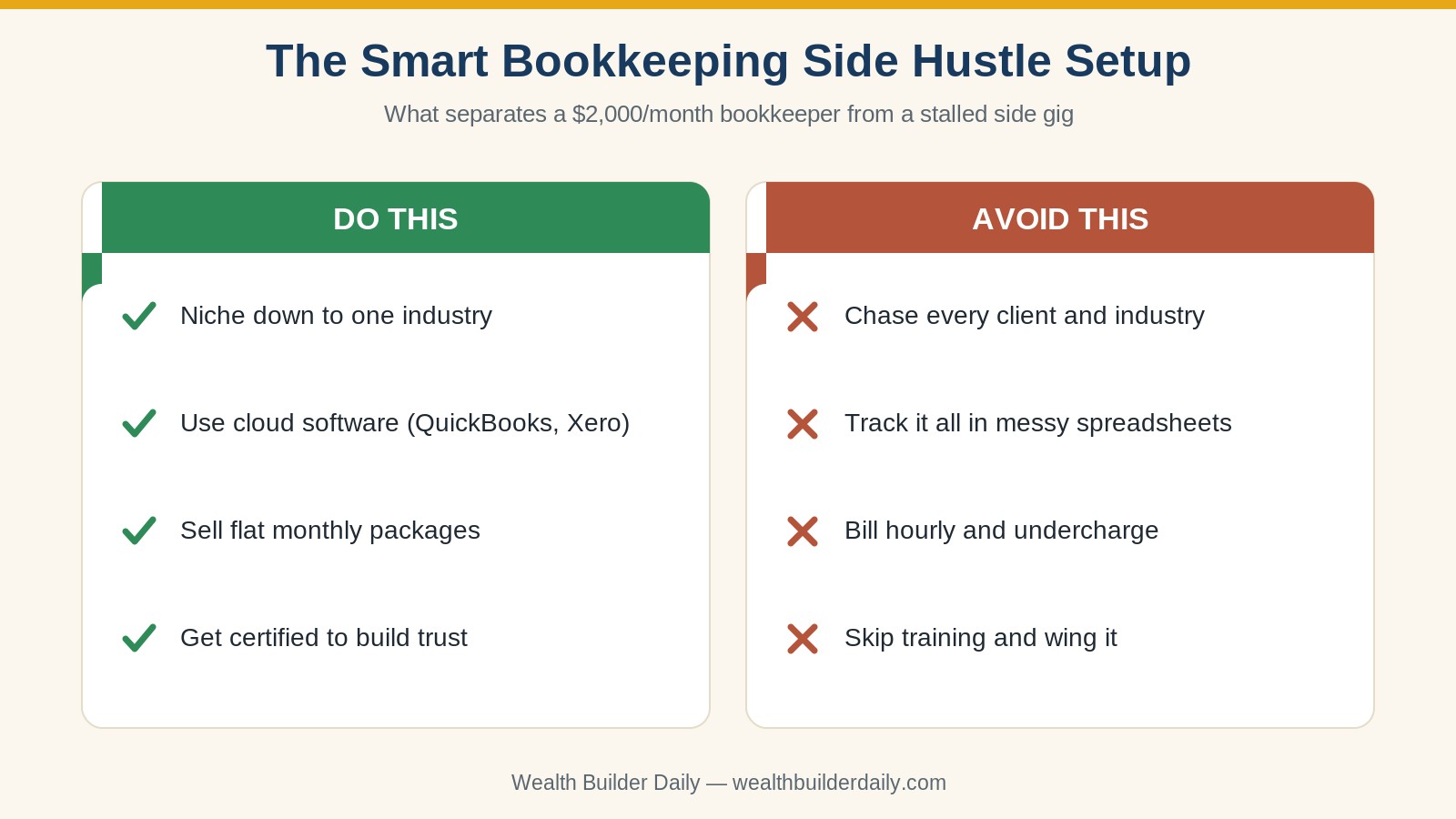
A quick expert tip: price in flat monthly packages, not hourly. When you charge $450 a month for a defined scope, you get paid for results instead of being punished for getting faster. As software automates more of the routine work, hourly billing quietly shrinks your income — packages protect it. If you want to think through how this income fits your bigger money plan, see our financial order of operations guide.
Certification vs. Experience: What Matters More
Beginners often freeze here, but the answer is simple: start with a certification, then let real clients build your experience. A recognized course or software certification gives you the credibility to land your first few clients, and those clients give you the hands-on reps that turn you into a pro. You don't need both before you begin — you need enough knowledge to do honest, accurate work, and the discipline to keep learning as you go.
Bookkeeping Side Hustle for Every Situation
The beauty of this work is how well it bends around your life. Whether you want a small weekend income stream or a path to full-time self-employment, the model scales with you.

Here's how different people make it work:
- The busy parent wants flexible, predictable hours. Two or three monthly clients fit neatly into nap times and evenings, and the work pairs well with other flexible income like a freelance side hustle.
- The career-changer wants a real exit ramp. They build a roster of monthly clients on the side, then go full-time once the income matches their salary — a far safer leap than quitting first.
- The online freelancer already lives on platforms and wants to add a steadier stream. They can find bookkeeping work the same way many do other gigs, including on marketplaces covered in our Upwork freelancing guide.
Beginner, Intermediate, and Advanced Setups
A beginner setup is one software certification, one niche, and a goal of two clients in your first 90 days. An intermediate setup adds standardized monthly checklists, simple contracts, and a waitlist so you're never scrambling. An advanced setup layers in payroll and cleanup upsells, raises rates yearly, and may even bring on a second bookkeeper so you earn from work you don't personally do.
Personalizing Your Bookkeeping Business in 2026
The smartest move in 2026 is to lean on automation without leaning on it blindly. Let bank feeds and categorization rules handle the repetitive entries, then spend your time on the judgment calls and the client relationship — that's the part owners actually pay a premium for. Keep an emergency cushion while you ramp; our emergency fund guide shows how to build a buffer so a slow month never rattles you.
Frequently Asked Questions
Do I need a degree or license to start a bookkeeping side hustle?
No. Bookkeeping does not require a degree or a government license in most places. What clients want is accuracy and trust, which you can prove with a short certification course and software credentials in QuickBooks Online or Xero. A degree helps your confidence, but real, reliable work is what actually wins and keeps clients.
How many clients do I need to make $2,000 a month?
Usually just four to seven, depending on your pricing. At $500 per client per month, four monthly clients reach $2,000. If you charge $300 for smaller businesses, you'll need closer to seven. Because the income recurs, you build to that number once and then it largely repeats every month with steady, dependable work.
How long does it take to get my first bookkeeping client?
Most beginners land their first client within four to eight weeks of finishing a certification. Speed depends on how actively you reach out to local businesses, your network, and online marketplaces. Offering a one-time catch-up cleanup is often the fastest entry point, because it solves an urgent pain and frequently converts into a monthly retainer afterward.
Final Thoughts
A bookkeeping side hustle rewards the exact traits many people already have: attention to detail, reliability, and a little patience with numbers. Get certified in one software, pick a niche, price in monthly packages, and deliver clean books on time — do that, and four to seven steady clients can turn into a dependable $2,000 a month in 2026, without a degree or a big upfront investment.
Here's why thousands of readers trust Wealth Builder Daily to guide their money moves:
- Plain-language guidance. We explain bookkeeping, pricing, and client-getting in clear terms, with no confusing jargon.
- Real numbers and examples. Every rate, package, and income target here reflects what bookkeepers actually charge and earn.
- Proven, time-tested methods. Niching down, recurring retainers, and certification-first are strategies that have built real businesses for years.
- Free, practical tools and guides. Our library is full of step-by-step resources you can use today, at no cost.
Your next step is simple: pick one software, find one short certification course, and commit to reaching out to five local businesses this month. The sooner you start, the sooner those first clients become recurring income. Explore more beginner-friendly money guides on the Wealth Builder Daily blog, and for trustworthy small-business basics, the U.S. Small Business Administration is a solid, free resource as you set up shop.
The Newsletter
Get the Free Budget Tracker
Join our weekly newsletter. Practical money guides, no fluff. Unsubscribe anytime.