

Lower Your Monthly Bills: How to Save $300+ a Month in 2026
The fastest way to lower your monthly bills is a simple three-part move: audit every recurring charge, cancel what you don't actually use, and negotiate the rest — and most households can free up $200 to $400 a month with a single afternoon of effort.
This guide is for anyone whose paycheck feels smaller than it should. You don't need a raise, a side hustle, or a stricter budget to find this money. It's already leaving your account every month — you just have to go get it back. Below, you'll find the exact bills worth attacking first, the scripts that work on the phone, and a repeatable 90-day system that keeps the savings from creeping back.
Lowering Your Monthly Bills at a Glance
If you only have 20 minutes today, start with the biggest recurring charges and work down. Here's what a typical household can expect to save from each category in 2026, based on the most common wins we see.
| Bill Category | Typical Monthly Savings | Time It Takes | Best First Move | |---|---|---|---| | Auto & home insurance | $40–$100 | 45 minutes | Get 3 fresh quotes and re-shop every 12 months | | Cell phone | $30–$80 | 30 minutes | Switch to a budget carrier on the same network | | Subscriptions & streaming | $30–$70 | 15 minutes | Cancel unused services, rotate the rest | | Internet & cable | $20–$60 | 20-minute call | Ask for the current new-customer rate | | Energy & utilities | $15–$40 | 1 hour | Set a thermostat schedule, enroll in budget billing |
A few quick facts before you pick up the phone:
- Add up the "typical savings" column and the full sweep is worth $135–$350 a month — $1,620 to $4,200 a year.
- The average household pays for more than 4 subscriptions it rarely or never uses, often $50+ a month in silent waste.
- Retention departments exist specifically to keep you from leaving — which means they're allowed to offer discounts the regular customer service line can't.
- Freed-up cash only builds wealth if you give it a job. A zero-based budget makes sure every recovered dollar gets assigned before it disappears.
At Wealth Builder Daily, we've spent years helping everyday people find money they didn't know they were losing — and recurring bills are the single most reliable place to look. In this guide, we'll walk you through the exact audit-cancel-negotiate system we recommend, including which bills respond to a phone call, which ones require switching, and how to lock in the savings so your budget actually feels the difference.
How to Lower Your Monthly Bills: The Bill Audit Method
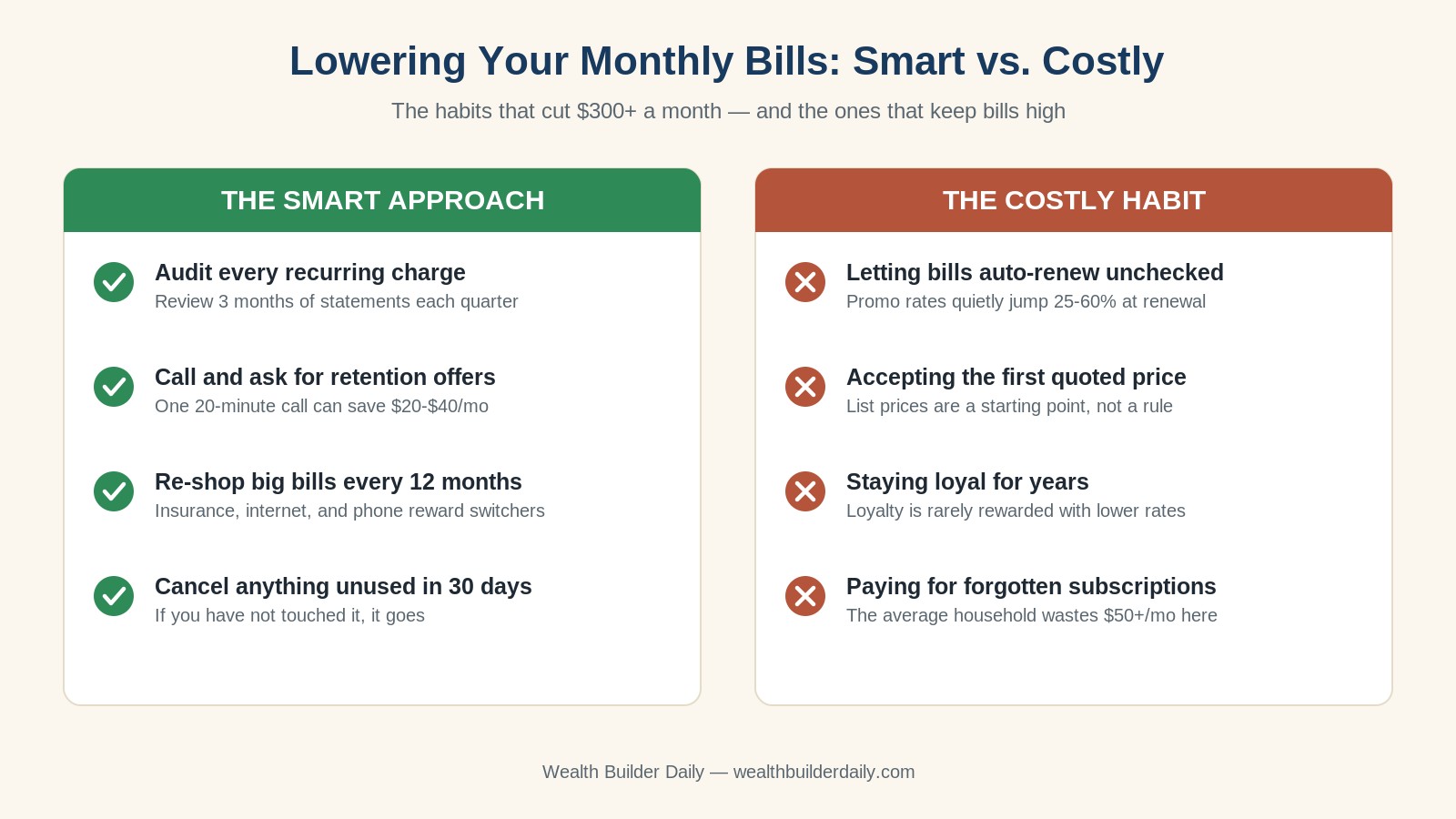
The reason most people overpay isn't carelessness — it's design. Companies price their services with "loyalty drift" built in: you sign up at an attractive promo rate, the promo quietly expires, and the price climbs 25–60% while the service stays exactly the same. Auto-pay makes the increase invisible. Multiply that pattern across eight or ten recurring bills and you get a budget that leaks hundreds of dollars a month with nothing to show for it.
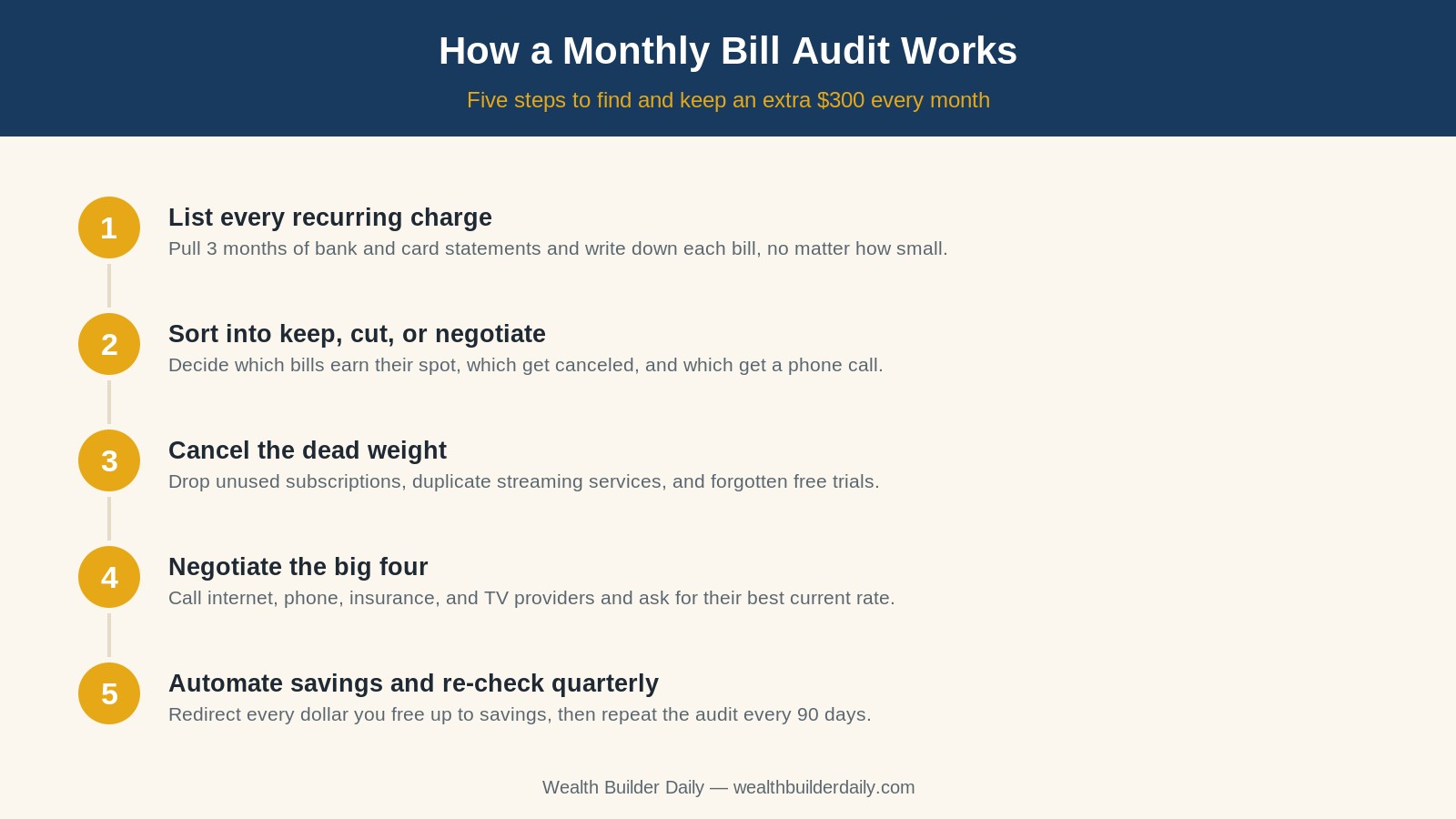
The bill audit method reverses that design. Instead of letting prices drift up automatically, you create a system where every recurring charge has to re-earn its place on your statement. Here's what makes it work:
- Visibility first. You can't cut what you can't see. Pulling 3 months of statements surfaces every charge, including the $7.99 ones that hide in plain sight.
- Three buckets, no exceptions. Every bill gets sorted: keep (it earns its cost), cut (cancel today), or negotiate (call and push for a better rate).
- Leverage on the phone. Competition is your bargaining chip. In 2026, insurers, carriers, and internet providers are all fighting for switchers, and a polite "I'm considering leaving" unlocks their best offers.
- A 90-day repeat cycle. Prices drift back up — so the audit runs quarterly. After the first pass, each repeat takes 30 minutes or less.
How to Choose Which Bills to Tackle First
Not all bills deserve equal effort. Use these five criteria to decide where your next hour goes:
-
Dollar size of the bill. A 20% win on a $200 insurance bill beats a 50% win on a $15 subscription. Start with your three largest recurring charges — for most households that's insurance, phone, and internet.
-
How long since you last shopped it. Any bill you haven't re-quoted in 18+ months is almost certainly overpriced. The longer it's been, the bigger the gap between your rate and the current market rate.
-
Whether a competitor exists. Negotiation only works when leaving is a real option. Two or more providers in your area? Call with confidence. A utility monopoly? Skip the haggling and focus on usage instead.
-
Contract status. Off-contract bills can be renegotiated today. If there's an early termination fee, do the math — a $150 fee is worth paying if switching saves $40 a month, because you break even in under four months.
-
Effort-to-savings ratio. Canceling a subscription takes two minutes and saves the full amount forever. Do all the two-minute wins first, then book the phone calls.
Here's the expert tip that separates people who save for a month from people who save for years: the moment a bill drops, redirect the difference automatically. If your insurance falls from $220 to $160, set up a $60 automatic transfer to savings on the same day — the exact pay-yourself-first move that turns a pricing win into actual wealth. A $300 monthly redirect is $3,600 a year before interest.
Negotiating vs. Switching Providers
Negotiating means calling your current provider and asking for a better rate; switching means moving to a competitor. Negotiate first when you like the service — it's faster, and retention offers in 2026 are aggressive. Switch when the provider won't budge, when a competitor's standard rate beats your negotiated rate, or when you're being charged for equipment and fees a competitor doesn't have. The real power move is being sincerely ready to switch: providers can hear the difference between a bluff and a customer with a competitor's quote in hand.
Lowering Bills for Every Situation

The audit works at every income level, but the highest-value targets shift with your situation:
- Tight budget, every dollar counts: Go straight for subscriptions and phone service — they're the fastest wins and require no credit check or new contract. If utilities are the pain point, federal programs listed at usa.gov's utility help page can reduce energy costs for qualifying households.
- Dual-income household with bill sprawl: Your risk is duplication — two music services, overlapping streaming, unused family plans. Merge accounts, move to family tiers, and route the recovered cash toward your emergency fund.
- Higher earner who "doesn't have time": You have the most loyalty drift because you've shopped bills the least. One annual afternoon re-quoting insurance alone is often worth $500–$1,200 a year — a better hourly rate than most consulting work.
Beginner, Intermediate, and Advanced Setups
Beginner: Do the two-minute wins. Cancel every subscription you haven't used in 30 days and switch one streaming service to an ad-supported tier. Typical result: $40–$80 a month, no phone calls required.
Intermediate: Run the full five-step audit. Make the big-four calls (internet, phone, insurance, TV) and re-shop insurance with three quotes. Typical result: $150–$300 a month.
Advanced: Systematize it. Calendar a quarterly 30-minute audit, keep a simple spreadsheet of every bill's rate and renewal date, rotate streaming services seasonally, and park the freed-up cash in a high-yield savings account so the savings themselves earn 4%+.
Personalizing Your Bill Strategy in 2026
Pricing in 2026 rewards the proactive. Insurers now re-price policies dynamically, carriers launch new budget plans every quarter, and streaming services have quietly raised prices while adding cheaper ad-supported tiers most subscribers never check. That churn is good news for auditors: the gap between "default price" and "best available price" is wider than it's been in years. Set a recurring calendar reminder for the 1st of January, April, July, and October, and treat those four half-hours as some of the best-paid time on your calendar.
Frequently Asked Questions
How much can I really save by negotiating my bills?
Most households that make the big-four calls — internet, cell phone, insurance, and TV — save $100 to $300 a month combined. Individual results depend on how long you've been overpaying and whether competitors serve your area. Even a single successful call typically trims $20 to $60 off one monthly bill.
Does canceling subscriptions or switching providers hurt my credit score?
Canceling subscriptions has no effect on your credit — they aren't credit accounts. Switching phone, internet, or insurance providers doesn't hurt your score either, though a new provider may run a soft check that doesn't affect it. The one caution: keep old bills paid through the switch date, since unpaid final balances can go to collections.
How often should I audit my monthly bills?
Run a full audit once, then repeat a lighter 30-minute version every 90 days. Quarterly is the sweet spot because promo rates commonly expire in 3 to 12 month cycles, and new charges have a way of sneaking in. Re-shop insurance annually and set renewal-date reminders so nothing auto-renews at a jumped price.
Final Thoughts
Lowering your monthly bills is the rare money move that pays like a raise but requires no new income, no lifestyle sacrifice, and no willpower after the initial effort. One afternoon of auditing, a handful of phone calls, and a quarterly check-in can permanently redirect $300 or more a month from corporate revenue back into your own accounts — exactly the outcome this guide promised at the top.
Here's why readers trust Wealth Builder Daily for this stuff:
- Plain-language guidance: No jargon, no fine print — just steps you can act on the same day you read them.
- Real numbers and examples: Every savings range in this guide reflects what typical households actually achieve, not best-case marketing.
- Proven, time-tested methods: Audit, cancel, negotiate isn't a hack — it's how careful money managers have kept costs down for decades.
- Free practical tools and guides: From budgeting frameworks to savings account picks, everything we publish is free to use.
Your bills will keep drifting upward in 2026 whether you act or not — so pick your biggest one and make the first call this week. When the savings land, give every dollar a destination with the guides at wealthbuilderdaily.com/blog, and if a provider ever won't play fair, know your rights as a consumer at the Consumer Financial Protection Bureau.
The Newsletter
Get the Free Budget Tracker
Join our weekly newsletter. Practical money guides, no fluff. Unsubscribe anytime.