

Tax-Efficient Investing: How to Keep Thousands More of Your Returns in 2026
Tax-efficient investing is the practice of holding the right investments in the right accounts so that less of your return goes to the IRS and more of it stays compounding for you. It is not a loophole, it is not aggressive, and it does not require a single change to what you actually own — only to where you own it and when you sell it.
This guide is for anyone who has money in a 401(k) or IRA and has started adding to a regular brokerage account too. That is the moment tax efficiency starts to matter, because for the first time your investments are generating tax bills you have to pay every April. We will walk through where each type of investment belongs, how long-term capital gains work, how to harvest losses without breaking the rules, and the order to pull money out in retirement.
Tax-Efficient Investing at a Glance
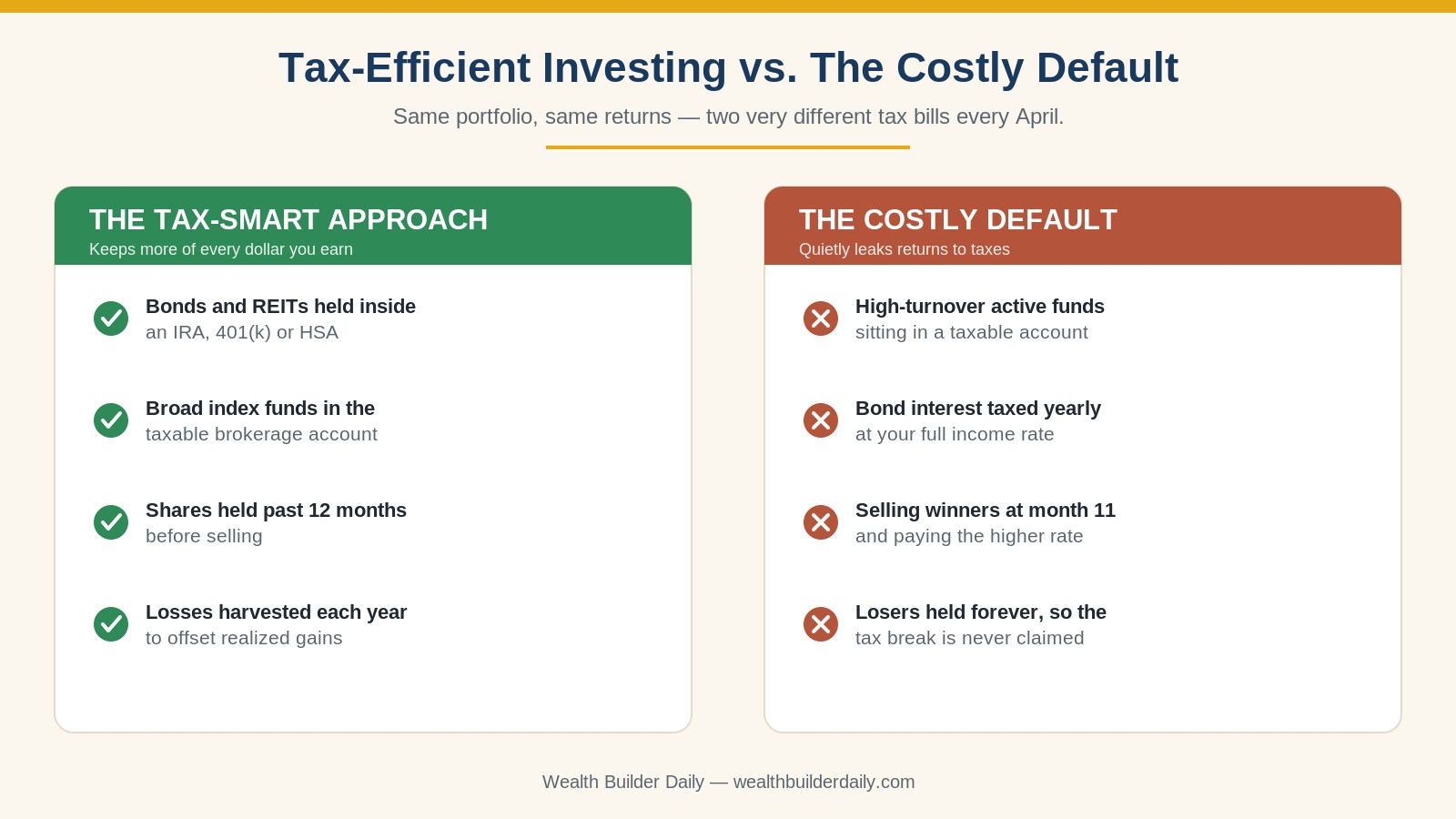
The short answer: put your tax-heavy investments inside retirement accounts, keep broad index funds in your taxable brokerage account, hold shares longer than one year before selling, and use your losses instead of ignoring them. Do those four things and you have captured most of the available benefit.
| Investment | Best Account | Why It Belongs There | |---|---|---| | Bond funds and CDs | 401(k), Traditional IRA | Interest is taxed at your full income rate every year | | REITs | Roth IRA, 401(k) | Most REIT dividends are non-qualified and taxed as income | | Broad index funds and ETFs | Taxable brokerage | Very low turnover means almost no forced capital gains | | High-turnover active funds | Any retirement account | Frequent trading creates surprise year-end distributions | | Individual growth stocks | Taxable brokerage | You control the timing of every sale, so you control the tax |
Quick facts worth knowing before you start:
- Long-term capital gains — profits on anything held more than 12 months — are taxed at 0%, 15%, or 20% in 2026, while short-term gains are taxed at your ordinary income rate, which can reach 37%.
- Qualified dividends get the same favorable long-term rates; ordinary dividends and bond interest do not.
- You can deduct up to $3,000 of net capital losses against ordinary income each year, and carry the rest forward indefinitely.
- Nothing inside a 401(k), IRA, or HSA generates a tax bill while it stays there, no matter how much you buy and sell.
Why We Wrote This Guide
At Wealth Builder Daily, we've spent years helping everyday people move from "I finally started investing" to "I'm actually keeping what I earn." The pattern we see over and over is the same: someone does the hard part beautifully — they automate contributions, they choose low-cost funds, they stay invested through a rough quarter — and then quietly hands back a meaningful slice of the result because nobody ever told them that account placement matters. In this guide, we'll show you exactly which investments belong in which account, how to calculate what a placement mistake is costing you, and the two or three moves that deliver almost all of the benefit without adding complexity to your life.
How Tax-Efficient Investing Works
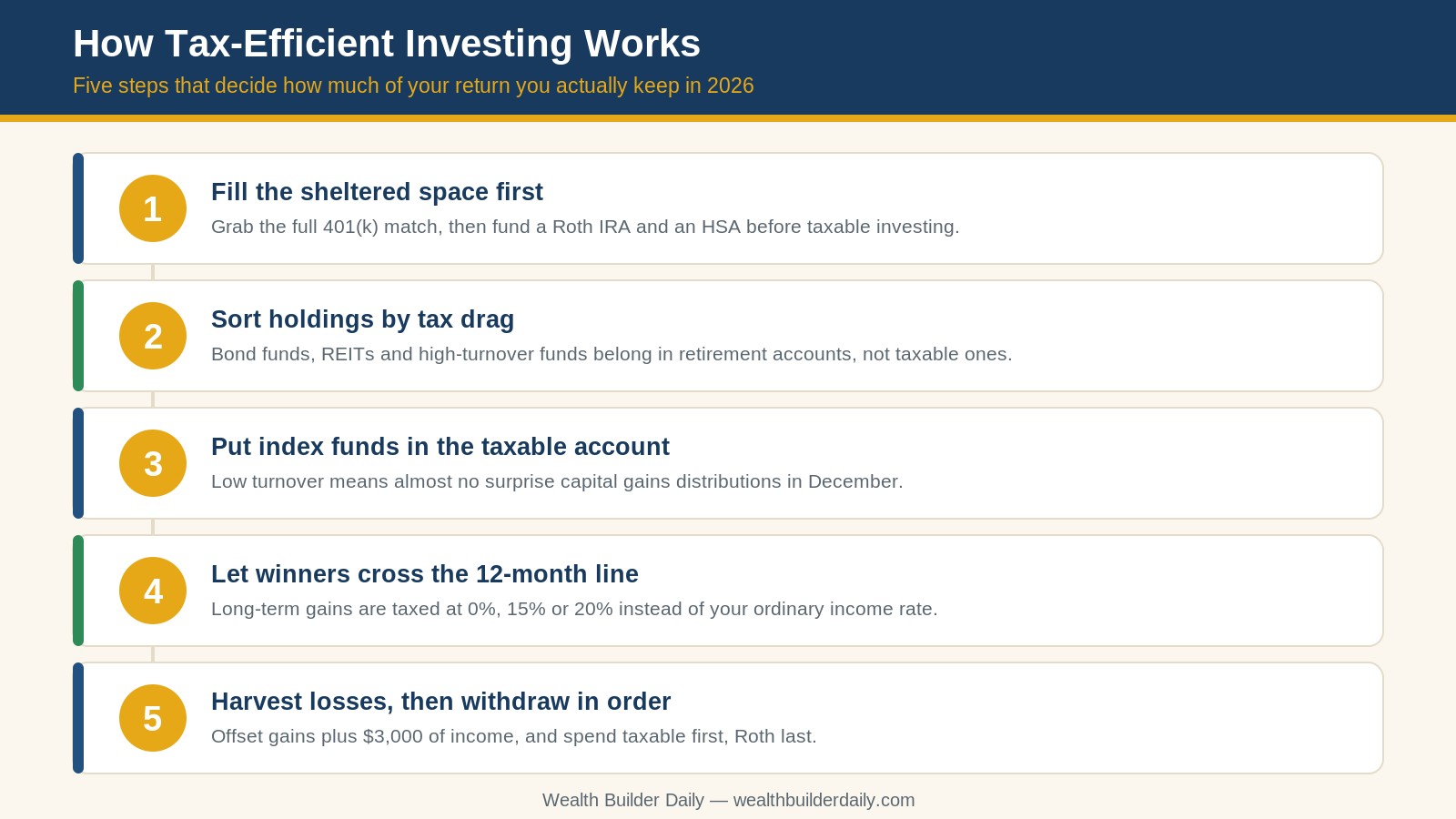
Every investment you own produces two kinds of taxable events. The first is income the investment throws off while you hold it — dividends, interest, capital gains distributions from a fund. The second is the gain you realize when you finally sell. Tax-efficient investing works by minimizing the first category and controlling the timing of the second.
The key insight is that different investments produce wildly different amounts of category-one income. A total stock market index fund might distribute 1.3% in qualified dividends a year and almost nothing in capital gains. A corporate bond fund yielding 5% distributes all of that as ordinary interest, taxed at your full rate, every single year, whether you wanted the money or not. Put the bond fund in a taxable account and you pay tax annually on income you are immediately reinvesting. Put it in an IRA and that same income compounds untouched.
Here are the components that determine your real, after-tax return:
- Turnover. How often the fund manager buys and sells inside the fund. A total market index fund runs 2–4% turnover a year. An actively managed fund can run 80% or more, and every sale it makes creates a distribution you owe tax on even if you never sold a share yourself.
- Distribution character. Qualified dividends and long-term gains are taxed at 0/15/20%. Ordinary interest, non-qualified dividends, and short-term gains are taxed at your marginal rate.
- Holding period. The 12-month line between short-term and long-term is the single largest tax lever most investors control.
- Account type. Tax-deferred (401(k), Traditional IRA), tax-free (Roth, HSA), and taxable each treat that income completely differently.
- Withdrawal sequence. In retirement, the order you draw from accounts changes your lifetime tax bill by tens of thousands of dollars.
How to Choose the Right Setup for Your Money
You do not need a spreadsheet or an advisor to get this right. Work through these criteria in order and stop when you run out of accounts.
-
Start with the free money, always. Contribute enough to your 401(k) to capture the full employer match before you optimize anything else. A 50% match is an instant 50% return that no tax strategy can compete with. If you have not claimed yours, that is the first move.
-
Fill tax-advantaged space before taxable space. In 2026, that is your 401(k), a Roth or Traditional IRA, and an HSA if you have a high-deductible health plan. Money inside these accounts grows without an annual tax drag, so every dollar you can fit inside them is a dollar that compounds faster.
-
Place the tax-heavy assets inside shelters. Bond funds, REITs, high-yield holdings, and any actively managed fund with heavy turnover should live in your retirement accounts. This is called asset location, and it is the core of tax-efficient investing.
-
Fill the taxable account with broad, boring index funds. Total market and S&P 500 index funds and ETFs are naturally tax-efficient because they rarely sell anything. That is exactly what you want in the one account the IRS is watching every year.
-
Control the calendar on every sale. Before you sell anything in a taxable account, check the purchase date. Crossing the 12-month mark can cut the tax on that gain roughly in half.
-
Review losses once a year, in December. Any position trading below what you paid is a potential deduction. Selling it and buying a similar-but-not-identical fund keeps you invested while banking the loss.
Here is what this is actually worth. Say you hold $60,000 of a bond fund yielding 5%, or $3,000 of annual interest, and you are in the 24% federal bracket. Held in a taxable account, that interest costs you about $720 a year in tax. Held in your IRA instead — with an index fund taking its place in the taxable account — that $720 stays invested. Over 20 years at a 7% return, that recurring difference compounds to roughly $31,000. You changed nothing about what you own. You only changed which account it sits in. If you are still deciding how much to invest versus how much to put toward debt, our guide on paying off debt or investing first covers that trade-off.
Roth vs. Traditional: Where the Growth Belongs
If you expect to be in the same or a higher tax bracket in retirement, the Roth is the better home for your highest-growth holdings, because everything that grows there comes out completely tax-free. If you expect a lower bracket later, the Traditional account wins, since you deduct at today's higher rate and withdraw at tomorrow's lower one. Most people in their 20s and 30s are earning below their peak, which is why the Roth usually gets the nod early in a career. If you are unsure, splitting contributions between both gives you flexibility to manage your bracket in retirement rather than betting everything on one guess about future tax law.
Tax-Efficient Investing for Every Situation

The right level of effort depends entirely on how much you have outside of retirement accounts. Find yourself below.
- Everything is in a 401(k) and IRA. You are already fully tax-efficient and there is nothing to fix. Nothing inside those accounts is taxed until you withdraw, so buy and rebalance freely. Focus your energy on contribution rate and keeping fund costs low instead.
- You have a taxable account under $25,000. Keep it simple: hold one or two broad index funds, let dividends reinvest, and do not sell anything before the 12-month mark. That single habit captures the majority of the available benefit.
- You have a taxable account over $100,000, or you own individual stocks. Now asset location and loss harvesting are worth real money. Move bond and REIT exposure into your retirement accounts, run a December review of unrealized losses, and pay attention to which specific tax lots you sell.
Beginner, Intermediate, and Advanced Setups
Beginner: One target-date fund or a total market index fund in each account. Nothing to optimize, nothing to break. If you are not sure your accounts are even open in the right order, our step-by-step brokerage account guide walks through it.
Intermediate: A three-fund portfolio where the bond fund lives entirely in your 401(k) or IRA, and the taxable account holds only broad stock index funds. Rebalance inside the retirement accounts so no rebalancing trade ever triggers a taxable gain.
Advanced: Specific-lot identification turned on at your brokerage so you can choose which shares to sell, annual tax-loss harvesting with a substitute fund to avoid the 30-day wash-sale rule, donating appreciated shares instead of cash to charity, and multi-year Roth conversions in low-income years.
Personalizing Your Approach in 2026
Two things make this personal. The first is your bracket: at lower income levels the long-term capital gains rate can be 0%, which means a single person with modest taxable income may be able to realize gains and legally owe nothing on them. The second is your timeline. If you will need this money in three years for a house down payment, the tax tail should not wag the dog — take the gain, pay the tax, and buy the house. Tax efficiency is a way to keep more of a long-term plan, not a reason to postpone a life you have already decided on.
Frequently Asked Questions
Does tax-efficient investing mean I should never sell?
No. It means you should be deliberate about when you sell. The main rule is to check whether you have held the shares longer than 12 months, because crossing that line moves the gain from ordinary income rates to long-term capital gains rates. If a sale genuinely improves your portfolio or funds a real goal, the tax is a cost of a good decision, not a reason to avoid it.
What is the wash-sale rule and how do I avoid breaking it?
If you sell an investment at a loss and buy the same or a "substantially identical" security within 30 days before or after that sale, the IRS disallows the loss. The standard workaround is to sell one broad index fund at a loss and immediately buy a different fund tracking a different index. You stay invested at nearly identical exposure while the loss still counts.
Do I owe taxes on gains inside my 401(k) or IRA?
Not while the money stays in the account. You can sell, rebalance, and switch funds inside a 401(k), Traditional IRA, or Roth IRA without generating any tax bill at all. Traditional accounts are taxed as ordinary income when you withdraw in retirement, while qualified Roth withdrawals come out entirely tax-free. That is why rebalancing belongs there.
Final Thoughts
Tax-efficient investing does not ask you to pick better funds, take more risk, or watch the market more closely. It asks one question: is each investment sitting in the account that treats it best? Answer that correctly and you keep thousands more of a return you were already going to earn. That is the closest thing to free money in investing, and it is available to anyone with more than one type of account.
- Plain-language guidance. No jargon dumps and no assumed background — we explain what a distribution is before we tell you what to do about one.
- Real numbers and real examples. Every strategy on this site comes with the math, so you can see what it is worth in your own situation before you act.
- Proven, time-tested methods. Asset location, long-term holding periods, and loss harvesting are decades-old, well-documented approaches, not trends.
- Free practical tools and guides. Step-by-step walkthroughs for every account type, always free, always written for people building wealth on a normal income.
Pick one thing this week. Open your taxable brokerage account, look at what is in it, and ask whether any of those holdings would be better off inside your IRA. That one review is often worth more than a year of market timing. When you are ready for the next step, our full library of investing and budgeting guides is waiting at Wealth Builder Daily, and you can confirm current-year capital gains brackets and contribution limits directly at Investor.gov, the SEC's free investor education site.
The Newsletter
Get the Free Budget Tracker
Join our weekly newsletter. Practical money guides, no fluff. Unsubscribe anytime.