

How to Rebalance Your Portfolio: The 20-Minute Habit That Protects Your Returns in 2026
If you want to know how to rebalance your portfolio, the short answer is this: once a year, compare what you actually own to the mix you meant to own, then sell a slice of whatever grew too big and buy whatever fell behind until the percentages match again.
That's it. No market predictions, no timing, no watching charts. This guide is for anyone who already has money in a 401(k), IRA, or brokerage account and has never gone back to check whether the mix still looks the way it did on day one. We'll cover when to rebalance, how to do it without triggering taxes, and the small number of decisions that actually matter.
Portfolio Rebalancing at a Glance
Rebalancing is portfolio maintenance, not portfolio strategy. Your investments grow at different speeds, so a mix you set years ago quietly shifts toward whatever performed best — usually stocks. Rebalancing pulls it back to the risk level you originally chose.
| Question | Short Answer | | --- | --- | | What is rebalancing? | Trading your holdings back to your target percentages | | How often should you do it? | Once a year, or when a holding drifts 5 percentage points off target | | How long does it take? | About 20 minutes once your target mix is written down | | Does it cost anything? | Usually $0 in fees; possible capital gains tax in a taxable account | | Where should you rebalance first? | Inside a 401(k) or IRA, where trades create no tax bill | | Does it boost returns? | Not reliably — it controls risk, which is the real point |
Three quick facts worth holding onto:
- A portfolio set at 70% stocks and 30% bonds ten years ago could easily sit near 85% stocks today without a single trade — a much riskier portfolio than the owner chose.
- Rebalancing forces you to sell high and buy low automatically, which is the opposite of what most people do under stress.
- If your money sits in a single target-date fund, the fund rebalances itself and you can skip the manual work entirely. Our guide to target-date funds explains how that works.
Why You Can Trust This Guide
At Wealth Builder Daily, we've spent years helping everyday investors turn vague intentions into simple, repeatable money routines — and rebalancing is one of the highest-value, lowest-effort habits we cover. We've watched too many readers discover that the "balanced" portfolio they built years ago had quietly become an all-stock portfolio right before they needed the money. In this guide, we'll walk you through the exact steps, the drift threshold that tells you when to act, and the account order that keeps the IRS out of it.
How Rebalancing Your Portfolio Actually Works
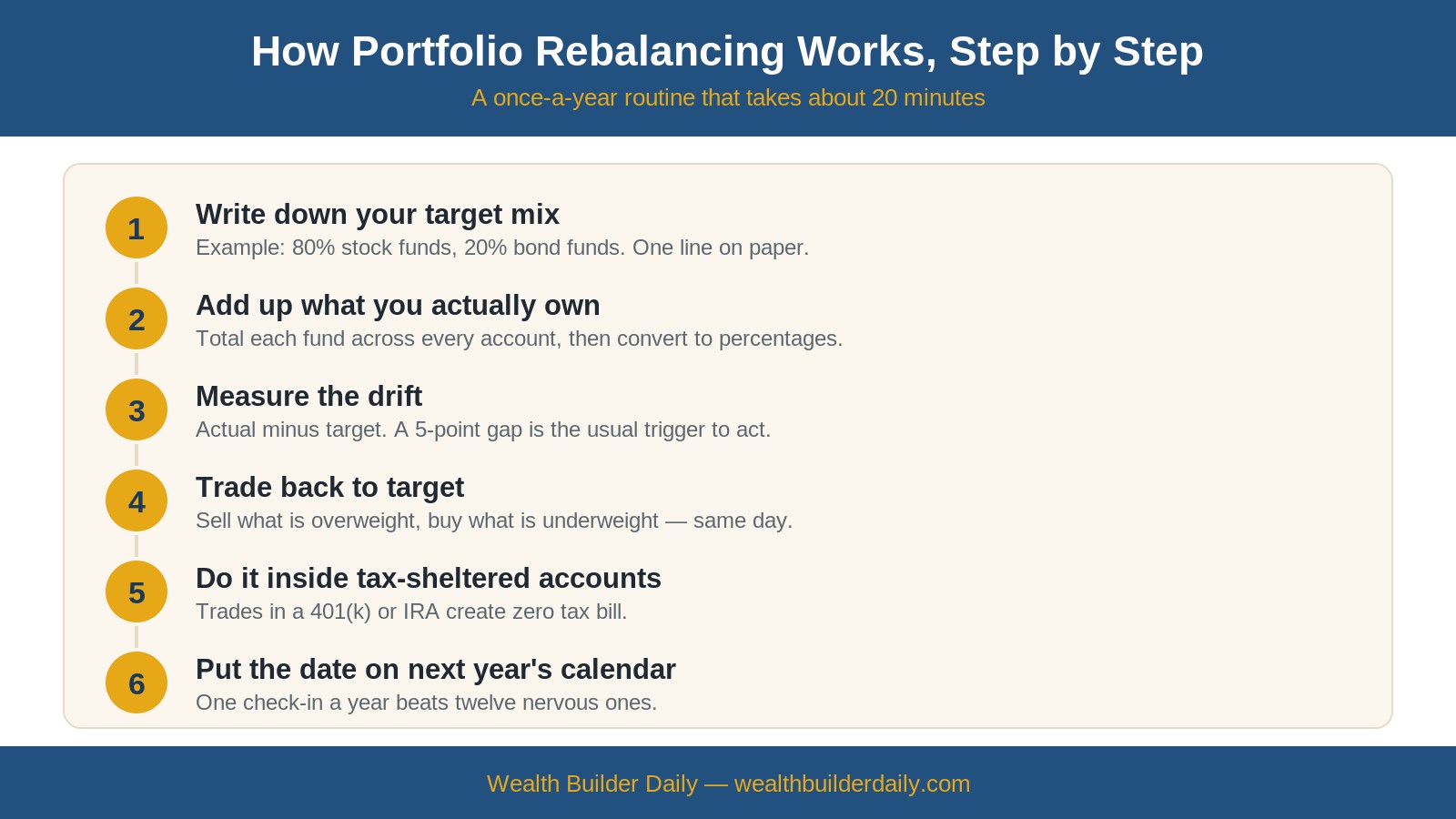
Start with the idea of a target mix. Say you decided on 80% stock funds and 20% bond funds. On the day you set it, your $50,000 account holds $40,000 in stocks and $10,000 in bonds. Clean.
Now let three years pass. Suppose stocks return roughly 11% a year and bonds return roughly 3%. Your stock side grows to about $54,700 and your bond side to about $10,900. Your account is now worth $65,600 — but the mix is 83% stocks and 17% bonds. You didn't decide to take more risk. The market decided for you.
Push that out a decade and the gap widens sharply. That's drift. Rebalancing closes it.
The key components:
- Target allocation — the stock/bond split you committed to, ideally written down somewhere you'll find it again.
- Actual allocation — what you hold today, added up across every account you own.
- Drift — the gap between the two, measured in percentage points, not dollars.
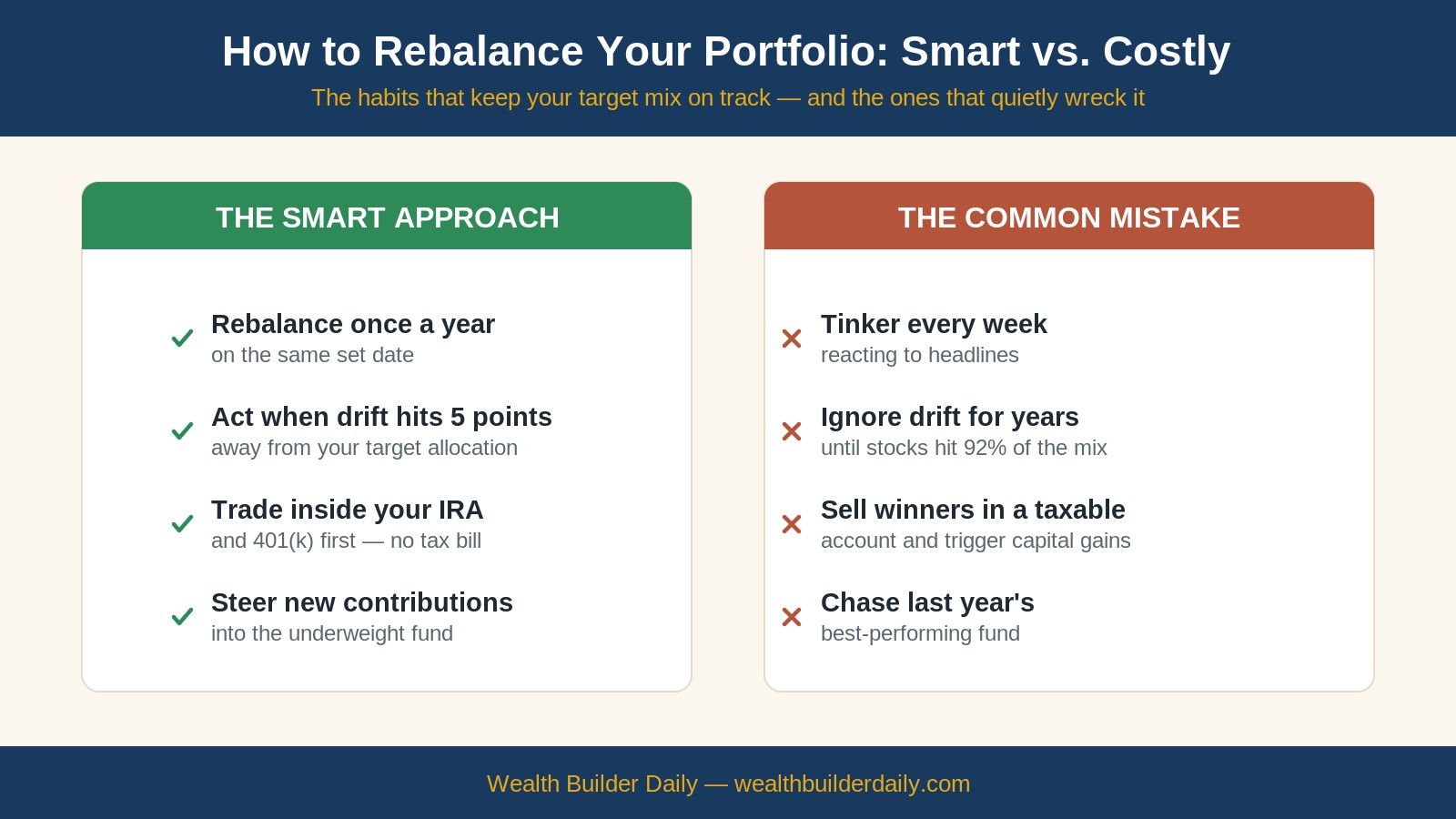
- Rebalancing band — the drift size that triggers action. Five percentage points is the common threshold; it filters out noise without letting big shifts slide.
- Trade direction — always sell the overweight asset and buy the underweight one, never the reverse.
The uncomfortable part is that rebalancing usually feels wrong. It asks you to trim the fund that just had a great year and add to the one that disappointed you. That discomfort is the mechanism working. You are being systematic instead of emotional, and over a long horizon that is worth real money.
How to Choose the Right Rebalancing Approach
There's no single correct method, but there are better and worse fits depending on your accounts and temperament. Work through these six decisions.
-
Pick your trigger: calendar or bands. Calendar rebalancing means you check on a set date — every January, or your birthday. Band rebalancing means you check periodically but only trade when drift exceeds 5 percentage points. Calendar is simpler; bands generate fewer unnecessary trades. Most people do best with a hybrid: check annually, act only if drift crosses 5 points.
-
Decide how often is often enough. Research on rebalancing frequency consistently finds that annual and quarterly schedules produce nearly identical long-run results. Monthly rebalancing adds cost and effort with no meaningful payoff. Once a year is the sweet spot for almost everyone.
-
Choose which accounts to trade in. Selling inside a 401(k), traditional IRA, or Roth IRA creates zero tax consequence. Selling inside a regular taxable brokerage account can create a capital gains bill. Always rebalance in tax-sheltered accounts first and only touch taxable accounts if you still can't reach your target.
-
Use new money before you use trades. If you contribute every month, you can often fix drift without selling anything. Point your next several contributions entirely at the underweight fund and let it catch up. This is the cheapest rebalancing method that exists.
-
Set a drift threshold you'll actually respect. Five percentage points is the standard. If you have a small account and a low tolerance for fiddling, widen it to 7 or 8 points. A threshold you'll ignore is worse than a wider one you'll honor.
-
Decide whether to automate it. Most robo-advisors and many 401(k) plans offer automatic rebalancing as a checkbox setting. If you know yourself well enough to know you won't do this manually, turn it on and stop reading.
Expert tip with real numbers: in a taxable account, selling $10,000 of a fund that carries a $4,000 gain at the 15% long-term capital gains rate costs you $600 in tax. That same trade inside your IRA costs $0. Before you sell anything in a taxable account, check whether you can reach your target using only tax-sheltered accounts and new contributions. Recurring costs matter here too — our breakdown of investment fees and expense ratios shows how small charges compound against you.
Rebalancing vs. Reallocating — The Difference That Matters
These get confused constantly. Rebalancing means returning to your existing target — your 80/20 drifted to 87/13, so you trade back to 80/20. Reallocating means changing the target itself — deciding that at 55 you now want 65/35 instead of 80/20. Rebalancing is maintenance you do on schedule. Reallocating is a decision you make deliberately, usually because your age, income, or timeline changed. Don't reallocate in a panic during a downturn; that's just selling low with extra steps.
Portfolio Rebalancing for Every Situation

Your situation changes what good rebalancing looks like:
-
You have one 401(k) and nothing else. Easiest case. Log in once a year, look at the allocation breakdown your plan already shows you, and use the "rebalance now" button most plans include. Ten minutes, no tax consequences, done.
-
You have a 401(k), a Roth IRA, and a taxable brokerage account. Treat all three as one portfolio, not three separate ones. Add up your total stock and bond dollars across all accounts, then make your corrective trades inside the 401(k) and Roth first. Our guide to opening a brokerage account covers how these accounts fit together.
-
You're still building and contribute every month. You may never need to sell anything. Redirect contributions toward whatever is underweight and let ongoing deposits do the rebalancing for you. This works best while your annual contributions are large relative to your total balance.
Beginner, Intermediate, and Advanced Setups
Beginner: one target-date fund, or a two-fund portfolio of a total stock index and a total bond index. Rebalance once a year in January, or let the target-date fund handle it for you.
Intermediate: three or four funds — total US stock, total international stock, total bond, maybe a small real estate slice. Track them in a simple spreadsheet and rebalance annually with a 5-point band. Our index funds and ETFs guide covers building this mix.
Advanced: multiple account types with deliberate asset location — bonds held in tax-deferred accounts, stocks in Roth and taxable. Rebalance across the whole household, harvest losses where available, and use new contributions as your primary lever. If you're still setting the target itself, start with our asset allocation by age framework.
Personalizing Your Approach in 2026
Two things are worth adjusting for right now. First, after several strong equity years, a lot of portfolios are running noticeably heavier in stocks than their owners realize — if you haven't checked in a few years, check. Second, with bond yields meaningfully higher than they were through most of the 2010s, the bond side of your portfolio is doing real work again rather than just sitting there. Rebalancing into bonds in 2026 is a far less painful trade than it felt like a few years ago.
Frequently Asked Questions
How often should I rebalance my portfolio?
Once a year is right for most investors. Annual and quarterly rebalancing produce nearly identical long-term outcomes, while more frequent trading adds effort and potential cost without improving results. Pick a memorable date, check your allocation, and only trade if a holding has drifted about 5 percentage points from its target.
Does rebalancing increase my investment returns?
Not reliably, and that isn't its job. Rebalancing controls risk by keeping your portfolio at the volatility level you chose. In some periods it modestly improves returns by trimming expensive assets and buying cheaper ones; during long bull markets it can slightly reduce them. The real payoff is never carrying more risk than you intended.
Will rebalancing trigger taxes?
Only in taxable brokerage accounts, where selling an appreciated holding creates a capital gain. Trades inside a 401(k), traditional IRA, or Roth IRA have no tax consequence at all. Rebalance in tax-sheltered accounts first, use new contributions to correct drift where you can, and treat taxable-account selling as a last resort.
Final Thoughts
Rebalancing is one of the rare money habits where twenty minutes a year genuinely protects everything else you've built. You're not predicting anything or outsmarting anyone — you're just making sure the portfolio you own is still the portfolio you chose. Write down your target mix, put one date on the calendar, and let the routine do the rest.
- Plain-language guidance. No jargon walls and no assumed background — just the steps in the order you'd actually take them.
- Real numbers and real examples. Dollar figures, drift percentages, and tax math you can check against your own accounts.
- Proven, time-tested methods. Everything here rests on decades of allocation research, not on whatever is trending this quarter.
- Free, practical tools and guides. Our full library is open to everyone, always, with no upsells attached.
The best time to check your allocation was the last time it drifted; the second-best time is this week. Open your accounts, add up your actual mix, and see how far it has wandered — then browse the rest of our investing and money guides to build the habits around it. For neutral, government-published background on allocation and diversification basics, the SEC's investor education site at Investor.gov is a reliable place to read further.
The Newsletter
Get the Free Budget Tracker
Join our weekly newsletter. Practical money guides, no fluff. Unsubscribe anytime.