

Traditional vs Roth 401(k): How to Pick the Right One in 2026
The choice between a Traditional vs Roth 401(k) comes down to one question: is your tax rate higher today, or will it be higher when you retire? Pay the tax in whichever year your rate is lower, and you keep more money — that's the entire decision in a sentence.
If you're staring at your benefits portal wondering whether to check the box marked "pre-tax" or the one marked "Roth," this guide is for you. We'll walk through what each option actually does to your paycheck, the 2026 contribution limits, the math on a real 30-year example, and the specific situations where one clearly beats the other.
Traditional vs Roth 401(k) at a Glance
Both accounts hold the same investments, grow the same way, and share the same annual limit. The only thing that changes is when the IRS takes its cut — on the way in, or on the way out.
| Feature | Traditional 401(k) | Roth 401(k) | |---|---|---| | Tax on contributions | None today — lowers your taxable income | Paid today at your current rate | | Tax on growth | None while invested | None while invested | | Tax on withdrawals | Taxed as ordinary income | $0 if qualified | | Effect on take-home pay | Smaller reduction | Larger reduction | | 2026 employee limit | $24,500 (shared across both) | $24,500 (shared across both) | | Age 50+ catch-up | $8,000 | $8,000 | | Required minimum distributions | Yes, starting at age 73 | No — none during your lifetime | | Best when | Your bracket is higher now | Your bracket is higher later |
A few quick facts worth locking in before we go deeper:
- The $24,500 limit for 2026 is a combined cap. You can split it between both types, but you can't contribute $24,500 to each.
- Your employer's match almost always lands in the Traditional (pre-tax) side, even if 100% of your own money goes to Roth. That match is free money either way — see our guide to claiming the full 401(k) employer match.
- Roth 401(k)s no longer have required minimum distributions, which makes them unusually good for people who want to leave money untouched.
- Most plans let you change your election at any time, often in under two minutes.
Why This One Checkbox Is Worth Real Money
At Wealth Builder Daily, we've spent years helping everyday savers turn confusing benefits paperwork into decisions they can actually defend. The Traditional vs Roth 401(k) question generates more hesitation than almost any other retirement topic — partly because both answers are defensible, and partly because the industry rarely explains the tradeoff in plain numbers. In this guide, we'll show you exactly how to match the choice to your own tax bracket, walk through the arithmetic on a 30-year contribution, and give you a rule you can re-apply every time your income changes.
How the Traditional vs Roth 401(k) Decision Works
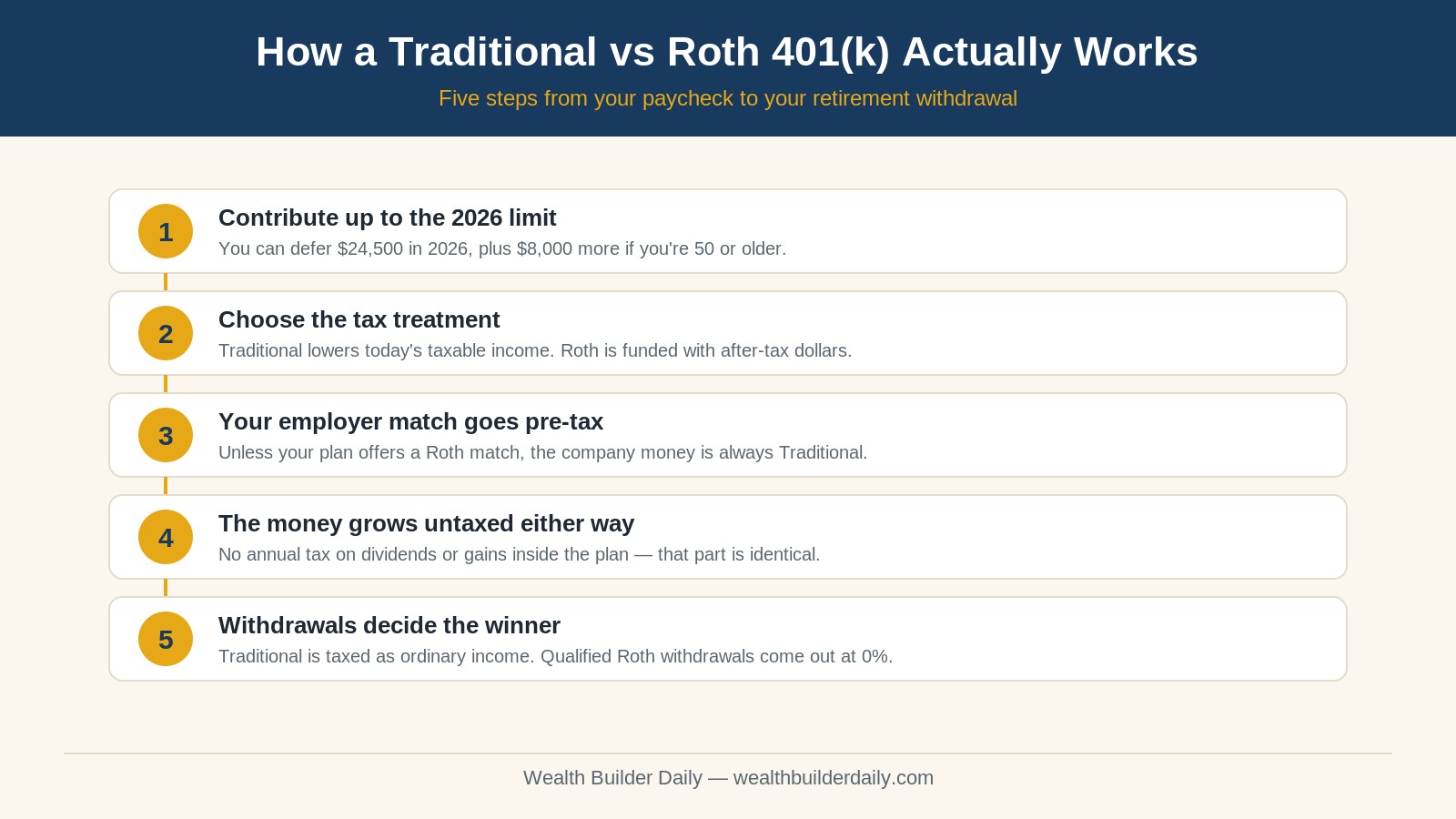
Picture your retirement money passing through three gates: the day you contribute, the years it grows, and the day you withdraw. A Traditional 401(k) waves you through gate one and charges you at gate three. A Roth 401(k) charges you at gate one and waves you through gate three. Gate two — the growth — is free in both.
That symmetry is why the math is cleaner than most people expect. Here are the moving parts:
- Your contribution. With Traditional, $1,000 into the plan costs you $1,000 of gross pay but only about $780 of take-home if you're in the 22% bracket. With Roth, that same $1,000 costs the full $1,000 of take-home.
- Your employer match. Company contributions are pre-tax by default. Some plans now offer a Roth match, but it's still the exception, so expect a pre-tax bucket to build up regardless.
- The growth years. Dividends, interest, and capital gains inside a 401(k) are untaxed annually in both versions. Nothing to choose between here.
- The withdrawal. Traditional dollars come out as ordinary income and stack on top of Social Security, pensions, and any other retirement income. Qualified Roth dollars come out at zero — and they don't inflate the income figure that determines how much of your Social Security gets taxed.
- The RMD rule. Traditional balances force withdrawals starting at 73 whether you need the money or not. Roth 401(k) balances don't.
How to Choose the Right 401(k) for Your Bracket
Here's the decision framework, in the order that actually matters.
-
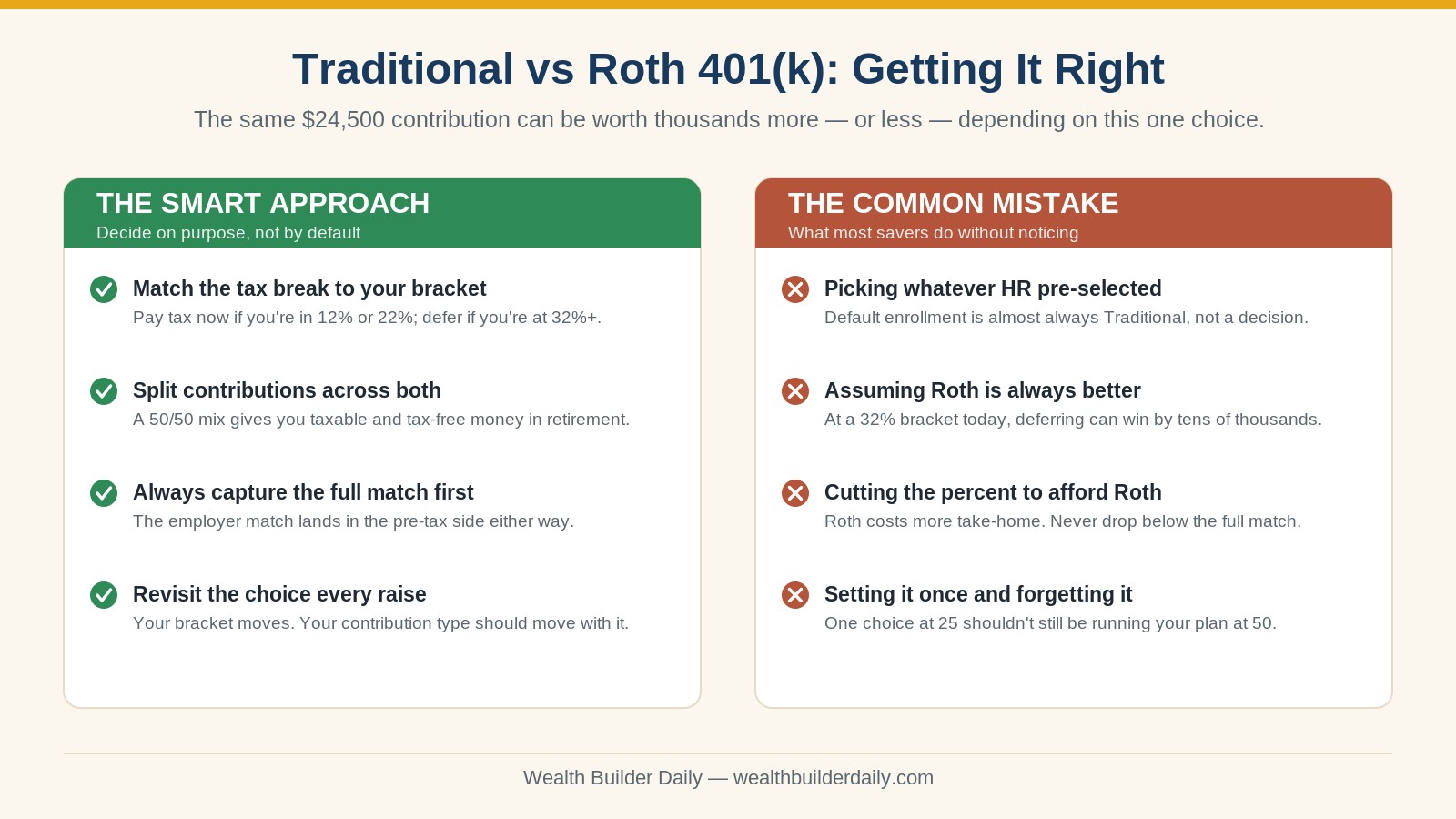
Capture the full employer match before anything else. If your company matches 4% and you're contributing 2%, fix that first. The match is an instant 100% return, and no Traditional-versus-Roth argument comes close to beating it.
-
Find your current marginal tax bracket. Not your effective rate — your marginal rate, the percentage applied to your next dollar of income. This single number drives most of the answer.
-
Estimate your retirement bracket honestly. Most people land lower, because they stop drawing a full salary. But if you're a strong saver with a large pre-tax balance, a pension, and Social Security, your retirement income can rival your working income.
-
Weigh the take-home cost. Roth reduces your paycheck more for the same contribution. If choosing Roth means you'd cut your contribution rate to afford it, that's a bad trade — contribution rate beats tax treatment nearly every time.
-
Consider what you already own. If you've spent fifteen years stuffing a Traditional 401(k), adding Roth money creates flexibility. Having both lets you control your taxable income year by year in retirement.
-
Factor in your state. Moving from a high-tax state to a no-income-tax state after you retire quietly strengthens the Traditional case. Moving the other direction strengthens Roth.
The expert tip that makes this concrete: run the numbers on a $10,000 annual contribution over 30 years at a 7% return. That grows to roughly $944,600 either way. If you're in the 22% bracket today and stay at 22% in retirement, Traditional leaves you about $736,800 after tax — but it also gave you $2,200 a year in tax savings along the way, roughly $66,000 you could invest elsewhere. The two paths land in nearly the same place. Now change one variable: if you're at 24% today and drop to 12% in retirement, Traditional nets about $831,200 and you kept the upfront savings. Same balance, very different outcome — because the bracket moved.
| Your situation | Better fit | Why | |---|---|---| | 10% or 12% bracket today | Roth | The tax you're skipping is cheap. Lock in tax-free growth. | | 22% bracket, early career | Roth or split | Your income should rise. Pay tax at today's lower rate. | | 22–24% bracket, mid-career | Split 50/50 | Genuinely close. Hedging costs you almost nothing. | | 32% bracket or higher | Traditional | A 32% deduction now is hard to beat later. | | Large pre-tax balance already | Roth | Build a tax-free bucket to balance the taxable one. | | Planning to retire in a no-tax state | Traditional | You'll skip state tax on the way out. |
Roth 401(k) vs Roth IRA: Where Your Dollars Go Further
These get confused constantly. A Roth 401(k) lives inside your employer's plan, has a much higher limit, accepts the employer match, and has no income restrictions — you can earn $500,000 and still contribute. A Roth IRA is yours personally, has a $7,500 limit in 2026, offers unlimited investment choices, and phases out at higher incomes. The practical order for most people: employer match first, then max the Roth IRA for its flexibility, then come back and fill the 401(k). Our Roth IRA guide covers that account in depth, and the financial order of operations shows where each fits in the bigger sequence.
Traditional vs Roth 401(k) for Every Situation

The right answer shifts with where you are in your career:
-
You're 25 and earning $52,000. You're in the 12% bracket, which is about as cheap as tax gets. Go Roth and don't overthink it. Four decades of untaxed growth withdrawn at zero is a genuinely rare advantage, and your income has nowhere to go but up.
-
You're 42 and earning $165,000. You're in the 24% bracket with real deduction value on the table. Traditional lowers your taxable income by nearly $6,000 on a $24,500 contribution. A 60/40 split toward Traditional captures most of that break while still building a tax-free bucket.
-
You're 58 with a $900,000 pre-tax balance. Your problem isn't saving — it's that future RMDs will push you into a higher bracket than you expect. Directing new contributions to Roth adds a withdrawal source that doesn't count as income, which protects your Social Security taxation and Medicare premiums. Pair this with the strategies in our guide to tax-efficient investing.
Beginner, Intermediate, and Advanced Setups
Beginner: Contribute enough to get the full match, put it all in one type, and pick a target-date fund. Done is better than optimal.
Intermediate: Contribute 15% of gross income, split between Traditional and Roth based on your bracket, and add a Roth IRA on top for flexibility.
Advanced: Max the $24,500, use catch-up contributions if you're 50 or older, coordinate with an HSA, and plan Roth conversions in low-income years — the gap between retiring and starting Social Security is often the cheapest conversion window you'll ever get.
Personalizing Your Approach in 2026
One rule change matters this year. Starting with the 2026 tax year, if you earned more than $150,000 in FICA wages from your plan's employer in 2025, your catch-up contributions must be made as Roth. It's no longer optional. That affects savers 50 and older at higher incomes, and it means a portion of your contribution is Roth whether you planned it or not. Two practical takeaways: confirm your plan actually offers a Roth option (if it doesn't, you may not be able to make catch-up contributions at all), and treat this as a nudge to build a deliberate mix rather than discovering one by accident.
Frequently Asked Questions
Can I contribute to both a Traditional and Roth 401(k) at the same time?
Yes, and many plans make it easy. You simply split your election — for example, 8% Traditional and 7% Roth. The important limit to remember is that $24,500 in 2026 is the combined cap across both types, not per account. Splitting is a reasonable default when you genuinely can't predict your future tax bracket.
What happens to my Roth 401(k) when I leave my job?
You can roll it into a Roth IRA, move it to a new employer's Roth 401(k), or leave it in the old plan if the balance qualifies. Rolling to a Roth IRA is common because it removes required minimum distributions permanently and opens up unlimited investment options. Any pre-tax employer match rolls into a Traditional IRA to keep the tax treatment clean.
Is a Roth 401(k) withdrawal really completely tax-free?
If it's qualified, yes — zero federal tax on both contributions and growth. Qualified means you're at least 59½ and the account has been open five years. Miss either test and the earnings portion becomes taxable with a possible 10% penalty. Your original contributions are always yours tax-free, since you already paid tax on them.
Final Thoughts
The Traditional vs Roth 401(k) choice isn't a trick question with one hidden right answer — it's a straightforward comparison between your tax rate today and your tax rate later. Pay the tax in the cheaper year. When the two years look similar, split the difference and stop losing sleep over it. What actually determines whether you retire comfortably is how much you contribute and how long you leave it alone, and both of those are entirely within your control starting with your next paycheck.
- Plain-language guidance. No jargon, no sales pitch — just clear explanations of what each option does to your money.
- Real numbers and examples. Every recommendation is backed by actual math on actual contribution amounts, not vague principles.
- Proven, time-tested methods. We stick to strategies that have worked across decades and market cycles, not whatever is trending.
- Free practical tools and guides. Everything we publish is free, and it's built to be used the same day you read it.
Open your benefits portal this week and look at what your contribution is actually set to — most people find a default they never chose. Change it on purpose, then let compounding do the rest. For more on building a portfolio that supports the account you just picked, browse our full library at wealthbuilderdaily.com/blog, and confirm the current-year limits directly at the IRS retirement plan contribution page.
The Newsletter
Get the Free Budget Tracker
Join our weekly newsletter. Practical money guides, no fluff. Unsubscribe anytime.