

Investment Fees: How to Keep More of Your Returns in 2026
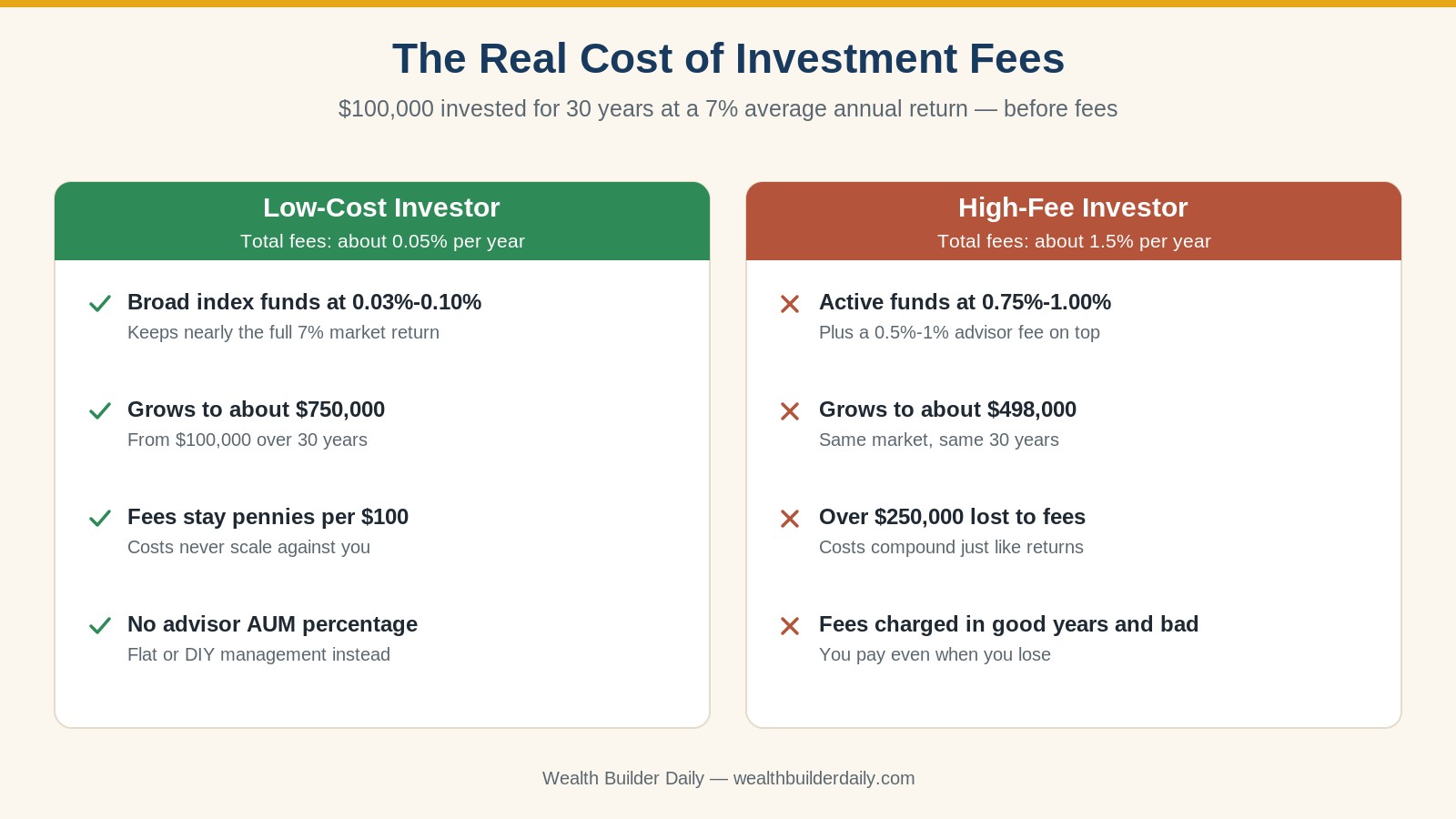
Investment fees are the most controllable factor in how fast your money grows — and trimming them from 1.5% to under 0.10% can add roughly $250,000 to a typical 30-year portfolio without changing a single thing about what you invest in.
If you own a mutual fund, an ETF, a 401(k), or work with an advisor, you're paying fees right now — probably more than you think, because most of them never show up as a line item on any statement. This guide is for everyday investors who want to see exactly what they're paying, understand which fees are worth it, and cut the rest in about an hour.
Investment Fees at a Glance
Here's the short answer: most investors should aim to keep their total annual investment costs under 0.25% of their portfolio. Broad index funds in 2026 cost as little as 0.03% per year, so anything dramatically above that needs to earn its keep.
| Fee Type | Typical Cost in 2026 | Who Charges It | How to Lower It | |---|---|---|---| | Index fund expense ratio | 0.03%–0.10% | Fund company | Already low — keep these | | Active fund expense ratio | 0.50%–1.00% | Fund company | Swap for an index equivalent | | Human advisor fee | 0.75%–1.25% of assets | Financial advisor | Negotiate or switch to flat-fee advice | | Robo-advisor fee | ~0.25% | Robo platform | Reasonable for hands-off investors | | 401(k) admin + fund fees | 0.20%–1.00%+ | Plan provider | Pick the cheapest menu options |
A few quick facts before we go deeper:
- Fees are deducted automatically from fund returns — you never get a bill, which is exactly why they're easy to ignore.
- A 1% annual fee doesn't cost you 1% of your wealth. Over 30 years it can consume 25% or more of your final balance, because every dollar paid in fees also loses its future compounding.
- Low-cost investing doesn't mean complicated. A simple index fund portfolio with two or three funds covers the whole market for pennies.
- Every fund is required to disclose its expense ratio — you can look any fund up for free using the SEC's tools at Investor.gov.
Why You Can Trust This Guide
At Wealth Builder Daily, we've spent years helping everyday people grow wealth with plain-language guidance and real numbers — no hype, no hot stock picks, no products to sell you. In this guide, we'll walk you through exactly where investment fees hide, how much they really cost at each level, and the step-by-step process we use to get a portfolio's total cost under 0.25% per year.
How Investment Fees Actually Work
Investment fees are charged as a percentage of your money, deducted automatically, every single year — whether your investments go up or down. That structure creates three quiet problems that most investors never do the math on.
First, fees scale with your balance. A 1% fee on a $10,000 starter portfolio is $100 a year — annoying, but survivable. The same 1% on a $500,000 pre-retirement portfolio is $5,000 every year, for the same service that used to cost $100.
Second, fees compound in reverse. Every dollar you pay in fees this year is a dollar that can't earn returns next year, or the year after, or for the next three decades. That's why a seemingly small 1.45% difference in annual cost turns into a $250,000+ gap over 30 years in the example above.
Third, fees are invisible. Fund fees are skimmed out of the fund's returns before you ever see them. Your statement shows the net result, so a fund that earned 7% and charged 1% simply reports 6% — and nothing on the page says you paid anything.
The main costs to know:
- Expense ratio — the annual percentage every fund charges. This is the big one. It's listed in the fund's summary prospectus and on any quote page.
- Advisory fee — what a human advisor or robo-advisor charges to manage your money, usually a percentage of assets under management (AUM).
- Trading commissions and spreads — mostly $0 at major brokerages in 2026, but frequent trading still costs you through bid-ask spreads and taxes.
- 401(k) administrative fees — plan-level costs your employer's provider charges, layered on top of each fund's expense ratio.
- Sales loads and 12b-1 fees — old-school commissions baked into some mutual funds. In 2026 there is almost never a good reason to pay either one.
How to Choose the Right Low-Cost Investments
Cutting fees isn't about finding the single cheapest fund on earth. It's about making sure every cost you pay is buying you something real. Here's the decision process:
-
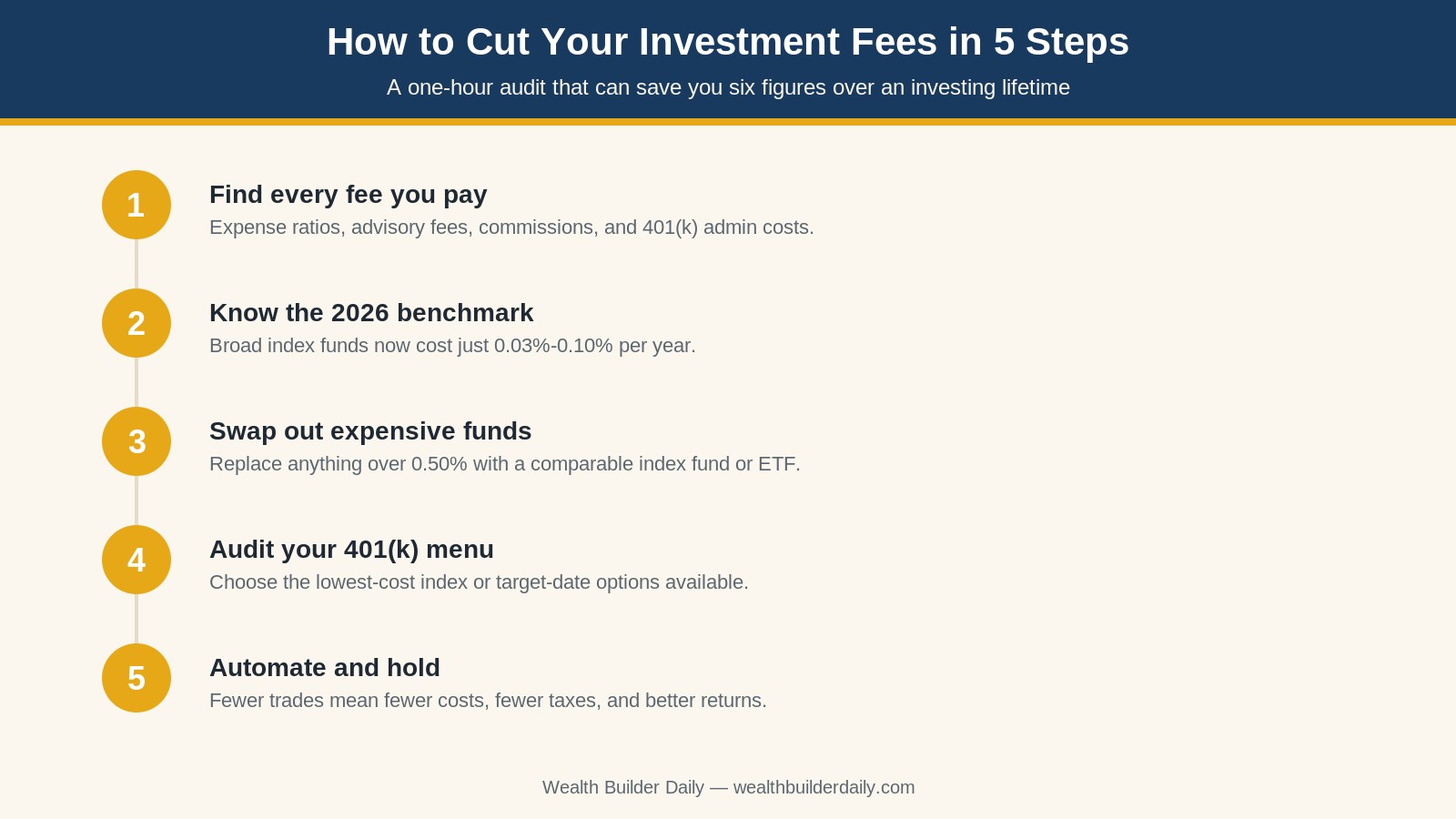
Check the expense ratio first. Before you buy any fund, look up its expense ratio. For broad U.S. stock or bond index funds, 0.03%–0.10% is the 2026 standard. Anything above 0.20% for a plain index fund is overpriced.
-
Compare against the index version. For almost every actively managed fund, there's an index fund covering the same market at a tenth of the cost. Decades of SPIVA research show most active funds underperform their index after fees, so the burden of proof is on the expensive fund.
-
Total up your "all-in" cost. Add your weighted average expense ratio plus any advisory fee plus any plan admin fee. That single number — your total annual cost — is what actually hits your returns. Under 0.25% is excellent; over 1% deserves serious scrutiny.
-
Decide what advice is worth to you. A good advisor can absolutely earn their fee through tax planning and behavior coaching. But pay for advice deliberately — a flat annual fee or an hourly planner is often thousands cheaper than a 1% AUM fee once your portfolio passes $250,000.
-
Mind the account, not just the fund. The same cheap fund can be held in a brokerage account, an IRA, or your 401(k). Taxes are a fee too — keep tax-inefficient assets in retirement accounts when you can.
Here's an expert tip with real numbers: a couple with $400,000 invested who moves from a 1% AUM advisor holding 0.6% active funds (1.6% all-in, $6,400 per year) to a flat-fee planner at $2,000 per year holding 0.05% index funds ($200 per year) saves about $4,200 every single year — and that's before the savings start compounding.
Expense Ratio vs. Advisory Fee: Which One Hurts More
They hurt in different ways. Expense ratios are usually the easier fix — swapping an expensive fund for an index equivalent takes minutes and changes nothing about your strategy. Advisory fees are larger but sometimes worth paying: if an advisor stops you from panic-selling in one bad market, they may earn a decade of fees. The rule of thumb: never pay a high expense ratio and a high advisory fee at the same time. Stack cheap funds under whatever advice model you choose.
Cutting Investment Fees in Every Situation

Different investors face different fee traps. Find yourself below:
- The 401(k)-only investor: Your fund menu is chosen for you, but you still have choices. Pick the lowest-cost index or target-date fund on the menu — in most plans the cheapest target-date series costs under 0.20%.
- The DIY brokerage investor: You control everything, so aim for a total cost under 0.10% using two or three broad index funds. Your main enemy isn't fees — it's overtrading, which reintroduces costs through spreads and taxes.
- The delegator: If you want someone else to manage things, a robo-advisor at ~0.25% is a fair price for automation and rebalancing. Just avoid paying a robo fee on top of expensive underlying funds — the good platforms use index ETFs inside.
Beginner, Intermediate, and Advanced Fee Setups
A beginner setup is one low-cost target-date fund in a retirement account — one decision, roughly 0.10%–0.20% all-in. An intermediate setup is a three-fund index portfolio (U.S. stocks, international stocks, bonds) at about 0.05%, rebalanced once a year. An advanced setup adds asset location — placing bonds and REITs in tax-advantaged accounts and holding tax-efficient stock index funds in taxable — plus a deliberate, flat-fee arrangement for any professional advice.
Personalizing Your Fee Strategy in 2026
Fee-cutting has gotten easier in 2026: fractional shares mean you can build a diversified index portfolio with $50, most major brokerages charge $0 commissions, and several fund families now offer core index funds at 0.00%–0.03%. The one growing trap is the rise of shiny niche ETFs — thematic and leveraged products routinely charge 0.75%+ for narrow bets most long-term investors don't need. Your plan doesn't have to be fancy. It has to be cheap, diversified, and automatic.
Frequently Asked Questions
What is a good expense ratio in 2026?
For broad index funds, 0.03%–0.10% is the current standard, and anything under 0.20% is acceptable. For your entire portfolio — funds plus any advisory and admin fees — aim for a total annual cost under 0.25% if you self-manage, or under 0.50% if you use a robo-advisor.
Are investment fees ever worth paying?
Yes, when they buy something measurable. A 0.25% robo-advisor fee buys automation and rebalancing. A flat-fee planner can save multiples of their cost in tax strategy and prevented mistakes. What's rarely worth it: high expense ratios on active funds that historically underperform cheap index funds after costs.
How do I find out what fees I'm paying?
Look up each fund's expense ratio on your brokerage's quote page or at Investor.gov, then check your advisor agreement for an AUM percentage. For a 401(k), request the plan's fee disclosure (called a 404(a)(5) notice) from HR — it lists every fund's cost plus administrative charges.
Final Thoughts
You can't control what the market returns, but you have almost total control over what you pay to participate in it. Keep your all-in investment fees near 0.25% or below, and the quarter-million-dollar gap in our 30-year example lands on your side of the table — same market, same funds' underlying holdings, dramatically different outcome.
Why readers trust Wealth Builder Daily:
- Plain-language guidance — every fee, acronym, and disclosure form explained in words you don't need a finance degree to follow.
- Real numbers and examples — actual 2026 expense ratios and a worked $100,000 case study, not vague warnings about "high fees."
- Proven, time-tested methods — low-cost index investing is backed by decades of SPIVA data and the track record of every major retirement study.
- Free practical tools and guides — from opening your first account to building a full portfolio, our step-by-step guides cost you exactly 0.00%.
Your next hour of financial work might be worth more than your next year of saving: pull up your accounts, total your fees, and make the swaps. For more step-by-step help building wealth on your terms, explore the latest guides at Wealth Builder Daily, and use the free fund-checking tools at Investor.gov to verify any fund's cost before you buy.
The Newsletter
Get the Free Budget Tracker
Join our weekly newsletter. Practical money guides, no fluff. Unsubscribe anytime.