

Tax-Loss Harvesting: How to Turn Investment Losses Into Real Savings in 2026
Tax-loss harvesting is the strategy of selling an investment that's worth less than you paid for it, so you can use that loss to lower your tax bill — and it's one of the few silver linings a down market actually hands you. If you've ever watched a stock or fund drop in value and felt like there was nothing to do but wait it out, this guide is for you.
This walkthrough is for anyone with a taxable brokerage account — not a 401(k) or IRA, where tax-loss harvesting doesn't apply — who wants a clear, step-by-step way to turn a rough patch in the market into a real dollar benefit. We'll cover how the strategy works, the rule that trips up most beginners, and how to decide if it's worth doing in 2026.
Tax-Loss Harvesting at a Glance
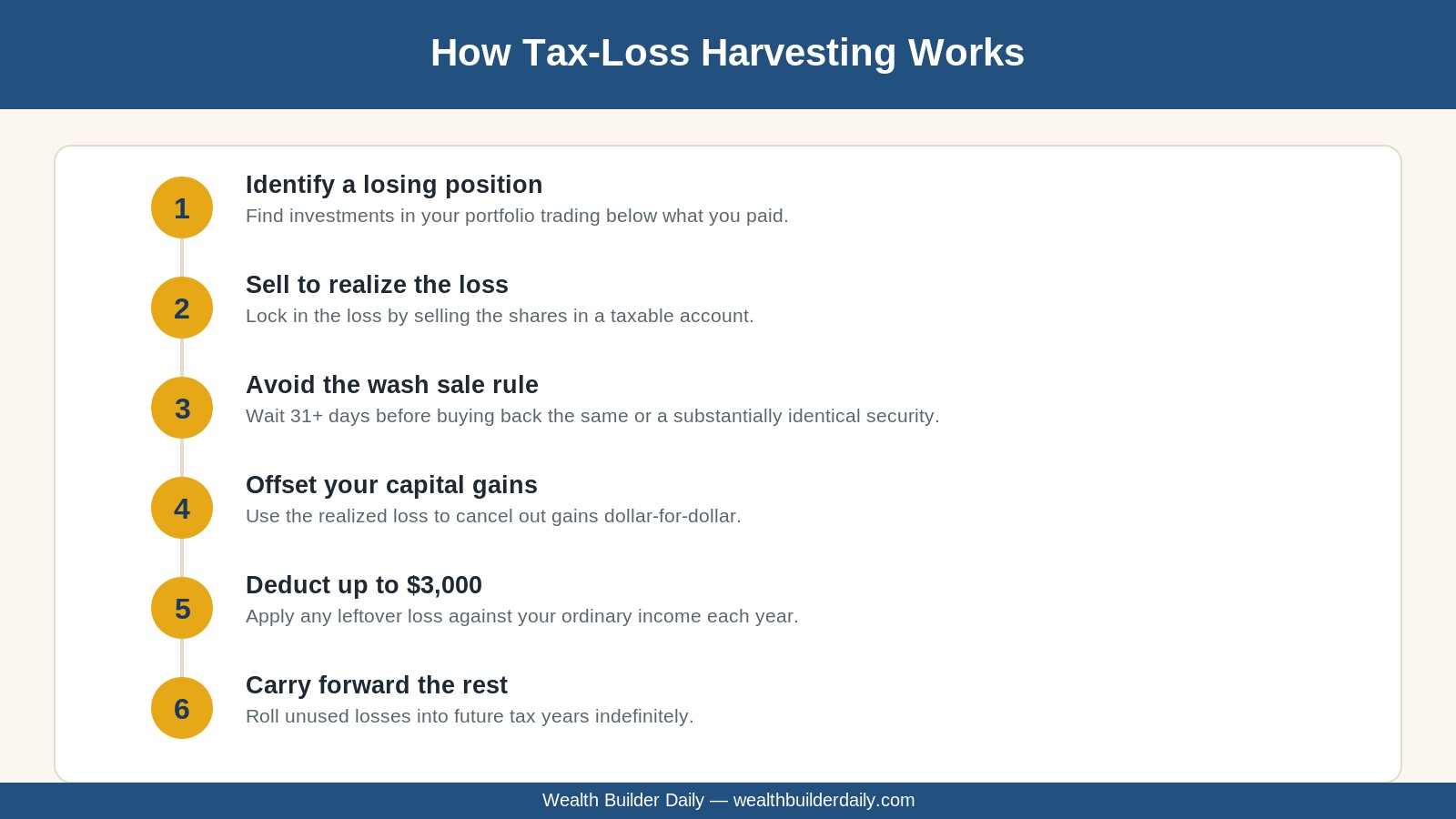
Tax-loss harvesting works by selling investments at a loss to offset capital gains you've realized elsewhere, and if your losses exceed your gains, you can deduct up to $3,000 against your regular income each year. Any leftover loss carries forward to future tax years indefinitely, so nothing goes to waste.
| Question | Short Answer | |---|---| | What accounts qualify? | Taxable brokerage accounts only — not 401(k)s or IRAs | | What's the annual deduction limit? | Up to $3,000 against ordinary income per year | | What happens to extra losses? | They carry forward to future tax years | | What's the biggest risk? | Triggering a wash sale by buying back too soon | | When should you do it? | Anytime a position is down — not just at year-end |
Quick facts to keep in mind:
- Tax-loss harvesting only works in taxable brokerage accounts, not tax-advantaged ones like a Roth IRA.
- Short-term losses offset short-term gains first, and long-term losses offset long-term gains first, before crossing over.
- The wash sale rule gives you a 61-day window (30 days before and after the sale) where a repurchase can disqualify the loss.
- You don't have to wait until December — harvesting can happen any time a position sits below your cost basis.
How Tax-Loss Harvesting Works
The core idea behind tax-loss harvesting is simple: when an investment loses value and you sell it, the IRS lets you use that loss to cancel out gains you've made elsewhere in your portfolio, which shrinks the amount of investment income you owe tax on. It's one of the only tax strategies that actually rewards you for something that already felt bad — the loss already happened; harvesting just makes sure it does you some good.
Here's what's happening mechanically when you harvest a loss:
- You sell a security for less than your cost basis, creating a "realized" capital loss (an unrealized loss on paper doesn't count until you sell).
- That loss first offsets capital gains of the same type — short-term losses against short-term gains, long-term against long-term — then crosses over if one category runs out.
- If your total losses exceed your total gains for the year, up to $3,000 of the excess reduces your ordinary taxable income.
- Anything left after that carries forward to next year, and the year after, for as long as you have losses to use.
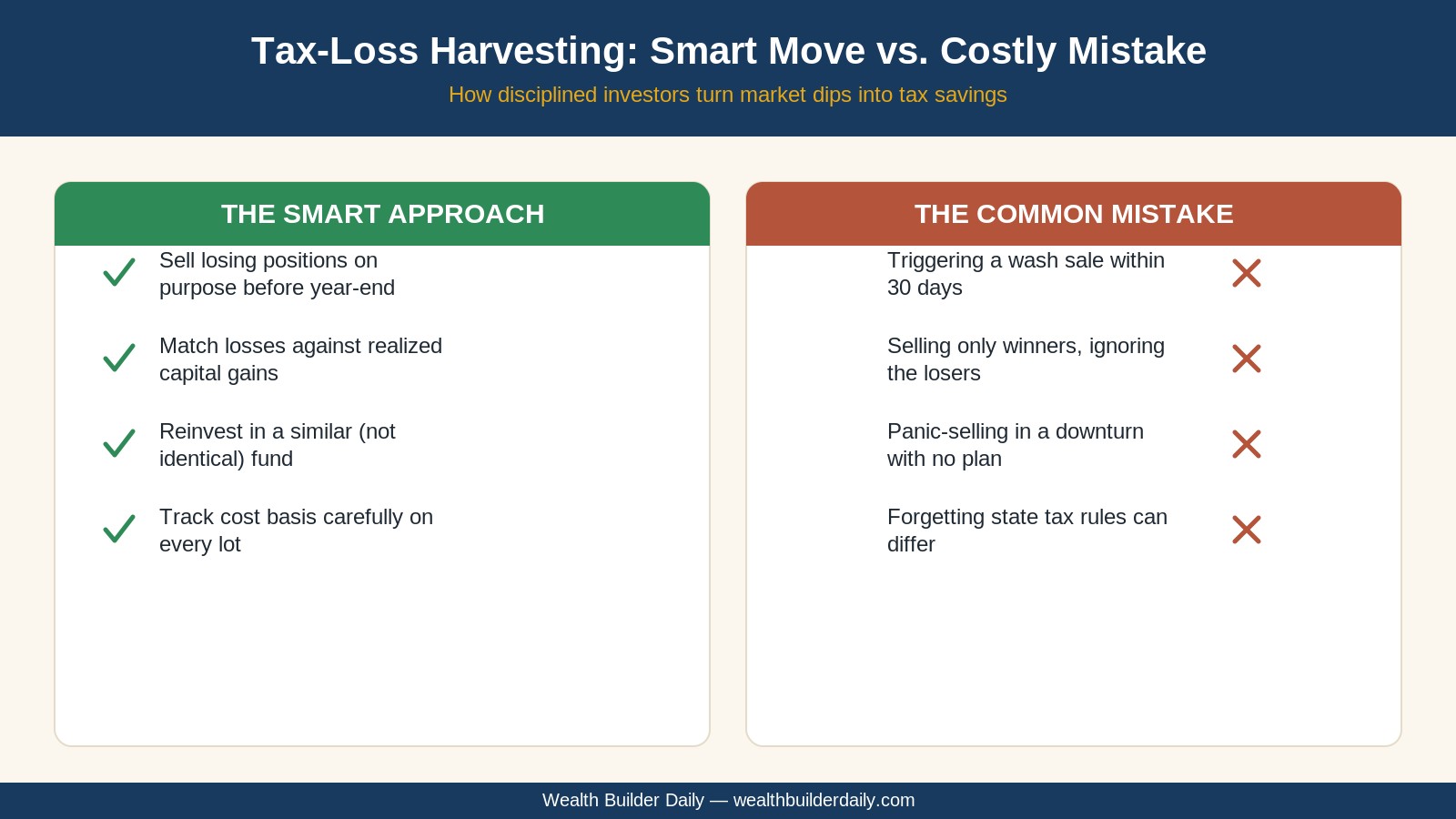
- To keep your money invested, you typically buy a similar (not identical) fund right away, so you stay in the market while banking the tax benefit.
At Wealth Builder Daily, we've spent years helping everyday investors make sense of strategies that sound complicated but are actually pretty mechanical once you see the steps. In this guide, we'll walk you through exactly how tax-loss harvesting works, the one rule that catches almost everyone off guard, and how to decide if it's worth your time in 2026.
How to Choose the Right Tax-Loss Harvesting Approach
Not every investor needs to harvest losses the same way, and the right approach depends on your account size, how often you trade, and how much you value simplicity. Here's how to think it through.
- Check whether you actually have a taxable account. If every dollar you invest sits in a 401(k), traditional IRA, or Roth IRA, tax-loss harvesting doesn't apply to you — those accounts don't generate taxable capital gains or losses in the first place.
- Look for positions currently below your cost basis. Log into your brokerage and sort your holdings by unrealized gain/loss. Anything showing red is a harvesting candidate.
- Confirm you have gains to offset — or income to shelter. If you sold something for a profit this year, harvesting a loss can cancel it out. If you didn't, up to $3,000 can still reduce your taxable income.
- Pick a similar (not identical) replacement. To avoid a wash sale while staying invested, swap into a fund that tracks a different index but holds a similar type of asset — for example, moving from one large-cap U.S. index fund to another with a different underlying index.
- Mark your calendar for 30 days. If you want to eventually buy back your original position, you need 31 days between the sale and the repurchase to keep the loss valid.
- Decide if the effort is worth the deduction size. For a $200 loss, harvesting might not be worth the paperwork. For a $5,000 loss in a volatile year, it almost always is.
Here's a number worth remembering: if you're in the 22% federal tax bracket and harvest $3,000 in losses against ordinary income, that's roughly $660 in real tax savings — money that would otherwise just be a loss on paper doing nothing for you. Pair that with offsetting a $10,000 capital gain, and the numbers add up fast. For a deeper look at how account choice affects your overall tax bill, see our guide on tax-efficient investing.
Tax-Loss Harvesting vs. Just Holding and Waiting
Some investors argue you should never sell at a loss — just hold until the price recovers. But tax-loss harvesting isn't about giving up on the investment; it's about realizing the loss for tax purposes while immediately reinvesting in something similar, so your money keeps working while you also bank a tax benefit. You're not abandoning your strategy — you're getting paid, in a sense, for a dip you were going to ride out anyway.
Tax-Loss Harvesting for Every Situation

Tax-loss harvesting looks different depending on where you are financially and how involved you want to be:
- The DIY investor with a taxable brokerage account should review holdings for losses at least once a quarter, not just in December, since market dips can happen any time and losses realized in March are just as valuable as ones realized in November. Check our guide on opening your first brokerage account if you're just getting started.
- The investor with a robo-advisor often gets this done automatically — many platforms run daily tax-loss harvesting scans and execute trades for you, so check your settings before doing it manually and duplicating the work.
- The investor who also holds a Roth IRA or 401(k) should remember harvesting only applies to the taxable account; losses inside tax-advantaged accounts simply don't count for this purpose, so don't waste time analyzing those balances for harvesting opportunities.
Beginner, Intermediate, and Advanced Approaches
A beginner setup means checking your taxable account for red positions once or twice a year and manually selling and swapping into a similar fund. An intermediate approach adds quarterly reviews and a simple spreadsheet tracking cost basis on each lot. An advanced setup — often handled by a robo-advisor or financial planner — continuously scans for harvesting opportunities daily and automatically executes trades while avoiding wash sales across multiple accounts, including a spouse's.
Personalizing Your Approach in 2026
With markets moving in both directions throughout 2026, the investors who benefit most from tax-loss harvesting are the ones who check in regularly instead of waiting for a year-end scramble. If you're managing multiple accounts, including old employer plans, take stock of everything with a net worth calculation so you know which accounts are taxable and eligible for harvesting in the first place.
It also helps to think about tax-loss harvesting as part of a bigger system rather than a once-a-year chore. Every time you rebalance your portfolio, add new contributions, or review your asset allocation, take thirty seconds to glance at which positions are underwater. That habit alone catches most of the harvesting opportunities you'd otherwise miss between now and December, and it keeps the strategy from feeling like a separate task bolted onto your regular investing routine.
One more thing worth knowing: harvesting losses doesn't require a big, dramatic market downturn to be useful. Even a single fund that's temporarily lagging while the rest of your portfolio climbs can still generate a usable loss. You don't need a 2022-style year for this to pay off — you just need to actually look.
Frequently Asked Questions
What is the wash sale rule?
The wash sale rule blocks you from claiming a tax loss if you buy the same or a "substantially identical" security within 30 days before or after the sale. If you trigger it, the loss is disallowed and added to the cost basis of your new shares instead, deferring the benefit rather than eliminating it entirely.
Can I harvest losses in my 401(k) or IRA?
No. Tax-loss harvesting only applies to taxable brokerage accounts, because retirement accounts like 401(k)s and IRAs don't generate a taxable event when you sell inside them. Gains and losses in those accounts simply don't affect your yearly tax return.
How much can tax-loss harvesting actually save me?
It depends on your gains, losses, and tax bracket, but a $3,000 deduction against ordinary income in the 22% bracket saves roughly $660. If you're also offsetting capital gains, the savings can be significantly larger since gains are often taxed at similar or higher rates.
Final Thoughts
Tax-loss harvesting won't turn a bad investment into a good one, but it does make sure a loss you've already absorbed does something useful for you at tax time. By selling strategically, avoiding the wash sale rule, and reinvesting in something similar, you keep your portfolio working while trimming what you owe the IRS.
- Plain-language guidance: we broke down a strategy that sounds complex into six clear, repeatable steps.
- Real numbers and examples: from the $3,000 deduction cap to the 61-day wash sale window, you have the specifics to act on.
- Proven, time-tested methods: tax-loss harvesting has been a standard tool for investors and advisors for decades.
- Free, practical tools and guides: everything here is built to help you take action without paying for advice you don't need yet.
Ready to put this into practice? Browse more guides on building and protecting your portfolio at the Wealth Builder Daily blog, and for the official rules straight from the source, see the IRS guidance on capital gains and losses via Investor.gov.
The Newsletter
Get the Free Budget Tracker
Join our weekly newsletter. Practical money guides, no fluff. Unsubscribe anytime.