

Proofreading Side Hustle: How to Make $1,500 a Month From Home in 2026
A proofreading side hustle is one of the simplest ways to earn $1,000 to $3,000 a month from home in 2026 — you catch spelling, grammar, and punctuation errors in other people's writing and get paid for a sharp eye you may already have. If you are the friend who spots the typo on the menu, this is a skill you can turn into steady income.
This guide is for beginners who want a flexible, low-cost way to make extra money without a degree, a fancy office, or a big upfront investment. You will learn what proofreading actually pays, how the work flows from skill to paycheck, how to pick a niche that clients will pay for, and how to land your first jobs. Everything here is written for real life, with real numbers you can plan around.
Proofreading Side Hustle at a Glance
A proofreading side hustle means reviewing finished writing — books, blog posts, student papers, emails, and marketing copy — and correcting the small errors that slip past the writer. You are the last set of eyes before something goes public. Here is the quick picture before we dig in.
| Question | Short Answer | | --- | --- | | What is it? | Catching spelling, grammar, and punctuation errors in others' writing for pay | | Startup cost | $0 to $500 (mostly optional training and tools) | | Time to first client | 2 to 6 weeks with steady effort | | Realistic income | $1,000 to $3,000 a month part-time | | Best for | Detail-oriented readers who love clean, correct writing |
A few quick facts worth remembering as you start:
- You do not need a degree. Clients care about accuracy and reliability, not diplomas.
- Startup costs are tiny. A laptop, a solid internet connection, and free grammar references are enough to begin.
- Rates scale with skill. Beginners often charge $15 to $25 an hour; experienced proofreaders in a niche can earn $40 an hour or more.
- It pairs well with other income. Many proofreaders stack it with writing or freelancing gigs on platforms like Upwork to smooth out slow weeks.
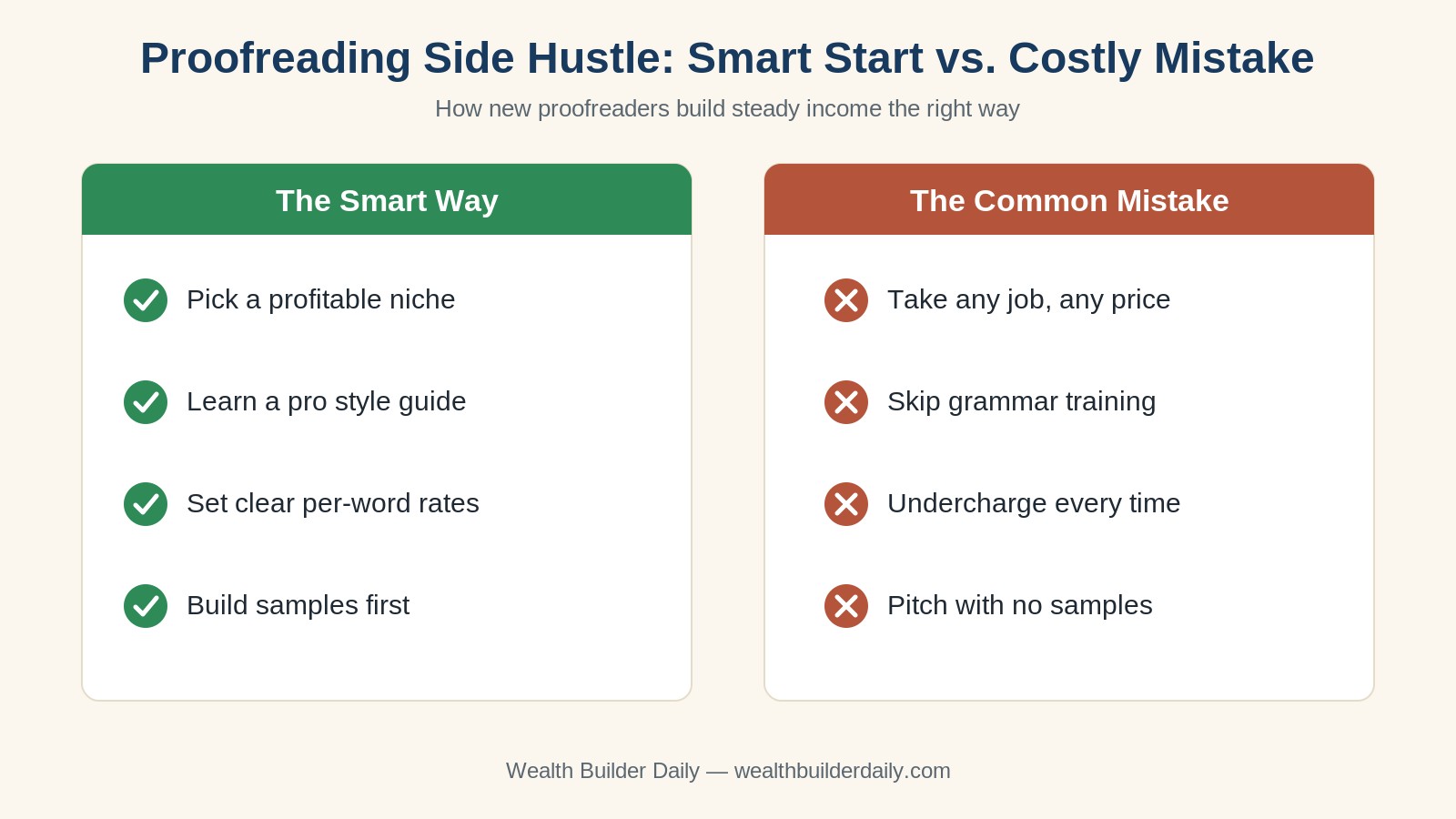
Proofreading is different from editing. Editors reshape sentences, restructure paragraphs, and question the writer's choices. A proofreader polishes what is already there — fixing typos, missing commas, doubled words, and inconsistent formatting. Knowing that line keeps your work fast and your promises clear.
Why You Can Trust This Guide
At Wealth Builder Daily, we have spent years helping everyday people turn ordinary skills into real income streams that fit around a full-time job or family life. We have watched readers go from proofreading a friend's résumé for free to charging paying clients within a couple of months. In this guide, we will walk you through the exact path — skills, niche, rates, and first clients — so you can start a proofreading side hustle in 2026 without guessing or wasting money on courses you do not need.
How a Proofreading Side Hustle Works
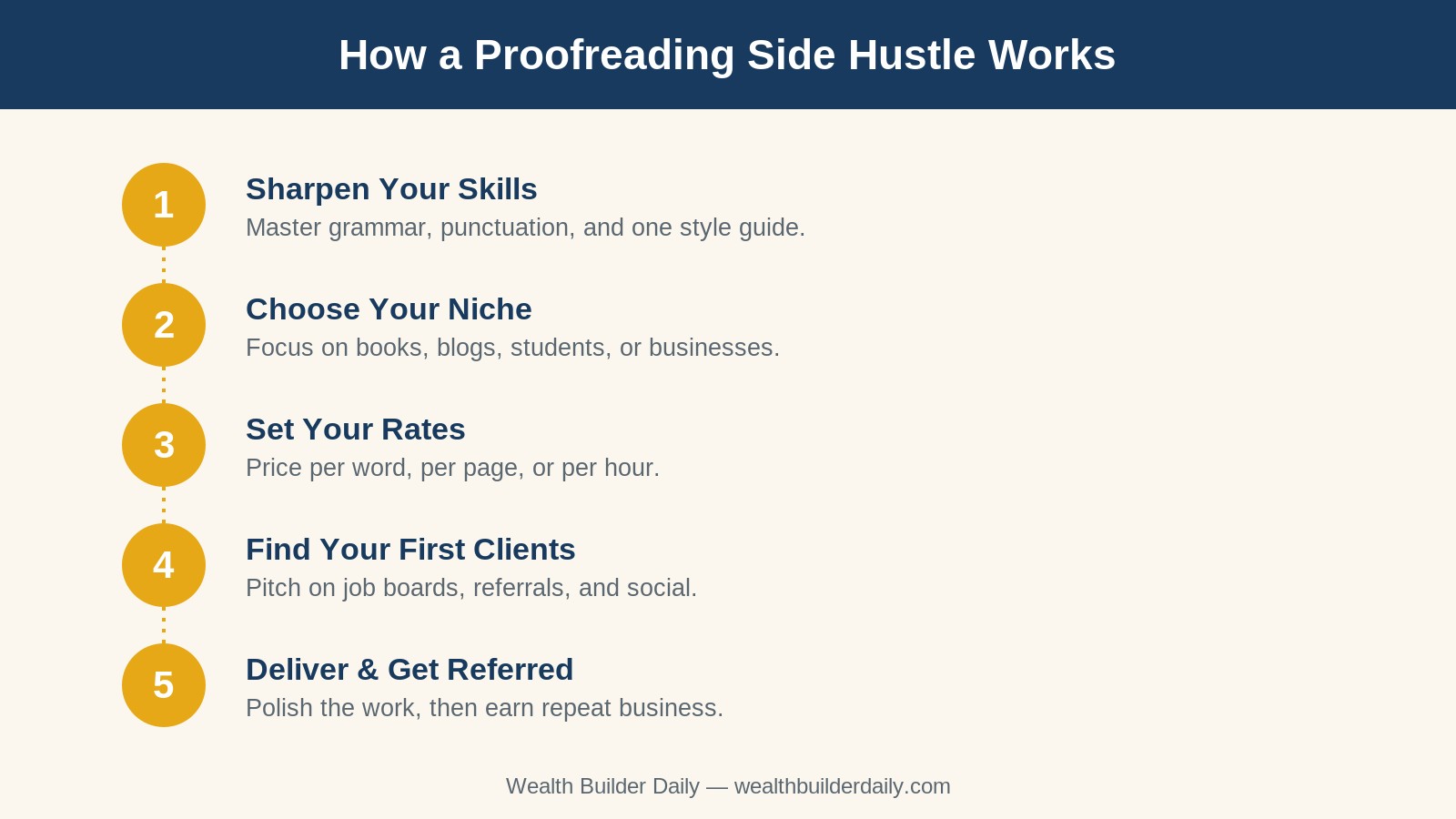
A proofreading side hustle works like a small service business: a client hands you a finished document, you clean it up, and you deliver it back error-free by an agreed deadline. You get paid per word, per page, or per hour, and good work leads to repeat clients and referrals. The whole model rewards accuracy and dependability far more than speed or credentials.
The work usually moves through a handful of clear stages:
- Skill building. You learn the grammar rules and one style guide that clients in your niche expect, such as Chicago for books or AP for blogs and news.
- Niche selection. You focus on one type of client — authors, students, bloggers, or small businesses — so your pitch and samples feel specific.
- Pricing. You set a rate per word (often 1 to 3 cents), per page, or per hour that reflects your speed and the difficulty of the material.
- Client acquisition. You find work through job boards, freelance platforms, referrals, and social media groups where your niche gathers.
- Delivery and repeat business. You return polished, on-time work, then turn happy clients into a steady pipeline.
Most beginners can proofread 1,500 to 3,000 words an hour once they build a rhythm, though dense or technical material moves slower. At 2 cents a word, a 5,000-word blog post earns $100 for roughly two hours of focused work — a clear picture of why proofreaders track both their rate and their speed.
How to Choose the Right Proofreading Niche
Picking a niche is the single biggest decision in a proofreading side hustle. A focused proofreader who says "I polish self-published fiction" wins more work than a generalist who says "I proofread anything." Use these criteria to choose a lane that fits you and pays well in 2026.
-
Match your interests. You will read a lot in your niche, so pick material you genuinely enjoy. If you love novels, self-published authors are a natural fit. If you follow business news, corporate and marketing copy will feel easy.
-
Check the demand. Some niches never run dry. Students need papers proofread every semester, bloggers publish constantly, and indie authors release books year-round. Steady demand means steady income.
-
Weigh the pay. Business and technical clients usually pay more than students, but they also expect faster turnarounds and stricter accuracy. Decide whether you want volume at lower rates or fewer jobs at premium rates.
-
Consider the style guide. Each niche leans on a standard: Chicago for books, AP for journalism and blogs, APA for academic work. Learning one guide deeply beats knowing three of them halfway.
-
Look at repeat potential. Authors, agencies, and busy business owners come back again and again. A niche with repeat clients builds a reliable base far faster than one-off jobs.
Here is an expert tip worth building your plan around: aim for two or three anchor clients who send you regular work. If three bloggers each send you 8,000 words a month at 2 cents a word, that is roughly $480 a month on autopilot before you take a single new job. Steady clients are what turn a proofreading side hustle from pocket change into a real income stream — money you can route straight into an emergency fund or savings goal.
Proofreading vs. Editing: What to Offer First
Beginners often wonder whether to advertise proofreading, editing, or both. Start with proofreading. It has a clear scope, a faster learning curve, and lower risk of overpromising. Editing requires deeper judgment about voice, structure, and flow, and clients pay more but expect more. Many people begin as proofreaders, learn the craft on real jobs, and add light editing once they are confident. Leading with proofreading lets you start earning sooner without stretching past your skill.
Proofreading for Every Situation
No two proofreading side hustles look exactly alike. Your ideal setup depends on your schedule, your goals, and how much you enjoy the work. The examples below show how different people build the hustle around their lives.

- The evening earner. You hold a full-time job and proofread two hours a night. Focus on blog posts and short business documents that fit into small windows, and target $500 to $800 a month in extra income.
- The parent at home. You need flexible work that bends around your family. Self-published authors and students often give generous deadlines, so you can proofread during nap times or after bedtime and still earn $1,000 or more a month.
- The scaling freelancer. You already do freelance work and want a stackable service. Offer proofreading to your existing clients, then package it with light editing and formatting to raise your effective rate.
Beginner, Intermediate, and Advanced Setups
A beginner setup is a free grammar reference, one style guide, and profiles on a couple of job boards. Total cost: near zero. An intermediate setup adds a paid proofreading course, a grammar-checking tool subscription, and a simple portfolio page with sample edits. An advanced setup layers in a niche specialty, a small website, testimonials from past clients, and a waitlist that lets you raise rates. Each stage should pay for the next, so you never spend money you have not already earned.
Personalizing Your Approach in 2026
The proofreading market keeps shifting, and 2026 rewards proofreaders who position themselves clearly. AI writing tools now produce huge volumes of first-draft content, which means more material than ever needs a human to catch the awkward phrasing, wrong words, and formatting errors that machines miss. Lean into that. Market yourself as the human accuracy check that busy creators and businesses still need, and price your reliability accordingly. Turning that income into wealth is the next step — automating a slice of every payment into savings the way we describe in our guide to paying yourself first.
Frequently Asked Questions
Do I need a certification to start a proofreading side hustle?
No. You do not need a certificate or degree to proofread for pay, and most clients never ask for one. What matters is accuracy, reliability, and clear communication. A paid course can shorten your learning curve and build confidence, but it is optional. Many successful proofreaders start with free grammar references, a style guide, and a few practice samples to show clients.
How much can I realistically earn proofreading part-time?
Most part-time proofreaders earn between $1,000 and $3,000 a month once they build a small base of repeat clients. Beginners often start around $15 to $25 an hour, while experienced proofreaders in a strong niche can charge $40 an hour or more. Your income depends on your speed, your rates, and how consistently you find work, so tracking both matters.
What tools do I need to begin proofreading in 2026?
Very little. You need a reliable laptop, a stable internet connection, and access to the style guide your niche uses. A grammar-checking tool helps you catch errors faster, and a simple document reader for tracking changes is useful. Free references cover the basics when you start, and you can add paid tools later once your proofreading side hustle is earning steadily.
Final Thoughts
A proofreading side hustle turns a skill you may already have into $1,000 to $3,000 a month, with almost no startup cost and a schedule you control. Start by sharpening your grammar and one style guide, choose a niche you enjoy, set clear rates, and land two or three repeat clients who keep the work flowing. That is the whole path from a sharp eye to a real income stream in 2026.
- Plain-language guidance. We explain every step in clear terms, so you never feel lost or talked down to.
- Real numbers and examples. From 2-cent-per-word rates to $480-a-month anchor clients, we show you what to actually expect.
- Proven, time-tested methods. The niche-first approach has helped countless freelancers build steady, repeatable income.
- Free, practical tools and guides. Our library gives you the checklists and next steps to grow without paying for hype.
Your next move is simple: pick one niche, proofread a few free samples to build proof, and pitch your first three clients this month. For more step-by-step ways to build income and put it to work, explore our full library at Wealth Builder Daily, and when you start earning, review the self-employed tax basics from the IRS so you keep more of what you make. A cleaner page — and a fuller bank account — is closer than you think.
The Newsletter
Get the Free Budget Tracker
Join our weekly newsletter. Practical money guides, no fluff. Unsubscribe anytime.