

Airbnb Co-Hosting Side Hustle: How to Earn $2,000 a Month Without Owning Property in 2026
The Airbnb co-hosting side hustle lets you earn $1,500 to $3,000 a month managing someone else's short-term rental — no mortgage, no down payment, no property of your own. You handle the messages, the cleaning schedule, and the calendar. The owner keeps the deed. You keep a slice of every booking.
This guide is for anyone who wants real side income without needing capital to start. We'll cover what co-hosts actually do, what they charge in 2026, how to land your first host, and how to tell whether this hustle is worth your hours before you say yes to anyone.
The Airbnb Co-Hosting Side Hustle at a Glance
A co-host is the person a short-term rental owner pays to run the day-to-day work of the listing. Most owners hire one because they're busy, out of state, or simply tired of answering guest messages at 11 p.m. You step in, take the workload, and take a cut.
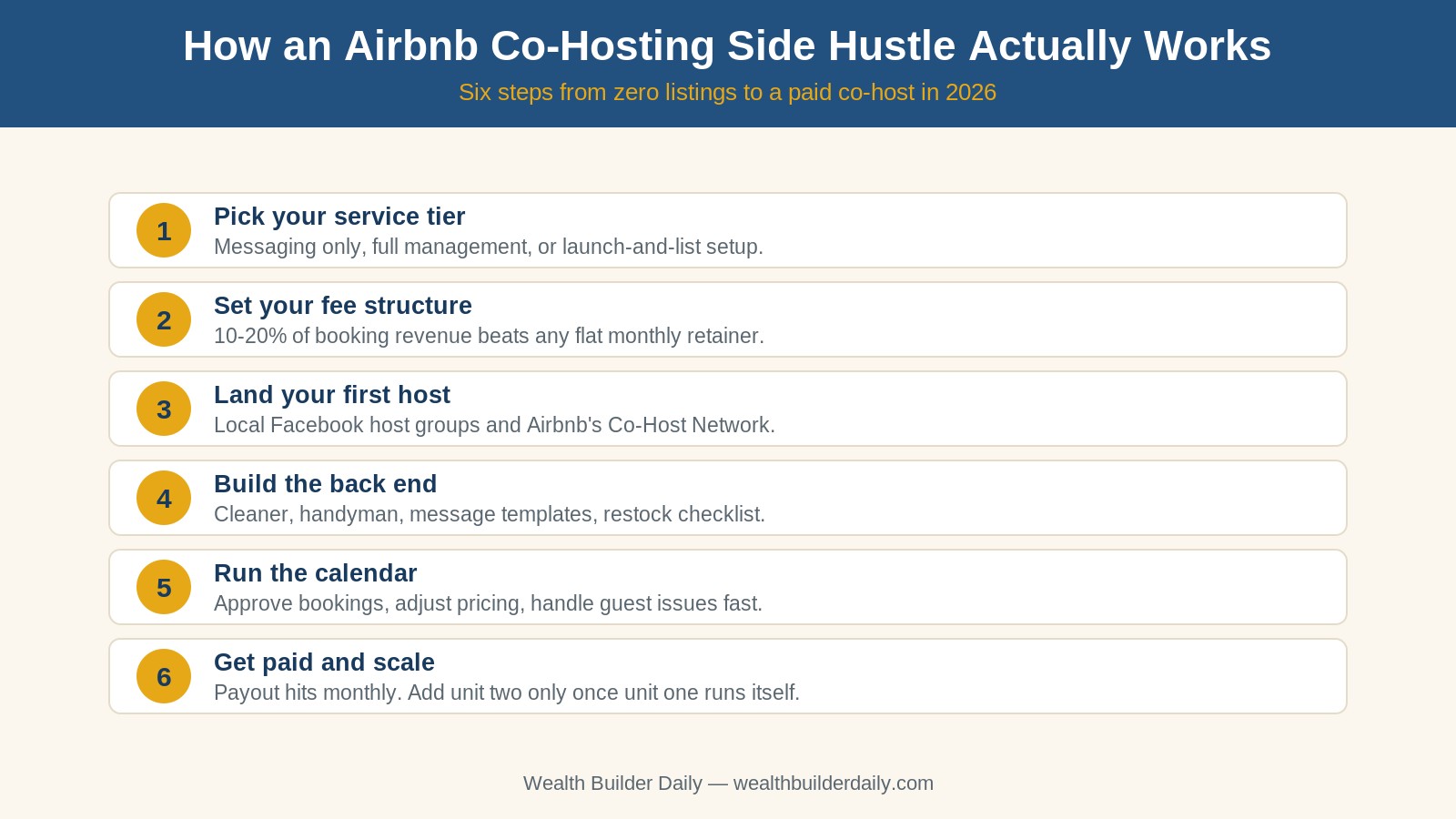
| Service Tier | What You Handle | Typical Fee | Time Per Unit/Month | |---|---|---|---| | Messaging only | Guest inquiries, check-in instructions, reviews | 5–10% of booking revenue | 4–8 hours | | Full co-hosting | Messaging, cleaning coordination, restocking, pricing | 15–20% of booking revenue | 10–20 hours | | Launch + list setup | Photos, listing copy, pricing setup, one-time build | $500–$1,500 flat, one-time | 15–25 hours | | On-site support only | Turnovers, supply runs, maintenance calls | $25–$45/hour or per turnover | Varies |
Quick facts before you go further:
- A single mid-tier listing grossing $4,000/month at a 15% co-host fee pays you $600/month for roughly 12 hours of work — about $50/hour.
- Three listings at that rate puts you near $1,800/month, which is the realistic path to the $2,000 mark.
- You need zero capital. Your startup cost is a phone, a laptop, and a spreadsheet.
- Income is variable and seasonal, so pair it with a plan for uneven months — our guide to budgeting on irregular income walks through exactly how.
Why You Can Trust This Guide
At Wealth Builder Daily, we've spent years helping everyday people turn spare hours into dependable income — and we're honest about which side hustles hold up and which ones quietly pay minimum wage. Co-hosting is one of the few that scales, because your second listing takes far less effort than your first. In this guide, we'll walk you through the exact fee structures co-hosts use in 2026, the traps that turn a $50/hour gig into a $12/hour one, and the step-by-step path to landing a paying host in your area.
How the Airbnb Co-Hosting Side Hustle Works
Owning a short-term rental sounds passive. Running one is not. A single listing generates dozens of guest messages a week, a cleaning turnover between every stay, restocking runs, pricing decisions, and the occasional 2 a.m. "the Wi-Fi is down" text. Plenty of owners bought the property for the returns and never wanted the job.
That gap is your business. You're not investing in real estate — you're selling the operational work that real estate creates. Airbnb even builds for this directly: the platform lets an owner add a co-host to a listing with defined permissions, so you can manage the calendar and messages without ever holding the title.
Here's what the work actually breaks down into:
- Guest communication. Inquiries, booking approvals, check-in and check-out instructions, mid-stay questions, and review responses. This is the bulk of the hours, and it's the piece templates make easy.
- Turnover coordination. Scheduling the cleaner between stays, confirming the unit is guest-ready, and handling same-day turnarounds without a gap.
- Restocking and supplies. Coffee, paper goods, toiletries, linens. Usually a monthly run with a fixed checklist.
- Pricing and calendar. Adjusting nightly rates for weekends, local events, and slow weeks. Most co-hosts use a dynamic pricing tool rather than guessing.
- Problem-solving. Lockout, broken A/C, noise complaint. Your value here is speed, not being a handyman — you keep a plumber, an electrician, and a locksmith on speed dial.
The money moves simply. The owner collects the Airbnb payout, then pays you your agreed percentage — or, if you're formally added as a co-host on the platform, Airbnb can split the payout automatically so your cut is deposited directly. Get the payment method in writing before your first booking, either way.
How to Choose the Right Co-Hosting Setup
Not every co-hosting arrangement is worth taking. The difference between a great one and a bad one is almost always the deal you agreed to in month one. Use these criteria before you sign anything.
-
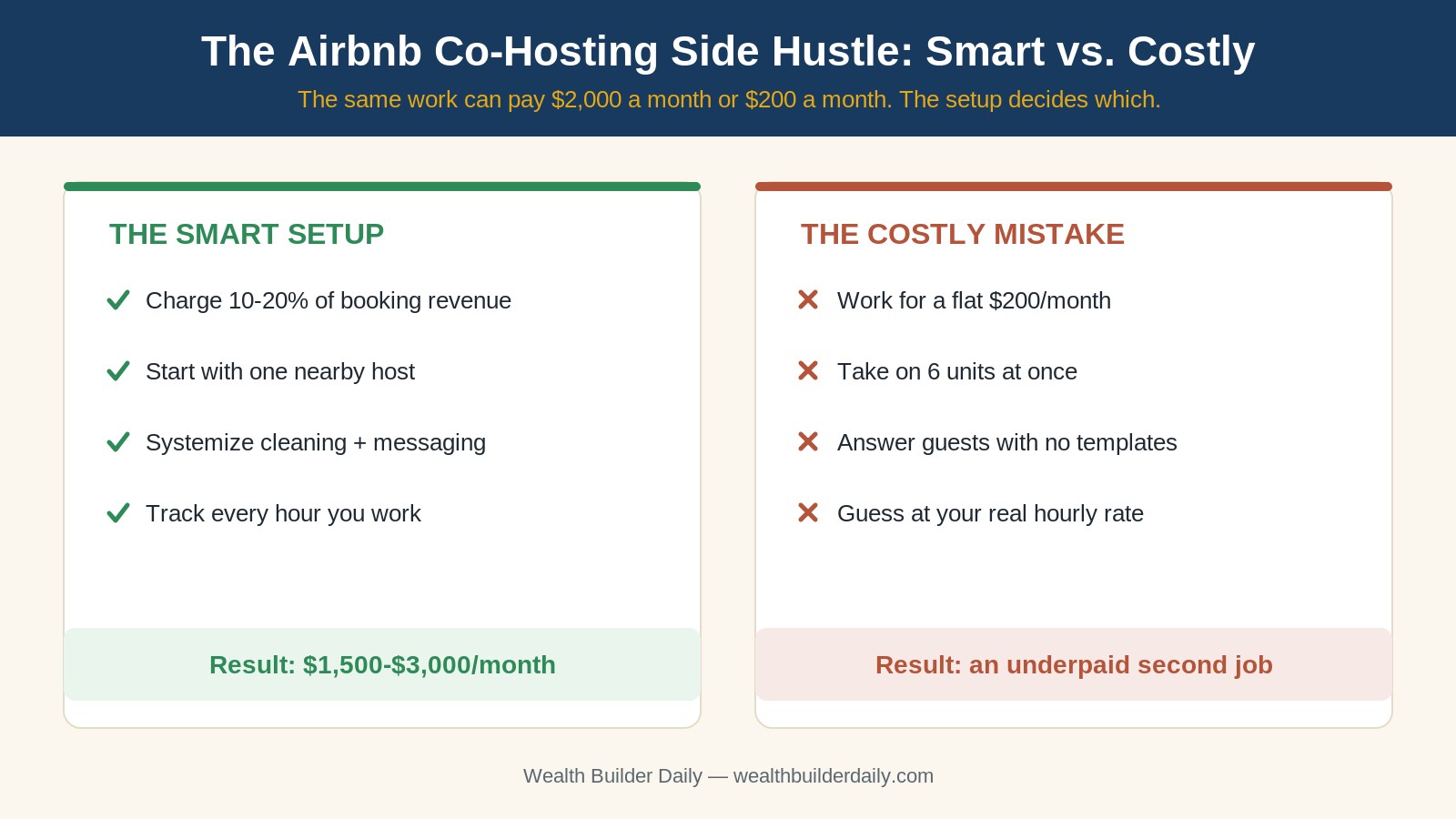
Take a percentage, not a flat fee. A flat $300/month sounds fine in January and feels terrible in July when the unit is booked solid and you're doing triple the work for the same check. A percentage of booking revenue means your pay rises with the workload. Ten to twenty percent is the standard band in 2026.
-
Check the listing's actual revenue before you agree. Ask the owner for the last 12 months of gross booking revenue. A listing doing $1,800/month at 15% pays you $270 — likely not worth 12 hours. A listing doing $5,500/month pays you $825 for similar effort. Same job, triple the money. Always look at the numbers first.
-
Define what you do — and what you don't. Put it in writing: are you cleaning, or coordinating the cleaner? Are you buying supplies out of pocket, or is the owner funding a float? Scope creep is what quietly destroys your hourly rate.
-
Start with a property you can reach. Your first listing should be close enough to drive to in under 30 minutes. Remote co-hosting works, but only after you've built a reliable cleaner and handyman on the ground.
-
Confirm who eats the cost of a bad night. If a guest breaks a lamp or a cleaner no-shows, who pays? Agree ahead of time. This one conversation prevents most co-host blowups.
-
Get a 30-day trial clause. Both sides get an easy exit if it isn't a fit. Owners love this, and it lowers the barrier to saying yes to a first-time co-host.
Expert tip: Track your hours for the first 60 days in a plain spreadsheet — date, task, minutes. Most new co-hosts think they're earning $50/hour and discover they're actually at $22 because of unbilled supply runs and text messages on weekends. Once you can see the number, you can fix it: raise your percentage, cut a task from your scope, or drop the listing. Whatever you clear, route the first chunk of it into an emergency fund before you spend a dollar of it — here's how to build one from scratch.
Co-Hosting vs. Buying Your Own Short-Term Rental
Owning the property gets you 100% of the booking revenue — and 100% of the mortgage, the insurance, the property taxes, the vacancy risk, and a down payment that could easily run $60,000. Co-hosting gets you 15% of the revenue and none of the downside. For someone building capital rather than deploying it, co-hosting is the entry point: you learn the entire operation on someone else's dime, and you get paid to do it. Many co-hosts buy their own unit two or three years in — with a real operator's playbook already in hand.
The Airbnb Co-Hosting Side Hustle for Every Situation

This hustle bends to your schedule, but it looks different depending on where you're starting from:
- You have a full-time job and 8 spare hours a week. Take one messaging-only or full co-hosting contract. Batch your guest replies into two windows a day, use saved templates, and let the cleaner own the turnover. Target $600–$900/month.
- You're already in real estate, cleaning, or property services. You have the vendor network most new co-hosts spend six months building. Lead with that. You can realistically run three to five units and clear $2,000–$3,500/month.
- You want a business, not a gig. Systemize hard from day one — templates, a cleaner roster, a dynamic pricing tool, a standard contract — and pitch owners as a small management company rather than a helper. This is the version that scales past $5,000/month.
Whichever version you pick, remember that side income only builds wealth if it goes somewhere. Once the money is steady, put it to work instead of letting it pool in checking — a Roth IRA is a strong first destination for self-employment income.
Beginner, Intermediate, and Advanced Setups
Beginner: One local listing, messaging plus turnover coordination, 15% of booking revenue. Tools: your phone, Airbnb's co-host access, a Google Sheet, and a shared calendar with your cleaner. Expected: $500–$800/month.
Intermediate: Two to three listings, full co-hosting, one reliable cleaner and one handyman on call. Tools: a dynamic pricing tool, saved message templates, and a supply checklist. Expected: $1,500–$2,500/month.
Advanced: Four or more listings under a simple LLC, with a written management agreement, a backup cleaner, and a virtual assistant handling first-response messages. You move from doing the work to owning the system. Expected: $3,500+/month.
Personalizing Your Approach in 2026
Short-term rental rules keep tightening in 2026 — plenty of cities now cap permits, require registration numbers on listings, or restrict non-owner-occupied rentals outright. That's not a reason to skip this hustle; it's a reason to check your city's rules first and to prefer owners whose permits are already in order. It also creates an opening: as compliance gets more complicated, owners are more willing to pay someone who understands the local rules. Being the co-host who knows the permit process in your market is a genuine competitive edge.
Frequently Asked Questions
Do I need a real estate license to be an Airbnb co-host?
In most U.S. states, no license is required to co-host a short-term rental, because you're providing hospitality and operational services rather than leasing or selling property. Rules vary, though, and a few states treat ongoing property management as licensed activity. Check your state's real estate commission before you sign a management agreement.
How much do Airbnb co-hosts actually make?
Most co-hosts charge 10% to 20% of booking revenue. On a listing grossing $4,000 a month, that's $400 to $800. Running three comparable listings puts you in the $1,200 to $2,400 range monthly. Your real hourly rate depends on scope — messaging-only contracts pay far better per hour than full-service ones.
How do I find my first co-hosting client?
Start local. Join Facebook groups for short-term rental hosts in your city, introduce yourself as a co-host, and offer a free listing audit. Airbnb's Co-Host Network also matches hosts with co-hosts directly. Your first client is usually an owner who's burned out, traveling, or launching a second unit and out of hours.
Final Thoughts
The Airbnb co-hosting side hustle is one of the rare ways to earn meaningful money from real estate without owning any. You don't need a down payment, a loan, or a credit score. You need reliability, a phone, and a system — and the willingness to do the unglamorous work that owners are happy to pay to hand off. Get the fee structure right, keep your scope tight, and one listing can turn into three faster than you'd expect.
Here's what we bring to every guide we publish:
- Plain-language guidance. No jargon, no gatekeeping — just how the thing actually works.
- Real numbers and real examples. Every figure here is a number you can check against a real listing.
- Proven, time-tested methods. We only publish approaches that hold up over years, not hype cycles.
- Free, practical tools and guides. Everything on this site is free, and always will be.
Your next step is small: find one short-term rental host in your city this week and offer to audit their listing for free. That single conversation is how most co-hosting businesses start. Browse more income-building playbooks at wealthbuilderdaily.com/blog, and if you want to understand the consumer protections and disclosure rules that apply when you start earning self-employment income, the Consumer Financial Protection Bureau is a solid, unbiased place to start.
The Newsletter
Get the Free Budget Tracker
Join our weekly newsletter. Practical money guides, no fluff. Unsubscribe anytime.